
Jerusalem Diary
The streets are crowded—actually, they’re overcrowded unlike anything we’ve ever seen in Jerusalem. The last time I saw anything like this was during Shavuos several years ago when hordes of people began heading to the Kotel at 4 a.m. and earlier.
So, this year we split the chag. That is, we were in New York for the first two days with the rain, then off from JFK on a ten-hour ride to Ben Gurion Airport in Tel Aviv. There’s no question about it: being here in Israel is a unique and special change of pace.
It was a particularly exciting time given the news about the flight from Dubai to Tel Aviv that was plunging from the sky until some Israeli heroes stepped forward to save the day.
It was chol ha’moed Sukkos when the news broke about the attempted hijacking aboard a Flydubai plane whose co-pilot attempted to crash it 9-11 style in Tel Aviv.
Here in Jerusalem, it was the evening of the Jerusalem concert featuring Ishay Ribo, Avraham Fried, Zusha, and Yaakov Shwekey. It was an all-star cast under the starlit skies of Sultan’s Pool. The concert was put on to benefit United Hatzalah, now in their 20th year under the leadership of their founder, Eli Beer.
It was the day we first got wind of that miracle in the sky on a jet with 170 mostly Israeli passengers that was heading for Ben Gurion Airport. No one knew it at the time, but the co-pilot, an Omani radical, was bent on committing a terrorist attack that could have devastated the country along the lines of October 7, whose third anniversary was solemnly observed this week. More about that in our From the Editor column.
All in all, combined with the miracle that saved so many lives, the concert had a full panoply of musical performances to celebrate the chag. The night before the United Hatzalah event, Eli Schwebel and his brother Avrumi sang an array of soulful tunes that beautifully punctuated and celebrated the holiday here in Israel.
It was a calm night in the courtyard of the YMCA across the street from the King David Hotel in Rehavia. It seemed like everywhere you went or any minyan you attended, it was led by one of the biggest names in Jewish entertainment. At the minyan at the Waldorf, Beri Weber and a choir of about ten offered an exceptional davening.
Other minyanim were led by Shulem Lemmer, Lipa Schmeltzer, Shwekey, the members of Zusha, and more.
After yom tov, we made our way to Tel Aviv and while there’s nothing newsworthy about that, what is newsworthy is how we traveled from Jerusalem to Tel Aviv. In short, we took the train, but permit me to elaborate on this rather new mode of transportation that currently traverses a good deal of the country with much more coming very soon.
Today, Israel finally has a modern transportation system almost on par with any other major city in the world. Perhaps it was just us, but for decades, we would travel to places like Beit Shemesh or Tel Aviv by either renting a car or taking a taxi to these various locations.
For those of you who are unfamiliar, the taxi business in Israel is not like it used to be in the old days. There are great taxi drivers up and down the country, but once you step inside their car, you’re sized up and that’s how they arrive at a price for any kind of ride, whether its 5 miles or 5 minutes.
In all fairness, when we asked the drivers to please use the taxi meter, their usual response was that the meter was broken. Then they would come up with an astronomical price of say, 150 shekels, which is about $50, to be driven less than two miles. And when you try to dispute the charge, they all come back with the same response: “Sure, it’s only two miles, but the traffic is just awful.”
Most of the time they’re not exaggerating. In much of central Jerusalem and Tel Aviv, the traffic is horrendous. If we weren’t from New York, we would never believe it.
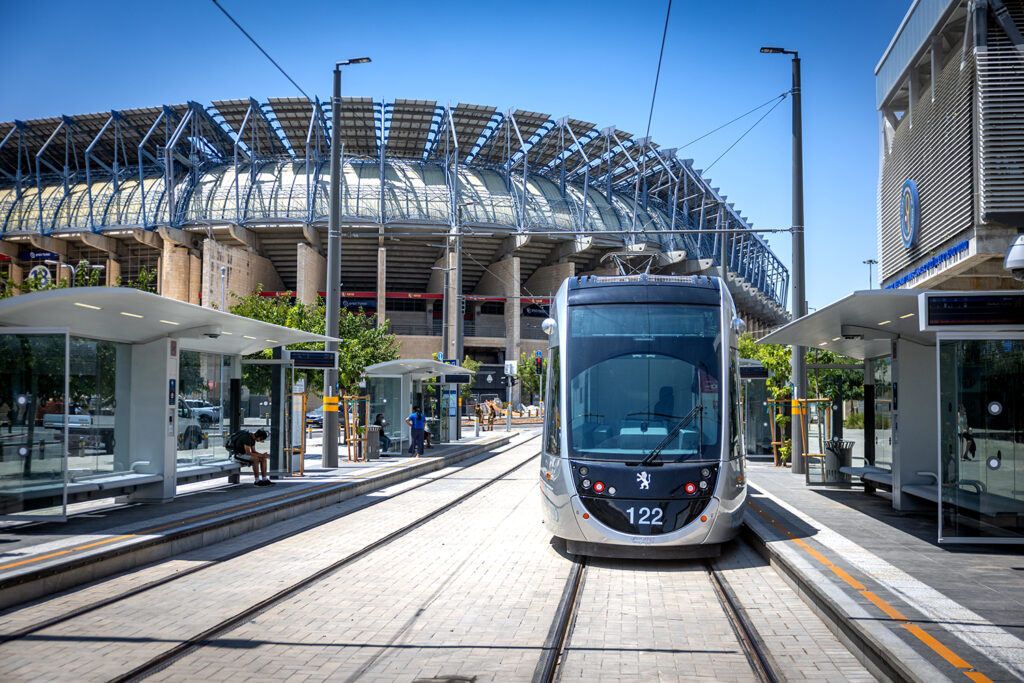
There are two types of train systems in and around Jerusalem. There’s the so-called Light Rail, which takes you to local stops, and then there’s the underground and above-ground rail systems that thankfully get you where you’re going in a fraction of the time it would normally take by car.
Once you arrive at the central train station, you take an elevator or escalator down three levels that go really deep until you reach the level that the trains begin to travel. Building this system took about 20 years, and when you see how deep they dug, you begin to understand why it took so long.
On the return trip from Tel Aviv to Jerusalem, we took the elevator up a few levels in order to reach the street. I don’t think I’ve ever been on an elevator so packed with people. Once the elevator was crammed full, there would always be a few stragglers who thought they could somewhere squeeze inside, and in every case, they managed to sandwich themselves inside.
The high-speed trains that take you from Jerusalem to Tel Aviv in a bit more than 30 minutes for 27 shekels (about $9) are a sleek and comfortable pleasure to ride. Every seat has a mechanism that you can use to charge your phone or computer, and unlike New York, there aren’t scores of people pressing against you.
Once you change to the Light Rail to get where you’re going in Jerusalem, once again it seems that to riders, there’s always more room to squeeze in even when it looks and feels like it’s jam-packed.
Part of what makes traffic so impossible in Israel is that the main streets are being dug up by construction crews to build more Light Rail lines to move the population. Israel is modernizing, but like so much else here, it does not come without some pain and inconvenience.
Let’s be thankful for the miraculous rescue of the Flydubai passengers and brave pilot, Capt. Smit Machchhar, a great cap to a wonderful chag.
Read more of Larry Gordon’s articles at 5TJT.com. Follow 5 Towns Jewish Times on Facebook, Instagram, and Twitter for updates and live videos. Comments, questions, and suggestions are welcome at 5TJT.com and on Facebook, Instagram, and Twitter.