




Gear-Up For A Baby Food Kitchen
By: Naomi Ross
While most of my articles serve the great majority of Five Towns readers, this article is dedicated to the youngest members of the community—the babies who are too young to read this paper!
Time and sleep are arguably the two most precious commodities a new parent can hope for in the first year or two their young child’s life. If given the choice of cooking, steaming, and puréeing homemade baby food versus throwing a few jars in the shopping cart, what sleep-deprived mother would object to the added expense for that timing-saving convenience? Surprisingly, it seems a lot. The $7+ billion baby food industry has had to step up and revamp their marketing, packaging, and production within the last few years to counter a large segment of consumers who have taken to their own stoves to make wholesome, fresh baby food the way their grandmothers did.
Economics and health concerns are the two main driving forces behind the resurgence of DIY baby food. To make ten servings of puréed carrots for the price of three purchased jars in a healthier, fresher, more nutrient-rich way is compelling even for many time-stretched parents. The clincher in this choice is the availability of many modern appliances and equipment that have streamlined and simplified the process, many of which are already found in today’s homes.
1. Steamers. Making your own baby food often requires some way to steam food, be it a steamer basket insert or steamer pot (or Instant Pot!). Steaming retains the nutrients without them leaching into the liquid during cooking. Simmering, however, in a small amount of liquid is fine if the liquid will subsequently be added back into the purée for thinner or smoother consistency.
2. Food Mill, Food Processor, or Immersion Blender? Yes. Any one of these appliances will make it possible to purée baby food, so don’t go out and make a special purchase. What are the unique benefits of each one, you may wonder?
Food Mill: This was how grandma made baby food before the invention of the electric food processor. It is a manual strainer with a rotary grinder that pushes the food through your choice of three strainer discs (fine, medium, or coarse). Yes, your arm will get a work-out, but the main benefit of using this traditional gadget is that you have total control over perfectly textured purées, holding back peels or fibrous pieces as it goes. (Incidentally, it is the opinion of this author that it also makes the best applesauce…for baby or the rest of the family).
Food Processor: The food processor overall does the fastest job of puréeing. However, it does not always do the most precise job. Make the pulse button your best friend for better control over texture, scraping down the sides of the bowl as needed.
Immersion Blender: This is your go-to appliance for an easy clean-up with only one part to clean. Simply immerse its head in the food and give a whiz. The only catch: like a real blender, it works most efficiently when liquids are involved. That means puréeing raw foods like melon might take a while…
3. Storage. Congratulations, you’ve just been crowned “parent-of-the-year” after feeding your baby homemade baby food! Chances are that if you’ve gone to all that trouble, you’ve made plenty more than Junior can eat in one sitting…so how do you store the leftovers?
Ice Trays: Probably one the smartest ideas I’ve ever come across is the use of an ice tray to freeze and apportion small amounts. Make a batch of puréed squash and apples and freeze into cubes. Pop them out and store them in labeled plastic storage bags. Repeat with another variety. Pure genius (and also works with grown-up items like pesto!).
Mini-storage containers: Purées can also be stored and frozen in mini-storage containers. Using disposable/reusable ones is a good idea for the mom on the go who can grab one from the freezer, already prepared and packaged, for a day of activities (and with no worry of having to bring the container home).
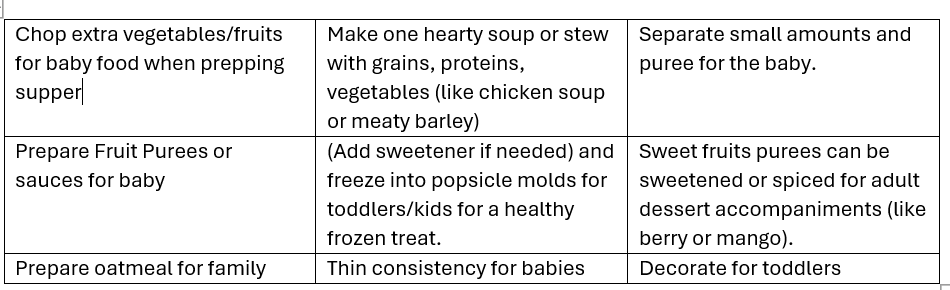
For many parents, the prospect of making baby food is yet another thing to worry about when juggling the food needs of the rest of the family. Many mothers of infants are also mothers of picky toddlers (and older children). How can you maximize your kitchen time and get “double duty” out of cooking to meet all the kids’ needs? See our chart below for helpful ideas.
These are some basic baby food “recipes” to give a sense of proportions, but feel free to improvise as your creativity (or baby’s tastes) dictate. Recipes are easily doubled or tripled for larger quantity. Just remember: if the dish is sent back to the kitchen (or tossed on the kitchen floor), it’s probably not you. Children can be finicky so don’t give up!
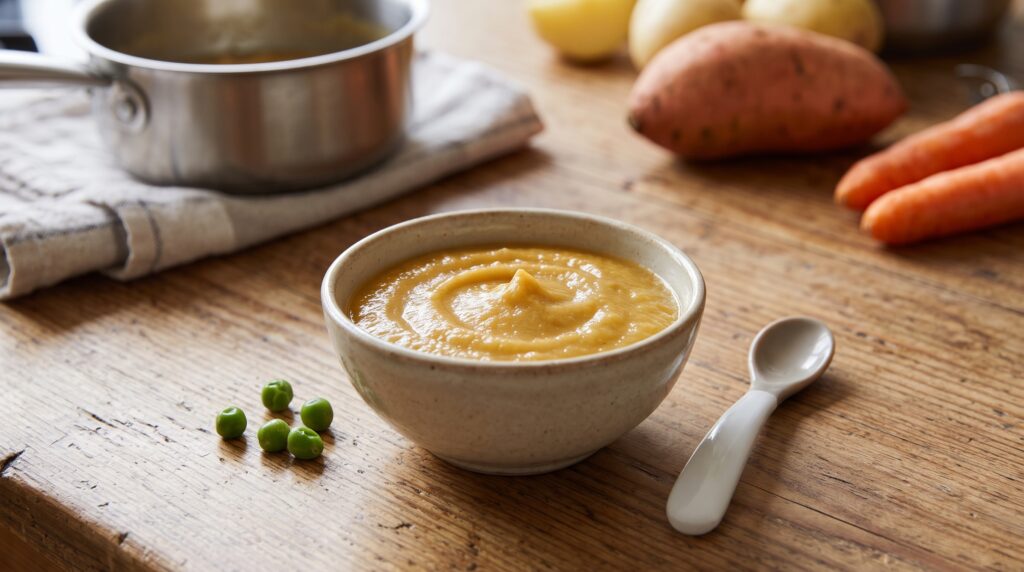
Baby’s First Chicken & Vegetable Stew
Credit Gemini Generated Image
Baby’s First Chicken & Vegetable Stew
Yield: 2–3 servings
Ingredients:
3 ounces cubed boneless chicken
1/2 cup peeled, cubed sweet potato
1/2 cup peeled, cubed potato
1/4 cup peeled, sliced carrots
3/4 cup water/chicken broth or more as needed
1/4 cup frozen peas
1/2 teaspoon salt
Directions:
Place chicken, sweet potato, potato, and carrots in a small saucepan. Cover with water/chicken broth. Bring to a simmer over medium heat. Add frozen peas and salt; cover and reduce heat to low. Continue to simmer for 15–18 minutes or until all vegetables are tender. Use an immersion blender to purée (alternatively, use a slotted spoon to transfer chicken and vegetables to food processor or food mill, reserving cooking liquid. Purée, adding reserved cooking liquid back as needed to achieve desired consistency).
Apple & Apricot Purée
Yield: 2 servings
Ingredients:
1 medium apple, peeled, cored, and cubed
1/4 cup dried apricots
1/2 cup water
Directions:
Combine all ingredients in a small saucepan. Bring to a simmer over medium heat. Simmer for about 10 minutes or until fruits are tender. Use an immersion blender to purée (alternatively, use a slotted spoon to transfer fruits to food processor or food mill, reserving cooking liquid. Purée, adding reserved cooking liquid back as needed to achieve desired consistency).
Naomi Ross is a cooking instructor and food writer based in Woodmere, NY. She teaches classes throughout the country and writes articles connecting good cooking and Jewish inspiration. Her first cookbook, The Giving Table, was released in 2023. Follow her @naomirosscooks on Instagram/FB or visit her website: naomirosscooks.com.