



Honoring A Hero’s Legacy of Torah
By: Rochelle Miller
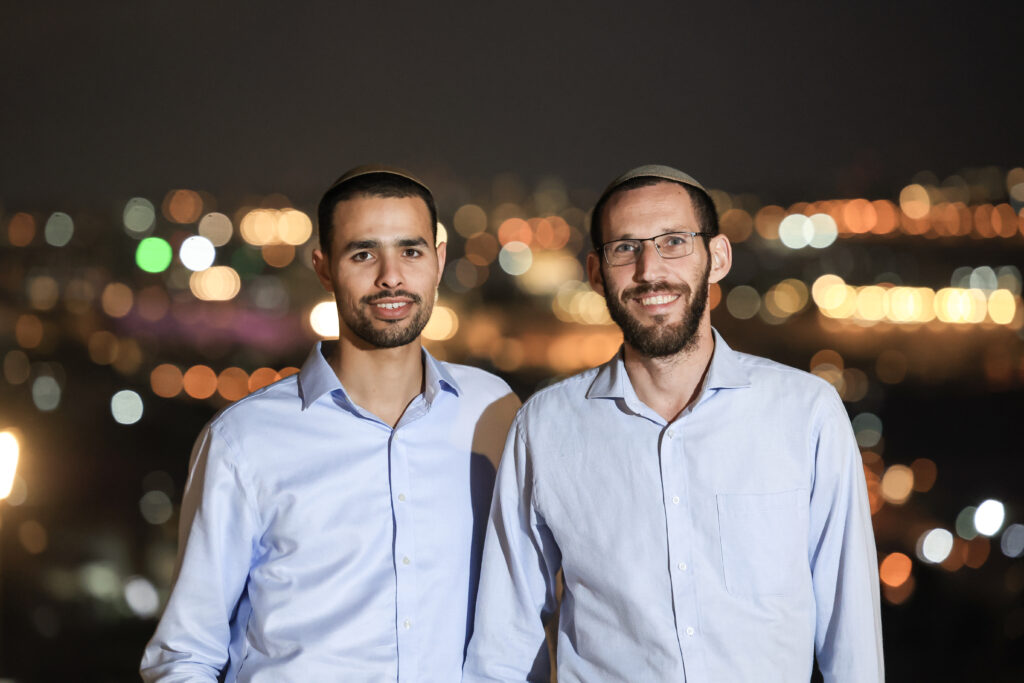
Yonatan Spanier and Yehuda Ben Ezra
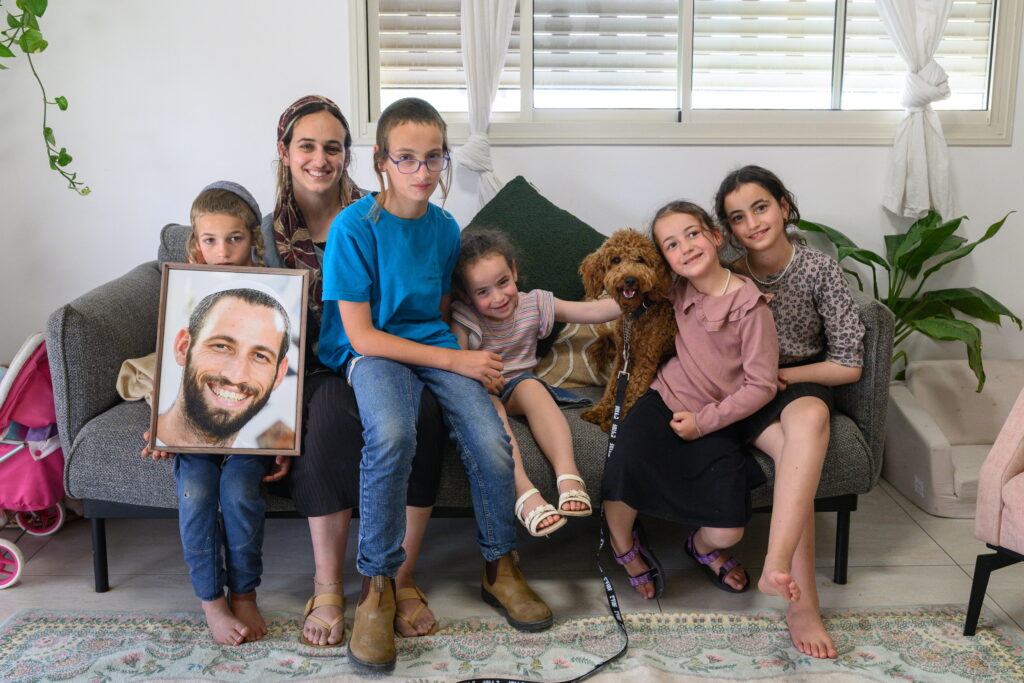
The Weitzen family—Talia and the children
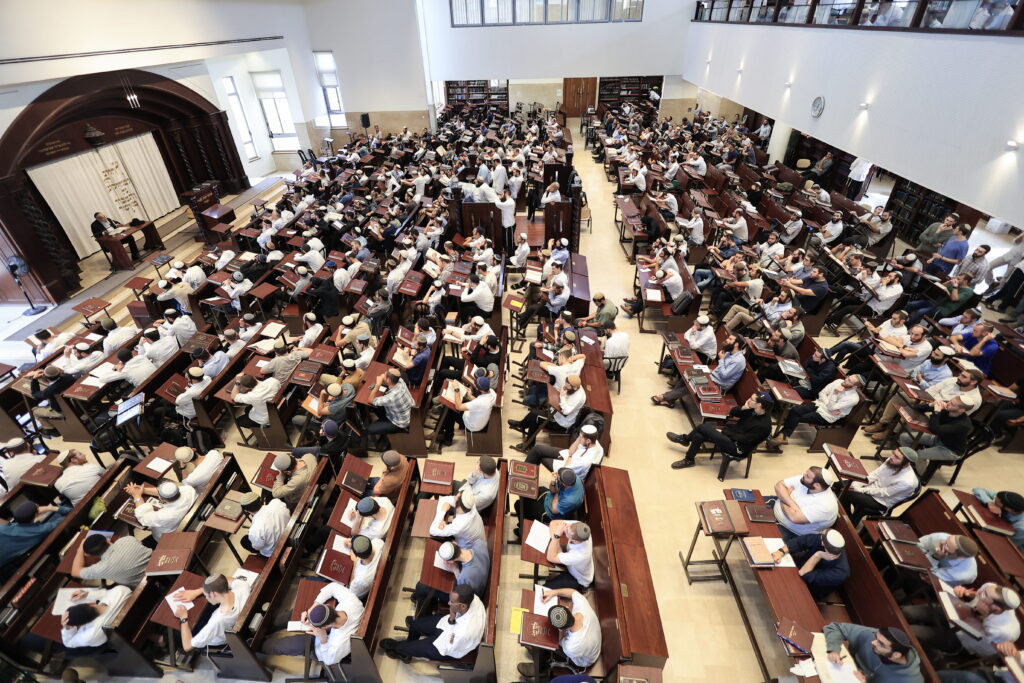
The beit midrash at Yeshivat Har Hamor
Yeshivat Har Hamor’s New Beit Midrash Will Commemorate Amichai Weitzen, z’l
From the window of their home in Kibbutz Kerem Shalom, the Weitzen children could see when their father’s car pulled in. They would run down the path toward the parking lot, where Amichai would lift them into the air, one child at a time. His wife, Talya, remembers what happened when the excitement of his arrival had subsided. He came inside and sat down at the children’s level. Each had a day to tell him about, and their father wanted to hear from each of them. Then they played.
Of all the memories Talya might have chosen to introduce her husband to people who will never have the privilege of meeting him, she chose this homecoming. Amichai Weitzen, z’l, was 33 when he fell defending Kerem Shalom during the Hamas attack on October 7, 2023. A member of the kibbutz security team, he was posthumously recognized as a fallen soldier with the rank of master sergeant in the reserves. He was an educator, a beloved son and brother, Talya’s husband, and the father of five young children who knew exactly where to find him at the end of a workday.
Yeshivat Har Hamor plans to commemorate Amichai in its new beit midrash. For Talya, the choice answers a deeply personal question. What could a family dedicate in memory of someone whose presence they miss in a hundred ordinary moments? She wanted something that had belonged to Amichai’s life and that would have a share in eternity. There was one place whose influence she could describe from experience. She had seen what happened in her own home every Thursday when her husband returned from learning in Jerusalem.
The trip from Kerem Shalom to Yeshivat Har Hamor took two hours in each direction, Talya recalls. Thursday was Amichai’s opportunity to spend time learning at the yeshiva while she cared for their five small children. A weekly arrangement like that tells a story about the spouse who stays home as surely as it does about the one who makes the drive. Talya is quite particular about the way their decision is remembered. “It was our home’s connection to the Yeshiva,” she says. “We chose to place the Torah and Yeshiva at the center of our lives.”
She used to tell Amichai something that might surprise any parent familiar with the demands of an afternoon alone with young children. Those Thursdays were among the easiest and most enjoyable afternoons of her week. She knew where her husband was, and the children knew where Abba was. “Knowing that Abba was in the Yeshiva, learning Torah, gave us all strength.” When he came through the door, she could see it in his eyes. “We all wanted to belong to that.”
His mother, Rachel, remembers the people at the other end of the journey. Amichai learned with his brother in the morning and with his father, Rav Shlomo Yosef Weitzen, rosh kollel and a rabbi at Yeshivat Beit El, at night. Amichai was by then an educator with students and responsibilities of his own, yet the two still made it a precious priority to learn Torah together. To Rachel, there was something heroic in the simple fact that her son kept coming. Full days of work and the considerable distance home had a place in his calculations. So did the knowledge that he needed to learn.
Jerusalem held other family memories as well. After the Weitzens survived a fire in their Jerusalem home, they made a practice of going to the Kotel each year to thank Hashem. Amichai also brought friends from the kibbutz to visit the Kotel and daven there. The city to which he returned for his own learning was a place he wanted the people he loved to know for themselves. A neighbor could come with him. His children could grow up knowing why their family went back to give thanks.
Yeshivat Har Hamor traces its founding in Jerusalem to 1998. Its founders were rabbanim steeped in the teachings of Rav Avraham Yitzchak HaCohen Kook, zt’l, and his son, Rav Zvi Yehuda HaCohen Kook, zt’l. After several moves, the yeshiva established its permanent home in Jerusalem’s Chomat Shmuel neighborhood. Its stated mission is an ambitious one. Har Hamor seeks to educate talmidei chachamim whose learning prepares them to help shape the spiritual life of the State of Israel and to shoulder responsibility for Am Yisrael.
What does such an aspiration look like to a child? In the Weitzen home, it looked very much like a place on the couch. Amichai’s oldest son was almost nine when his father was killed. Every day, the two of them sat there and learned together. Asked what she especially wants readers to know about her husband, Talya returns to those hours. An important part of the boy’s inheritance is the pleasure his father took in learning with him. Long before he could understand all that Har Hamor meant to his parents, he knew the pleasure of having Abba to himself and Torah to share with him.
“For Amichai, learning Torah was a connection to the depth of his soul,” Talya says. It helped him recognize the goodness within himself. She saw the effects most clearly when the children interrupted him to ask for something. Whatever he might personally have preferred to do at that moment, he had a familiar answer ready. “Besimcha uve’ahavah,” he would say. With pleasure and with love. Talya credits his years in the company of great talmidei chachamim with helping him become a person who saw what someone else needed before considering his own convenience.
She has another picture of him that she holds especially dear. On the Yomim Noraim, Amichai served as chazzan for some of the tefillot. Talya remembers him in his white kittel, his face alight, entirely absorbed in the responsibility of a shaliach tzibur entrusted with the prayers of the congregation. “Dressed in white, in his kittel, he truly looked like an angel.” The memory has a particular tenderness coming from the woman who also knew him with a child in his arms and another waiting to be tossed into the air.
Amichai grew up in Psagot and studied at the yeshiva in Elon Moreh before continuing to Yeshivat Har Hamor. He served as a squad commander in the Golani Brigade and married Talya during his military service. He subsequently returned to Har Hamor for three more years of learning while also working in education. By the time he had students of his own, he had experience of several kinds of responsibility, including the particular privilege of being a young man to whom other young men could turn.
In choosing a profession, Amichai was drawn to both education and social work. He found a place for those interests at Halutzei Dror, an agricultural high school yeshiva, where he worked as a counselor and educator. By the Elul preceding his death, he had begun working with his third group of students. Talya understood why the work suited him so well. After he was killed, she saw his students and heard them describe their loss. They told her they felt like orphans, bereft of their father. It is a remarkable thing for a young person to say about a teacher, and a painful thing for the mother of that teacher’s children to hear.
The community Amichai and Talya chose was itself an expression of what they valued. At Kerem Shalom, near the Gaza border, religious and secular families were building a shared life. Among their neighbors was Yedidya Raziel, z’l, a friend of Amichai’s from Psagot. The two had grown up together, learned in yeshiva and helped establish the group that made its home on the kibbutz. Years later, when Rav Weitzen spoke publicly about losing his son, he made a point of naming Yedidya, too. The families had known each other when the two men were boys.
On the night of Simchat Torah, Amichai danced at the hakafot in the kibbutz shul. There was another celebration ahead, one his oldest son was already looking forward to. Amichai had promised to take the children to hakafot shniyot at Yeshivat Har Hamor, where the dancing would continue after the chag. For a boy accustomed to seeing his father set out for Jerusalem each Thursday, here was an occasion when he would get to go along.
The next morning, as Hamas terrorists attacked Kerem Shalom, Amichai joined the kibbutz security team. Talya took shelter with their five children in the safe room. Even while defending his neighbors, Amichai found opportunities to send voice messages home. He wanted the children to have treats. He wanted them to dance because it was Simchat Torah. For all that was beyond his power to give them in those hours, he could still offer the sound of their father’s voice and his permission to enjoy everything in the snack cupboard.
Inside the safe room, his oldest son kept returning to the plans they had made. Talya remembers his question. “Abba promised to take us to hakafot shniyot at Yeshivat Har Hamor. Will he be able to take me?” It was the question of a child whose experience had given him every reason to count on his father. The man who had made that promise was the man who sat down beside him to learn every day.
Amichai and Yedidya both fell defending Kerem Shalom. Amichai was laid to rest on Har Herzl in Jerusalem on October 11, 2023. In mourning him, Rav Shlomo asked people to consider the years still ahead for the people his son had helped save. All the ordinary things those people would yet live to do, all the time their families would have together, entered into his father’s reckoning of what Amichai had accomplished in his 33 years. Rachel put a mother’s understanding into a few words. “He lived as a hero and died heroically.”
That year, the Weitzens did not go to Hakafot Shniyot. The following year, Talya took the children to Yeshivat Har Hamor. The year after that, they went again. The children received berachot from the rabbanim. For the oldest, there will always be the memory of the person who first promised to take him. Alongside it he now has a memory his mother made possible, of going to his father’s yeshiva and receiving a berachah there himself.
“I speak to them about him all the time,” Talya says. Each of her children resembles Amichai in some way she recognizes, sometimes in a feature, sometimes in a middah. She wants them to know the whole person whose qualities she sees emerging in them. “Amichai was a man of spirit and light. He loved the Torah, he loved his wife and kids, and he loved Eretz Yisrael.” When Talya considers what her husband would want for their future, happiness has a place in her answer. So does the privilege of passing on to their children the time-treasured traditions they received from their own parents.
Building a beit midrash to commemorate Amichai’s life is a most fitting and meaningful way to honor the memory of this young Torah hero and cements his eternal bond with Yeshivat Har Hamor. Moreover, it offers an especially personal way for people who never met Amichai to come to know him. A young man learning there may one day have a student who needs someone to listen, a child eager to tell him about his day, or a son waiting for him on the couch. Perhaps he will remember what a talmid of Har Hamor once said when one of his five children wanted a little of his time. It is a small enough piece of Torah to carry all the way home. Besimcha uve’ahava. With pleasure and with love.
Yonatan Spanier, CDO, and Yehuda Ben Ezra, CPO of Yeshivat Har Hamor, will be visiting the United States between December 13–December 23. Based primarily in the Five Towns, they are launching Stand with Talya, a fundraising initiative to bring the beit midrash to fruition. A special Five Towns Community Donors Wall will be prominently displayed within the beit midrash. For details regarding dedication and sponsorship opportunities, scan the QR code below, call (Yehuda Ben Ezra: +972-58-485-1527 or Yonatan Spanier: +972-54-222-8603), or visit donation.asakimerp.com/Campaing/?CampaingID=52507&utm_source=1. We look forward to welcoming Yonatan and Yehuda to our community and supporting this sacred citadel of Torah. Tizku lemitzvot.
Rochelle Maruch Miller is a contributing editor for the Five Towns Jewish Times. She is a journalist, creative media consultant, lecturer, and educator, and writes for magazines, newspapers, websites, and private clients. She welcomes your comments at [email protected]. Read more of Rochelle Miller’s articles at 5TJT.com.