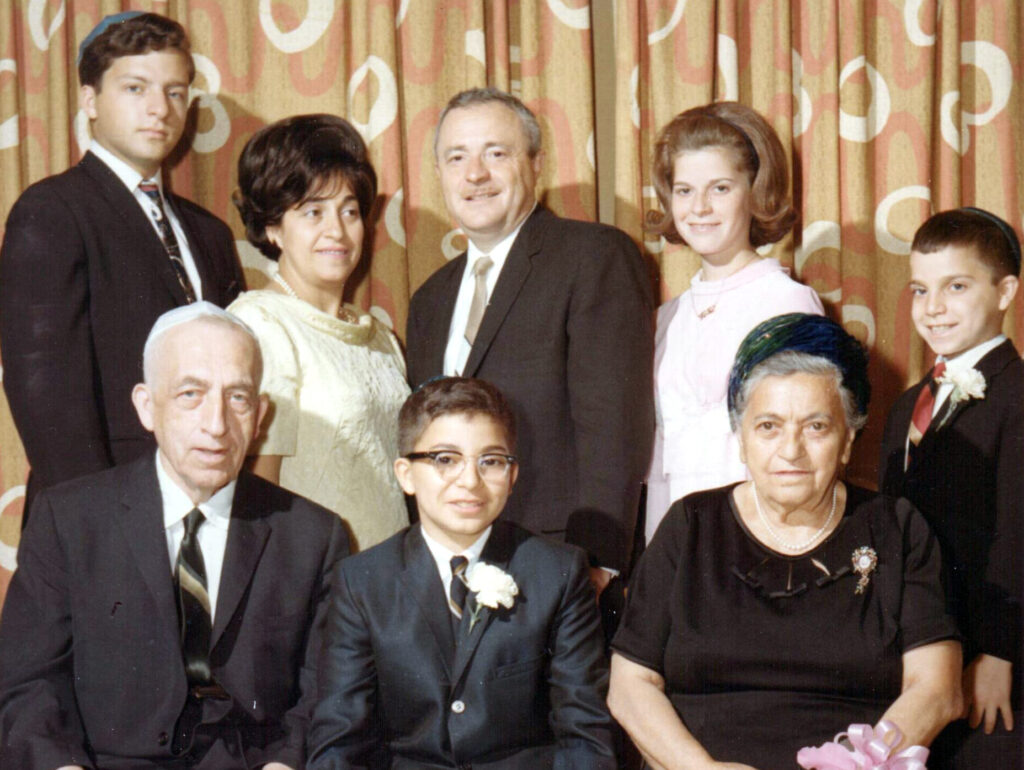

That Bar Mitzvah
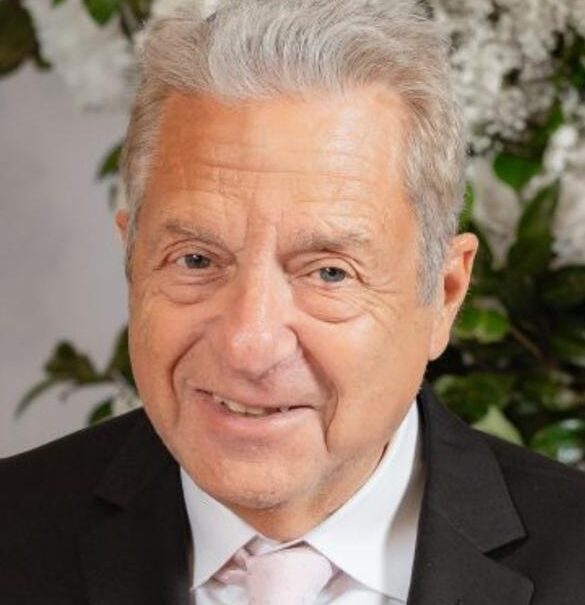
By: Larry Gordon
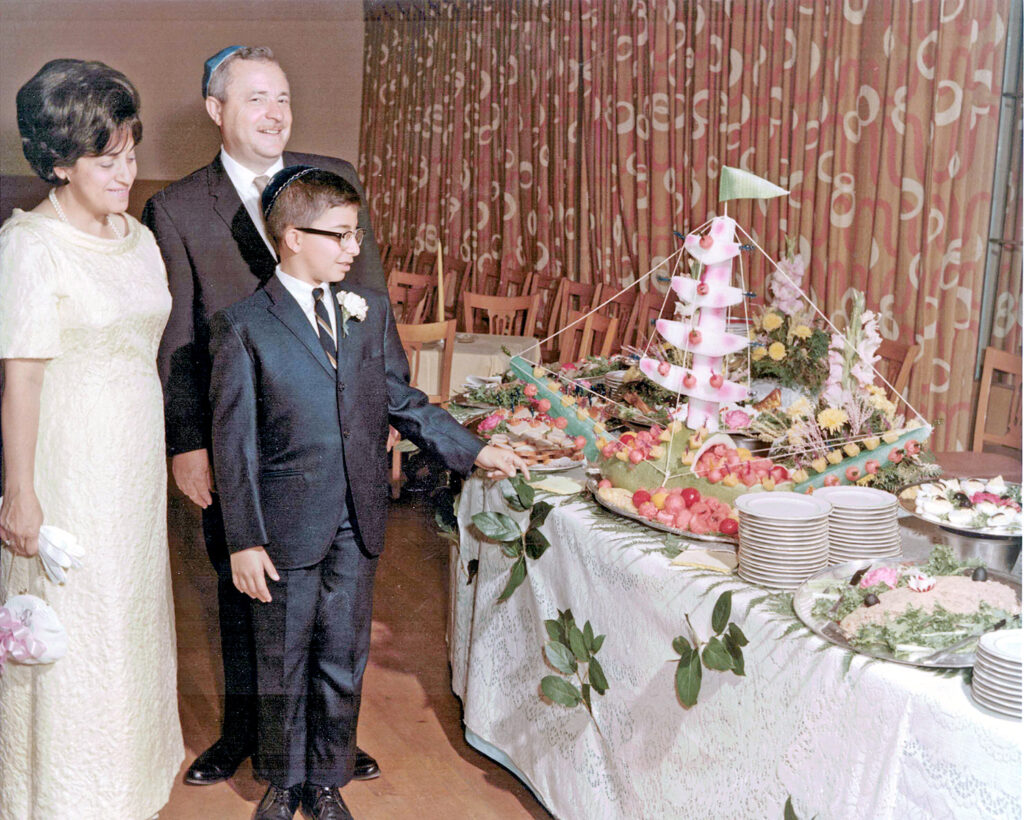
Larry and parents with fruit boat
One thing is clear to me—that day will never be forgotten. And the fact that I write about this event at least once a year illustrates to me that you, the reader, might never forget about it either even though you weren’t there.
Later on, it would become known as the “weekend bar mitzvah.” That means that people arrived at the hotel on a Friday afternoon before Shabbos and would stay until breakfast on Sunday morning.
Actually, in retrospect, I think that celebrating my bar mitzvah posed a dilemma of sorts for my parents. It sounds funny now, but I think all these years later that they wanted to celebrate my big event in style for some reason.
It was the Shabbos after Tishah B’Av. I was born on the 10th of Av. It’s been said that especially in Israel there’s a significant uptick in births right after Tishah B’Av and Yom Kippur. Let’s just say that there’s something about fasting that stimulates the birth process and results in a bump in births the day after or even on the fast day.
So, should a woman in her ninth month of pregnancy fast at all? Most will say you’re best off asking your local posek whether a woman near her delivery date should fast or not. You might get a split decision from many on that one. Did my mom fast on Tishah B’Av the day before I was born? I never asked her and I don’t know. But whether she did or not, that’s when I was born.
Whatever the circumstances were at that time, 13 years later was going to be my bar mitzvah, so my parents had plenty of time to plan. Because it fell smack dab in the middle of a long, hot summer, the question they dealt with was how to celebrate the bar mitzvah. Not that an event of this nature is so complicated, but for my dad especially it posed a dilemma of sorts.
My dad at the time was in his prime. He was 49 years old and my mom was a few years younger. My dad was a well-known journalist in his circles, which included Jewish organizations, publications, noteworthy personalities, and so on.
Then there was his father, who was the gabbai in the main Chabad shul at 770 Eastern Parkway. My zaidy was a confidante of the Rebbe. In fact, the story I heard over the last few years was that the Rebbe’s wife—Rebbetzin Chaya Mushka—was concerned that her husband did not have Chassidim the way her father did. Her father was the Rebbe Rayatz, R’ Yosef Yitzchak Schneersohn.
Apparently, she confided her concern to my grandfather, R’ Yochanan Gordon. I’ve heard it said that my zaidy responded that she might be right and that the Rebbe—R’ Menachem Mendel—did not have Chassidim like his father-in-law. But he added: “Ober er hut soldaten.” In other words, he told the Rebbetzin that perhaps the Rebbe didn’t have Chassidim like her father, but he had an army of foot soldiers.
The next time the Rebbe saw my zaidy, he told him with a smile that his response had made his wife feel more confident, and thus the story has never been forgotten.
Today, all these years later, all you have to do is look around the world, spin the globe, and you can see every habitable spot on the map covered by the presence of the Rebbe’s foot soldiers. They are indeed everywhere, bringing Jews the world over back to Judaism.
It’s at this point that the first part of my bar mitzvah comes into the picture. In those years, the Rebbe davened Shacharis in his office or study. It was on Monday and Thursday mornings that the Rebbe would step out of his office in his tallis and tefillin so that he could hear the reading of the Torah portion. It was that Thursday morning of V’etchanan that I had the privilege of reading the Torah portion for the Rebbe.
A few years ago, a friend of mine told me that having that zechus to lein the parashah for the Rebbe until Sheini was not a simple matter. I didn’t realize it at the time, but my friend said that my grandfather must have used some of his influence to arrange for me to read the Torah portion for the Rebbe.
The next day, the extended family left for the Catskills and the Empire Hotel, where we celebrated together my reaching the age of 13 years and my bar mitzvah.
The weather was perfect and beautiful over that glorious Shabbos. I leined the parashah and recited thehaftarah—Nachamu, nachamu ami, yomar Elokaychem. After Tishah B’Av, there are seven haftarahs (shivah d’nechamata) spanning the seven weeks between Tishah B’Av and Rosh Hashanah to comfort the Jewish people after all we had suffered, culminating in the destruction of our Beit HaMikdash.
“G-d will say to the prophet Yeshayah, ‘Comfort, comfort my people, says your G-d. Speak tenderly to Jerusalem and proclaim to her that her period of exile has been fulfilled, that her sins have been forgiven, for she has already been punished for all her sins with two exiles.’”
These are not just the words of the prophet Isaiah, but of a bar mitzvah boy on a warm Catskills morning somewhere near Ferndale, New York. All these years later, we are reading the same text and telling the same story. Hashem is patient and we are patient. It’s a great Shabbos for a bar mitzvah. After all, it’s a weekend when we are able to break out of the confines and limitations of the Three Weeks, the Nine Days, and Tishah B’Av.
It was a great simcha and I was proud and happy to be both the center of attention and the star of the show. My grandparents were there, as were my aunts and uncles along with many young cousins, some of whom were still babies.
This was a family unlike others that managed to escape what would shortly become the European inferno. It was the 1960s and maybe we didn’t realize how much comforting we really needed.
Following Shabbos Nachamu, my parents must have felt that not enough of their friends attended the simcha, so on September 12th after the summer, there was another event celebrating my bar mitzvah at the hall of the Young Israel of Eastern Parkway, which now after all these years is not there anymore.
It was a bar mitzvah trifecta, if you missed one leg you were hopefully able to make one of the others. It’s been a lot of years and every moment of those events is clear in my mind. The best part was after I had spoken at the seudah on Shabbos. I cannot describe the feeling of relief as I sat down between my parents and leaned against one and then the other. They wrapped their arms around me and I felt happy, good, and safe.
Today, as we approach Shabbos Nachamu, we hope and pray for the comfort of our people. It’s nice when the bar mitzvah boys are comforted, but after all these years and all those bar mitzvahs, we just need more simchas and the ultimate geulah. May it happen speedily in our days, b’ezras Hashem. n
Read more of Larry Gordon’s articles at 5TJT.com. Follow 5 Towns Jewish Times on Facebook, Instagram, and Twitter for updates and live videos. Comments, questions, and suggestions are welcome at 5TJT.com and on Facebook, Instagram, and Twitter.