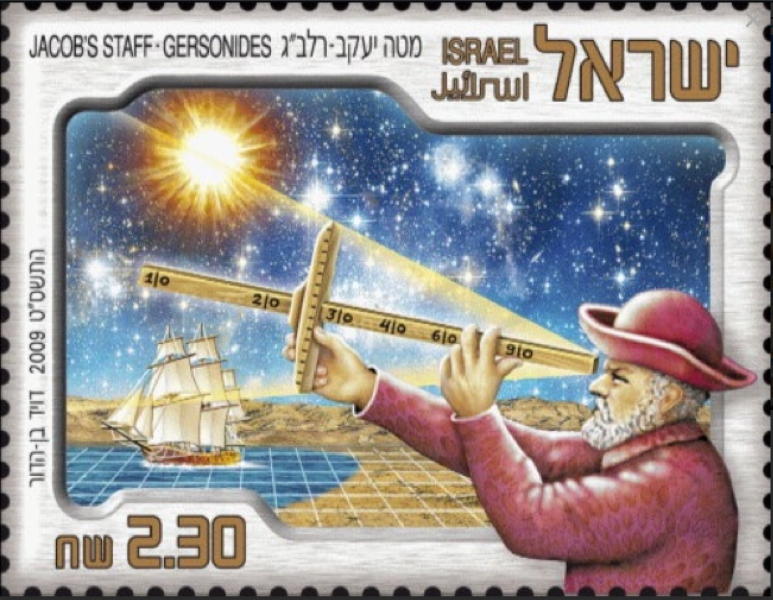

Ralbag: The Life and Works of Rabbi Levi Ben Gershom (1288-1344)
Rabbi Levi ben Gershom, known as Ralbag or Gersonides, was born around 1288 in Provence, southern France. Throughout his life, he lived a several cities in Provence, including Perpignan and Avignon. Sefer Yechusin reports that his father, Gershom, was a wise and scholarly man. This is also indicated by Shaarei Tzion’s description of Ralbag (see quote below). According to many scholars, Gershom was none other than Rabbi Gershom ben Shlomo, author of an important philosophical work titled “Shaar ha-Shamayim.” In his commentary to Shemos (34:9) Ralbag cites his grandfather as “my master, my grandfather, Rabbi Levi ha-Kohen.” This was likely Rabbi Levi ben Chayim, a prominent rabbinic scholar and philosopher who authored many works including a sefer titled “Levayas Chen.”
The Chida records that Ramban was Ralbag’s maternal grandfather. Although not mentioned explicitly, the Chida seems to be citing “Sefer Yechusin.” However, a close look at the wording of “Sefer Yechusin” yields a great deal of ambiguity about this matter. In addition, Ralbag never quotes or even mentions Ramban throughout his writings, a startling fact if Ralbag was indeed Ramban’s grandson. For these reasons among others, some scholars question whether Ralbag was in fact Ramban’s grandson.
{Milchamos Hashem
Ralbag is known as one of the greatest Jewish philosophers of the Medieval period. His philosophical work, “Milchamos Hashem,” was published before he turned thirty. In this lengthy sefer, Ralbag explores the views of earlier philosophers and then states what he believes to be the truth regarding these matters. Some of the philosophical views contained within “Milchamos Hashem” were subject to the critique of later Rishonim; however, Ralbag’s descendant, Rashbatz (Rabbi Shimon ben Tzemach Duran) composed Levayas Chen, to defend Ralbag’s controversial philosophical views.
{Commentary on Tanach
Ralbag is well-known for his acclaimed commentary on Tanach. One unique feature of this commentary are the ethical and spiritual lessons learned, which he wrote as a summary at the conclusion of a topic or story. In addition to “Milchamos Hashem,” Ralbag authored: a commentary of the writings of Aristotle, books on health and medicine, books on mathematics, including trigonometry, a book on astronomy, “Yesod Mishnah,” an introduction to the Mishnah, Mechokek Tzafon, on Aggadic passages in Bava Basra, and commentaries on the Talmud.
The Provençal rabbi and scholar, Rabbi Yitzchak de Lattes, describes Ralbag in his Shaarei Tzion:
“And the eminent Rabbi, preeminent in every sphere of learning, Rabbi Levi, son of the great Rabbi Gershom, known as “Meor HaGolah” (Light of the Exile), a distinguished scholar, he was a man of great distinction and renown; he expounded the entire Written and Oral Law and provided profound insights into every branch of wisdom, he was unequaled throughout the land, particularly in the sciences of logic, natural philosophy, metaphysics, mathematics, and medicine, and he provided a most distinguished exposition of the Written Torah, the excellence of which is unsurpassed.”
Nosson Wiggins (@jewishhistorysheimhagedolim) is the author of two books on the subject of Jewish history, “The Tannaim & Amoraim” and “The Rishonim” (Judaica Press). He researches Jewish History at the Klau Library, HUC-JIR in his hometown of Cincinnati and leads tours of Klau’s Rare Book Room. He is a passionate enthusiast of Jewish history and when he’s not in the hospital working as a nurse, he can be found researching and writing posts for his Substack, “Jewish History—Sheim Hagedolim.”