
Seven Minutes to Save a Life: MDA Brings Israeli Mass Casualty Incident Training to American Shuls
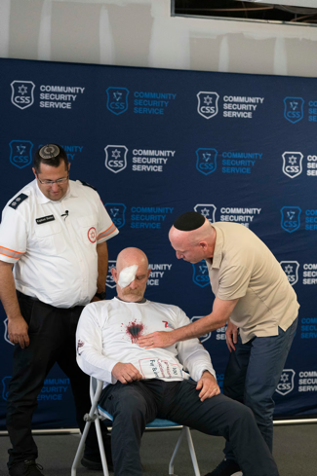
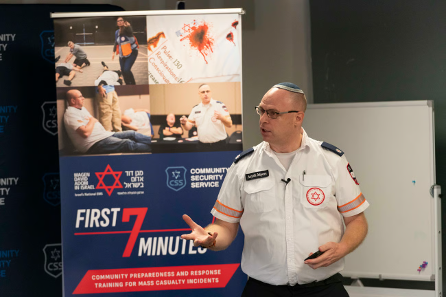
Magen David Adom instructors demonstrate emergency response techniques during the First 7 Minutes training for Community Security Service volunteers.
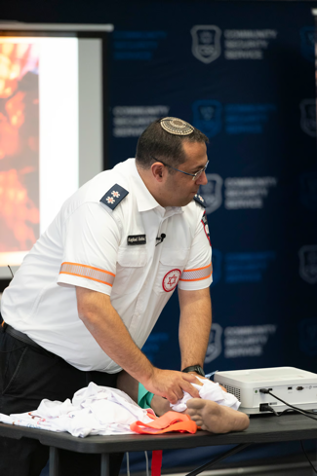
Magen David Adom instructor Raphael Herbst demonstrates lifesaving emergency response techniques during the First 7 Minutes training.
There was no tourniquet.
A man had been stabbed in the leg during a terror attack in Ramla, and he was bleeding badly. By the time Magen David Adom responder Aryeh Myers arrived, someone was already trying to save him. Not a doctor. Not a paramedic. A bystander whose only first-aid training was a course some 20 years earlier.
The man remembered enough to know the bleeding had to stop. He took off his belt, wrapped it around the wounded man’s leg, and used it as an improvised tourniquet, slowing the bleeding until professional teams took over.
For MDA, stories like that confirm a lesson learned across decades of terror attacks, missile strikes, and mass casualty events: the person who saves your life may be the person standing next to you.
Now MDA is bringing that lesson to American Jewish communities, including this one.
American Friends of Magen David Adom (AFMDA) and Community Security Service (CSS) have launched a partnership to train CSS volunteer leaders in MDA’s “First 7 Minutes” mass casualty incident response program. Those instructors will carry the training into a national CSS network of more than 7,000 volunteers protecting schools, Jewish events, campus organizations, and synagogues, including shuls across the Five Towns and Far Rockaway.
The name is the premise. The first seven minutes of a mass casualty incident are usually the most chaotic and can be the most decisive.
“While we train volunteers to detect and mitigate threats using a variety of security techniques tailored for the Jewish community, MDA’s specialized training will add a critical skillset: the ability to save lives in the very situations our work is meant to prevent,” said Richard Priem, CEO of CSS.
Until now, much of CSS’s preparation has answered one question: How do we keep danger out?
The new partnership adds a second: If something happens anyway, what can I do before help arrives?
The first instructor courses began this month at the CSS Academy, with dozens of seasoned volunteer trainers in the pilot cohort learning to assess a scene, prioritize victims, control severe bleeding, and make decisions under pressure. Trainees work with real tourniquets and proper technique. Improvisation, as in Ramla, is taught as the last resort, not the plan.
“Israelis have learned something the hard way: the minutes before the ambulance arrives belong to whoever is already standing there,” said Catherine Reed, CEO of American Friends of Magen David Adom. “The volunteers guarding our shuls are already choosing to stand on the front line for their communities. We want to give them the tools to save a life there, too.”
That network is already substantial. CSS volunteers completed more than 300,000 hours of guard duty in 2025, helping protect more than 750,000 people. More than 500 synagogues and events are covered nationwide, and more than 20,000 community members completed a CSS training program in the past year.
“The first minutes of a mass casualty incident can determine what happens next,” said Raphael Herbst, Deputy Director of International Relations at Magen David Adom in Israel. “People already at the scene can preserve life before an ambulance arrives if they have the knowledge and confidence to act.”
“By preparing CSS volunteer leaders to teach these skills in their own communities,” Herbst said, “this partnership will build a wider network of people ready to help in emergencies large and small.”
Because when an emergency happens, the first person on the scene may not have an ambulance, a medical bag, or years of training.
Sometimes all they have is a belt. And seven minutes to make it count.
Synagogues and organizations interested in bringing First 7 Minutes training to their community, can contact CSS at TheCSS.org.