


A Seat At The Table. A Line In The Sand.
By: Chaskel Bennett
The uncomfortable realities of political influence, communal principles, and the responsibility we all share.
Few things magnify frustration, skepticism, and cynicism like an election. Endorsements trigger outrage. Political alliances invite suspicion. Everyone has an opinion.
Beneath the noise lies an uncomfortable dilemma: How do we, as a socially conservative community, remain faithful to our Torah values while navigating a political landscape shaped by leaders whose ideology conflicts with our own?
We remain a small minority, numerically and ideologically, within a rapidly changing electorate. Longstanding political assumptions can no longer be taken for granted.
Look at Michigan’s U.S. Senate race. Abdul El-Sayed, an outspoken progressive whose positions on Israel and American foreign policy are outright frightening, is the Democratic nominee. Like Zohran Mamdani, his rise reflects a stunning departure from America’s traditional bipartisan support for Israel. This shift is happening nationwide.
We cannot ignore those in power simply because we disagree with them.
From individual voters to communal leaders, we all face the same question: How do we preserve our conscience without sacrificing our ability to matter politically?
There are no simple answers. But there must be lines in the sand we refuse to cross.
Our safety and security must be sacrosanct. Many Jewish New Yorkers believe this mayor has repeatedly crossed that line. One would be hard-pressed to disagree that no relationship, or political advantage can justify compromising our families’ safety.
Also not negotiable is our right to worship freely, educate our children according to our faith, and live as Jews without fear. These priorities cannot ever be bargained or compromised. They are the reason communal advocacy exists.
Across the Atlantic, Jews question whether they can safely remain in countries their families have called home for generations. Assuming America is immune would be a dangerous mistake.
Shared moral values and the character of those entrusted to govern matter, too. Let’s be honest: no party has a monopoly on morality or a spotless record. Few candidates fully meet our Torah standards. That makes our judgment more consequential, not those standards expendable.
We must distinguish between differences we can work through and violations we cannot excuse. We can engage without applauding and disagree without disappearing.
Political strategies and endorsements deserve debate. But anger over support for a questionable candidate or praise for a politician can obscure the considerations behind a communal decision. Voters demand black and white when the world is more often a place of grey.
Through decades in government relations and communal advocacy, I have confronted these contradictions firsthand. Rabbinical guidance and mentorship have been central to fulfilling my responsibilities as a Torah Jew in an arena where access, power, and self-interest too often override sacred principles.
These dilemmas are not theoretical. Taking a stand can carry personal and professional costs, while walking away can weaken our representatives’ ability to help families and institutions facing real, everyday challenges. Access creates influence, and influence is power: a seat at the table or a personal phone number can secure desperately needed resources, protection, and assistance for those otherwise ignored. Those relationships cannot be casually discarded. Preserving political capital, protecting community priorities, and anticipating future needs are responsibilities, not automatic compromises. To put it succinctly, we cannot sacrifice our principles in the name of advocacy, nor abandon our communities in the name of principle.
Still, political capital without results is meaningless. Influence purchased at the expense of fundamental principles is, at best, a hollow accomplishment.
Communal leaders owe the public honest explanations. What interests are being protected? What results justify their decisions? The risk of being on the outside after Election Day is important, but it does not erase those obligations.
Critics demanding that we abandon relationships owe answers as well. What would walking away cost? What credible alternative do they propose? Outrage is not a strategy.
Consider New York City’s June 2025 Democratic mayoral primary. Too many failed to register as Democrats in a city where the primary is often decisive, or simply couldn’t be bothered to vote. An election with profound implications was shaped without their input. Yet some of those same inactive citizens remain among communal leadership’s loudest critics.
We have become remarkably good at expressing political outrage and remarkably inconsistent about accepting political responsibility.
An endorsement is guidance, not a commandment. Knowledgeable insiders who have spent time with candidates, examined the issues, and understand the political landscape and difficult communal tradeoffs deserve serious consideration. Having said that, their judgment should not replace yours.
Responsibility for your vote belongs to you. Hear the facts, weigh the endorsements, and understand the candidates, issues, and realities facing our community. Then make an informed choice, vote, and urge others to do the same. Sitting out and staying home surrenders your voice and weakens our community at a critical moment in history when everyone is needed.
A seat at the table without principles is surrender. A line in the sand without participation is meaningless. Our future demands both.
Chaskel Bennett is a nationally recognized Jewish communal leader and advocate who serves on the boards of several not-for-profit organizations. Contact: [email protected]
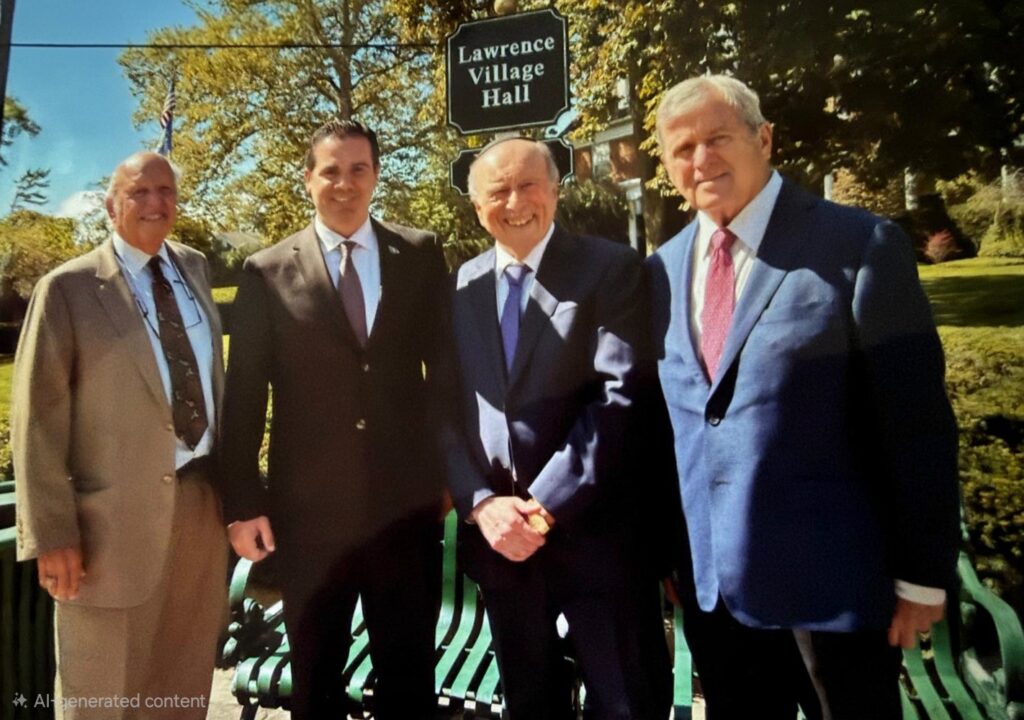
Former Mayor of Lawrence Martin Oliner endorses Supervisor John Ferretti pictured with Al D’Agostino and Nassau GOP Chairman Joe Cairo
Oliner Endorses Ferretti
By Larry Gordon
Independent candidate for Town Of Hempstead Supervisor, Martin Oliner, is stepping aside to endorse incumbent Supervisor John Ferretti, in next week’s election. The key matter in the decision by Mr. Oliner was the position articulated by Ferretti when he spoke several weeks ago at Congregation Beth Sholom in Lawrence.
The issue is additional building on Lawrence Avenue just past the railroad tracks in the area known as North Lawrence. Ferretti expressed his opposition to overbuilding and said that in the current building project on the agenda he is against apartment rentals which means that the project will feature exclusively apartments that are for sale.
Oliner’s campaign was dedicated to prevent the type of congestion that can come with overbuilding and Ferretti is on the same page as Oliner along with the opposition to rentals of the new apartments. While Oliner is on the ballot, he is urging you to vote for Ferretti and the entire Republican line, especially Bruce Blakeman for governor. n
Rep. Gillen Introduces Bipartisan Bill with Local Mayors and Advocates to Fund PFAS Cleanup and Reduce Water Utility Costs for Long Islanders
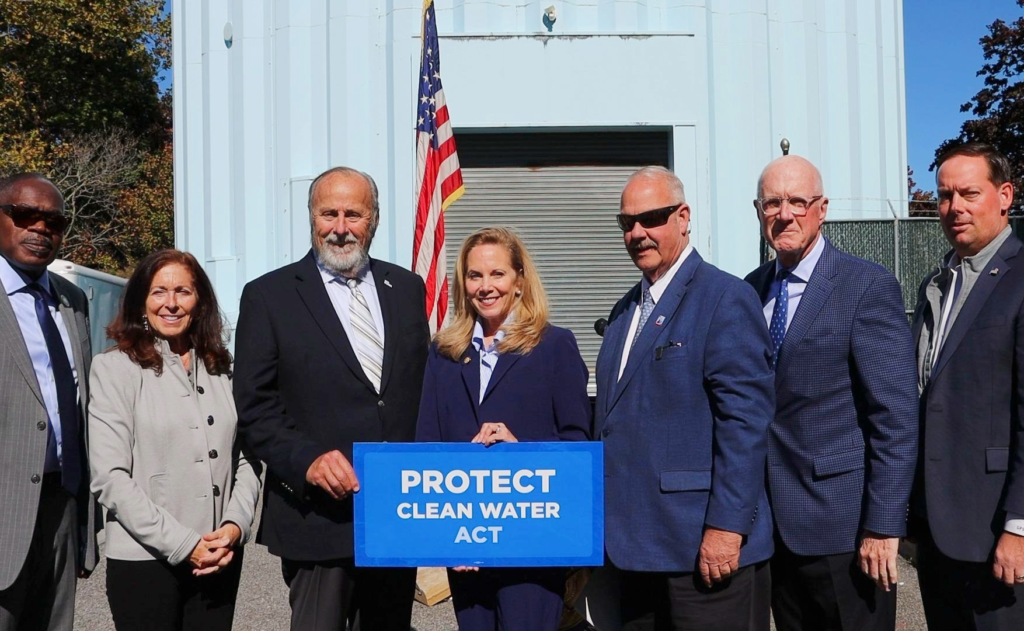
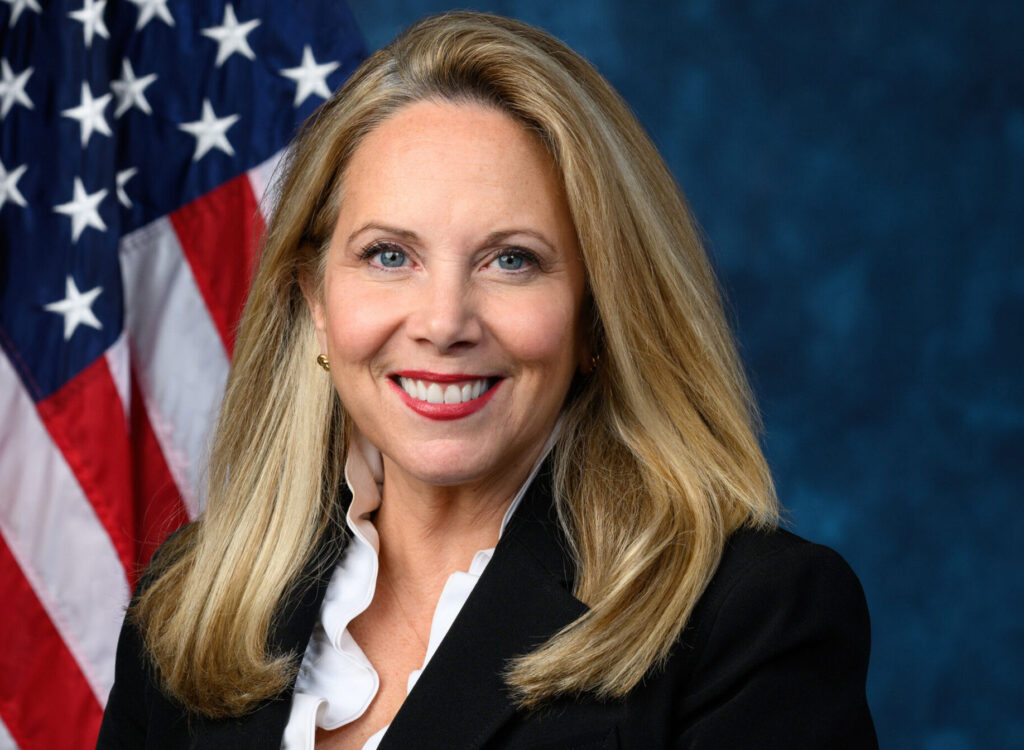
Congresswoman Laura Gillen (D-NY-04) held a press conference with local Long Island mayors and clean water advocates to announce her bipartisan Protect Clean Water Act.
Congresswoman Laura Gillen (D-NY-04) held a press conference with local Long Island mayors and clean water advocates to announce her bipartisan Protect Clean Water Act. Introduced alongside Congressman Brian Fitzpatrick (R-PA-08), the legislation will help communities fund the removal of toxic per- and polyfluoroalkyl substances (PFAS), “forever chemicals,” and emerging contaminants from their water supply while relieving the financial burden on local ratepayers.
“For too long, Long Islanders have faced toxic cancer-causing PFAS contamination in our water while shouldering the high cost to make it safe,” said Rep. Gillen. “I am proud to introduce the bipartisan Protect Clean Water Act alongside local mayors and clean water advocates in the fight to secure clean, safe water for Nassau County. This bill will authorize federal funding that our communities need to protect our water supply for the future without driving up costs for working families.”
“Every family deserves access to clean, safe drinking water, regardless of where they live,” said Rep. Fitzpatrick. “Across Pennsylvania and the country, PFAS and other emerging contaminants threaten our water supplies and put communities at risk. I’ve spent years fighting to clean up contaminated sites, hold polluters accountable, and protect the health of communities. This bill ensures states have the dedicated funding they need to address these threats, remove harmful contaminants from drinking water, and protect our waterways for generations to come.”
“I want to thank Congresswoman Gillen for her continued partnership and her commitment to addressing the critical infrastructure needs of communities across the region,” said Rockville Centre Mayor Francis Murray. “Providing safe, reliable drinking water is one of the most important responsibilities we have as local government officials. Congresswoman Gillen’s bipartisan legislation to provide $10 billion over five years in federal funding for water contaminant remediation, including PFAS, represents an important step toward helping communities address emerging contaminants and make necessary investments to protect their water supplies.”
In 2021, the Infrastructure Investment and Jobs Act (IIJA) provided $5 billion to help communities remove PFAS and other emerging contaminants from their water systems. However, that funding expired at the end of fiscal year 2026.
The Protect Clean Water Act would authorize $10 billion in funding dedicated for PFAS and emerging contaminant remediation over five years through the Clean Water and Drinking Water State Revolving Funds, giving communities critical federal support to invest in treatment technology and upgrade water infrastructure.
Removing PFAS is essential to protecting public health, though costly, as exposure to the chemical is linked to high cholesterol, birth defects, and an increased risk of kidney and testicular cancers.
The American Water Works Association estimates that drinking water treatment investments alone could cost $2.7 billion to $3.5 billion annually. Local governments and water utilities will need to continue to increase their investment to make sure our water is free of PFAS. The Protect Clean Water Act would help communities address PFAS contamination while keeping water affordable for ratepayers.
The legislation is endorsed by the Clean Water Construction Coalition, the Association of Metropolitan Water Agencies, the National Association of Clean Water Agencies (NACWA), the WateReuse Association and Citizens Campaign for the Environment. n
Record-Breaking Rollout: Hempstead Town Repaves Record 115th Mile of Roadway in a Single Year
Hempstead Town Supervisor John Ferretti announced the 115th mile of repaved roadway in 2026. The official town record was broken during a road repaving project in Wantagh.
“During my first 14 months in office, I have followed through on my commitment to prioritize affordability for Town of Hempstead residents by cutting taxes in 2026 and freezing taxes for 2027,” Ferretti said. “As we continue to ensure significant savings for taxpayers’ hard-earned money, my administration continues to make significant investments throughout our township to keep it the best place to live, work, and raise a family. Today’s record-breaking 115th mile of repaved roads in 2026 symbolizes our priority to save taxpayers’ money while still doing more for our residents.”
Ferretti, joined by Deputy Supervisor Dorothy Goosby, Councilman Dennis Dunne, Sr., Councilman Tom Muscarella, Councilwoman Missy Miller, Councilwoman Laura Ryder, Councilman Chris Schneider, Town Clerk Kate Murray, and Receiver of Taxes Jeanine Driscoll, made the announcement prior to the Hempstead Town Board’s public budget hearing on the Supervisor’s tax-freeze budget proposal for 2027, which holds the line on taxes, while maintaining and enhances town infrastructure and programs.
Under Ferretti’s leadership, the Town of Hempstead cut taxes in 2026 and has repaved nearly 10 percent of the entire highway system within the town’s jurisdiction—an area that encompasses over 1,200 of public highways.
“We are moving at a rapid pace unlike any other town administration has done before and are breaking records each year,” Ferretti said. “These are smart investments that our residents see every day, driving or walking through their neighborhoods. The projects enhance quality of life and help make our roads safer.”
Ferretti and the Town Board reminded residents that as the colder weather makes its way to the region, potholes will emerge on some roadways. They reminded residents of the Town’s “Pothole Patrol,” crews that are ready to respond and make repairs on a regular basis. Residents can report potholes by calling the Highway Department at 516-489-5000, ext. 3471.