



Surgical Skills 101: Turkey Carving
By: @premingerplasticsurgery
Thanksgiving is upon us, and with it comes the annual question of who gets the honor of carving the turkey. In most families, this responsibility falls to the patriarch, the host, or whoever happens to be standing closest to the carving knife. In my family, however, I would like to think that having spent years training as a plastic surgeon should give me a certain advantage. After all, I have spent much of my adult life learning how to cut, dissect, separate tissue, and put things back together. Surely that qualifies me to carve a bird? Then again, the turkey has one distinct advantage over my patients: it doesn’t complain about the scar.
The truth is that the art of surgery is something most people know surprisingly little about. Patients understandably focus on the surgeon’s education, credentials, experience, and results. But how does someone actually learn to operate? At what point does a medical student who has never held a scalpel become a surgeon capable of performing intricate procedures with confidence and precision? The answer is years of training, thousands of hours of practice, and a great deal of humility.
Surgical training begins long before a resident is entrusted with performing an operation. Medical students first learn anatomy, not simply by memorizing diagrams, but through dissection and understanding the complex relationships between muscles, nerves, blood vessels, and other structures. In medical school, we spend countless hours studying the human body. We learn that every structure has a purpose, every layer matters, and what lies beneath the surface is often far more complicated than what appears above it.
Then comes residency, where the real apprenticeship begins. Young surgeons initially observe, assist, retract, complain about how much retracting they do, and suture. They learn how to handle instruments, tie knots, control bleeding, and manipulate tissue without damaging it. They practice suturing repeatedly, sometimes on simulation materials, until movements that once required intense concentration become second nature.
Another essential component of surgical training is repetition. The first time a resident places a suture, it may take several minutes. Years later, the same movement becomes fluid and almost instinctive. But repetition alone is not enough. Practice must be accompanied by feedback, correction, and constant refinement. A surgeon never really stops learning. New techniques emerge, instruments evolve, and even experienced surgeons continue to improve their skills throughout their careers.
There is a reason surgeons spend so much time learning to tie square knots. A knot that looks perfectly respectable on a birthday present may be entirely unacceptable inside the human body. Over time, under the supervision of experienced surgeons, residents are entrusted with increasingly complex portions of operations. Eventually, they learn not only how to perform procedures, but also how to anticipate problems, recognize anatomical variations, and make decisions when things don’t go exactly as planned.
And things don’t always go exactly as planned. One of the most important lessons in surgical training is that operating is not simply a matter of technical dexterity. It requires judgment. Knowing where to cut is important. Knowing where not to cut is often even more important.
Plastic surgery adds another dimension to this training. We are taught to think in three dimensions, to understand tissue movement, preserve blood supply, minimize tension, and consider how the body will heal over time. A plastic surgeon doesn’t simply remove or rearrange tissue. We must anticipate what the result will look like weeks, months, and years later.
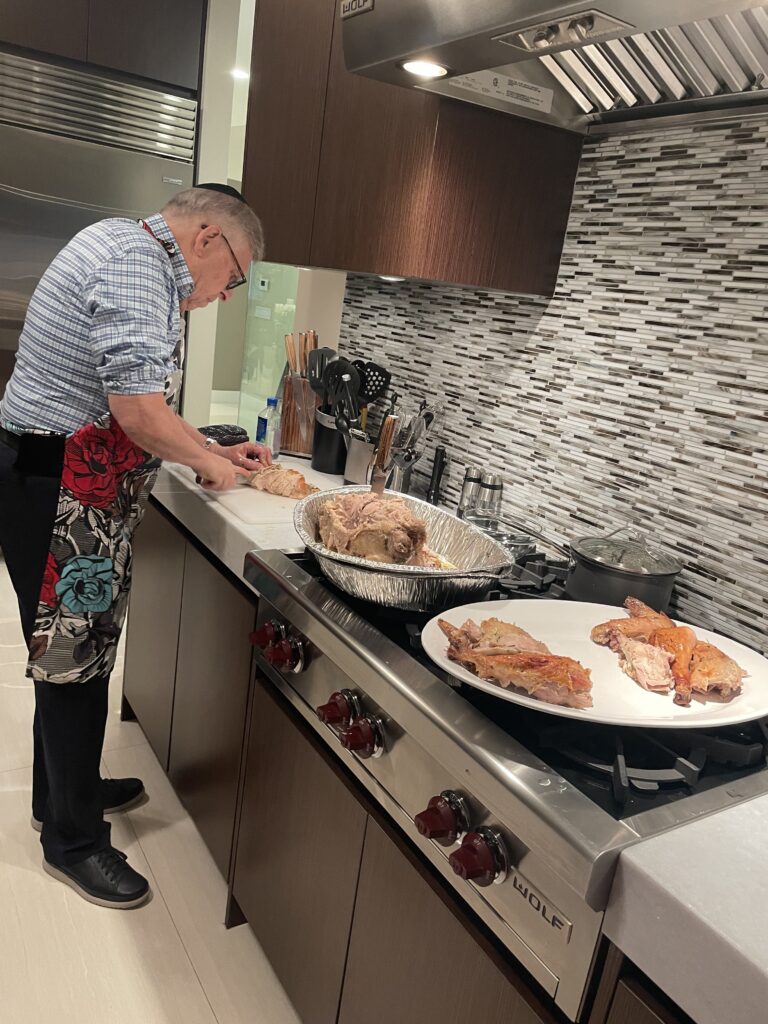
This is where the turkey analogy becomes particularly interesting. A novice turkey carver may attack the bird with enthusiasm, sawing away until something resembling a slice lands on the platter. An experienced carver understands that there are natural planes between structures, that the direction of the cut matters, and that a sharp instrument used with precision is far more effective than brute force. Surgeons learn the same principles, although with considerably higher stakes.
In surgery, we often speak about finding the correct tissue plane. This means identifying the natural separation between anatomical structures and carefully following it. When you are in the correct plane, dissection can proceed smoothly. When you are in the wrong plane, even a relatively straightforward procedure becomes unnecessarily difficult. The same principle applies to carving a turkey. Find the joint, follow the anatomy, and the leg comes away far more easily than if you simply try to saw through the bone.
Of course, there are some important differences. In the operating room, we work meticulously to preserve blood supply. At Thanksgiving dinner, the goal is generally to avoid getting gravy on the tablecloth. At least it’s not as bad as the Seder where the odds of the tablecloth standing up to four cups of wine poured for multiple people in succession are very low.
Perhaps the greatest lesson surgery teaches us is respect for the responsibility that comes with holding a knife. There is something profoundly humbling about being entrusted with another person’s body. Patients place their confidence in our hands, and that trust is something we must earn every day.
This brings me back to Thanksgiving. As I contemplate the beautifully roasted turkey sitting in the center of the table, I cannot help but appreciate the parallels between carving and surgery. Both require preparation, knowledge of anatomy, a steady hand, and the ability to remain calm while several people watch your every move. Although, in my experience, the audience around the Thanksgiving table is considerably more opinionated than the operating room staff (well, sometimes!).
“You’re cutting it too thick.”
“Can I have some dark meat?”
“Don’t forget the other side.”
And inevitably, “Are you sure you know what you’re doing?”
After years of medical school, residency, and surgical practice, I would hope the answer is yes. But perhaps the most important lesson is knowing when to put down the knife and enjoy the meal.
So this Thanksgiving, whether you’re carving the turkey or simply enjoying the results of someone else’s efforts, take a moment to appreciate the skill that comes from patience, practice, and experience. And if your family happens to include a plastic surgeon, by all means, offer her the carving knife.
To be honest, though, I am generally the one cooking, not carving the turkey because my father (as my mother likes to remind me), the urologist, is still the most senior surgeon at the table. Maybe someday I will earn the right to hold the knife at Thanksgiving dinner…for now, I will continue to work on continuing to perfect my surgical skills in the operating room.
Happy Thanksgiving!
At Preminger Plastic Surgery, we are committed to educating our patients and providing personalized care tailored to their unique needs. For those considering plastic surgery, we offer guidance every step of the way to help you achieve your aesthetic and wellness goals. Dr. Preminger is a board-certified plastic surgeon with degrees from Harvard, Cornell, and Columbia.
For more information or to schedule a consultation, please visit premingermd.com or call 212-706-1900. Follow us on Instagram @premingerplasticsurgery.