
The Royal Secretary of Portugal, Diego Pires
{David Reubeni and Shlomo Molcho (Part II)
Diego Pires, born into a family of converso Jews in 1500, occupied the position of royal secretary in the court of King John III. Diego had some awareness of his Jewish identity and when David Reubeni arrived in Portugal, Diego became intrigued. Diego soon developed a strong desire to return to his Jewish roots and desperately tried to connect with Reubeni to get circumcised. Diego risked his life in doing so because the Inquisition office was about to be instituted in Portugal. But Reubeni, who was worried that the king would discover that he had violated his promise, distanced himself from Diego.
But Diego didn’t allow this setback to deter him. Instead of being circumcised by Reubeni, Diego circumcised himself and called himself Shlomo Molcho. News of Shlomo Molcho’s circumcision and return to Judaism quickly reached King John, but Shlomo Molcho managed to escape in the middle of the night. After several days of wandering, he eventually found refuge in the house of David Reubeni, who was outraged at Shlomo Molcho and demanded that he flee the country. Although Shlomo Molcho was able to escape to safety, his brief encounter with Reubeni ruined Reubeni’s relationship with King John III. Several months later, Reubeni was expelled from Portugal and returned to Venice.
{A Rising Star in Salonika
Meanwhile, Shlomo Molcho fled to Turkey and settled in Salonika, a center of Torah scholarship which had absorbed many of the Spanish Jews following the expulsion in 1492. In Salonika, Shlomo Molcho began studying under one of the greatest scholars of the Sephardic Torah world, Rabbi Yosef Taitazak. Rabbi Taitazak was renowned as an expert in Talmud, halacha, and Kabbalah and was one of the preeminent Torah leaders of his generation. According to the Chida, Rabbi Taitazak was on such a lofty spiritual level that he merited the visitations of a celestial teacher. Shlomo Molcho excelled in his studies at an exceptional rate and was soon learning Kabbalah with his teacher, Rabbi Taitazak. Soon after, Shlomo Molcho proclaimed that the messiah was to arrive shortly.
After announcing that the messianic era was around the corner, Shlomo Molcho travelled to Eretz Yisrael, arriving there in 1529, where he visited the Holy Land and the surrounding countries, encouraging the Jews to fast and repent in preparation for the redemption. Although it seems that a substantial portion of the population was inspired by Shlomo Molcho’s messianic news, the excitement was silenced by the chief rabbi of Jerusalem, Rabbi Levi ibn Chaviv.
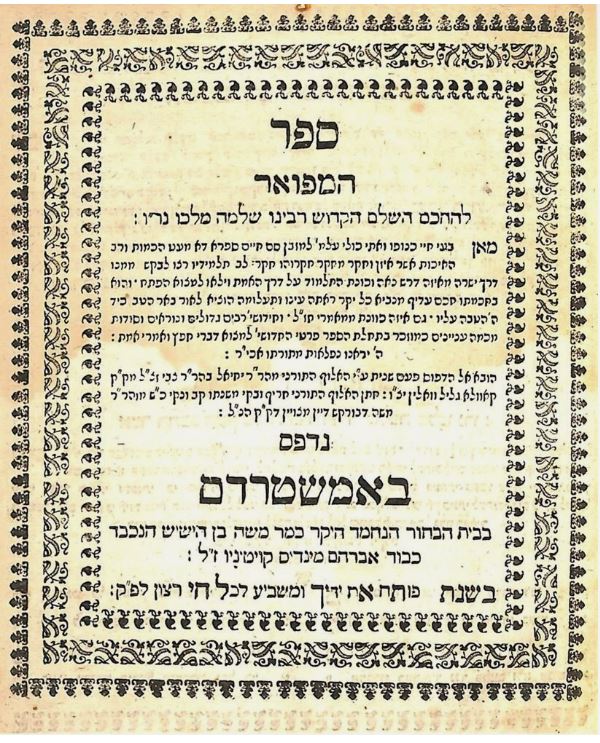
At the request of his colleagues and followers in Salonika, Shlomo Molcho published a compilation of his discourses on the topic of redemption titled Sefer HaMefoar. Included in this sefer was a calculation that the Final Redemption would occur in eleven years in the year 1540!
In the summer of 1530, Shlomo Molcho left Eretz Yisrael and travelled to Italy. Upon arrival in Rome, he spent a month living like a homeless beggar in the slums. In Rome, Shlomo Molcho had a dream that a catastrophic flood would devastate Rome and an earthquake would shake the country of Portugal. Shlomo Molcho informed the Pope of his prediction and sent a letter to the King of Portugal, informing him of the impending calamity. As the date of the great flood approached, Shlomo Molcho left Rome and settled in Venice. As he predicted, the Tiber River, which runs through the center of Rome, rose sixty-two feet on October 8, 1530; hundreds of homes were destroyed and thousands drowned. Shlomo Molcho’s second prediction materialized several months later when, on January 26, 1531, a severe earthquake devastated Lisbon and its environs claiming approximately 30,000 lives.
In 1532, David Reubeni and Shlomo Molcho met several times in Italy. The two agreed to travel together to Germany, where they would attempt to convince King Charles V of Regensburg to supply them with arms to fight the Turks. At the time, Rabbi Yosef of Rosheim was the great shtadlan of German Jewry and a close confidant of King Charles V. Aware of the grave danger German Jewry would face if these two Jews made such a strange request, Rabbi Rosheim desperately tried to dissuade Shlomo Molcho and Dovid Reubeni from meeting with King Charles V. Sadly, his pleas were ignored and they ultimately succeeded in arranging a meeting with the king.
Following their meeting with King Charles V in Germany, Shlomo Molcho and David Reubeni were accused of practicing Judaism. They were arrested and transferred to the Inquisitor’s tribunal in Mantua, Italy. Shlomo Molcho’s fate was decided on Chanukah, 1532 and he was burned at the stake in an Auto-da-Fé. Reubeni, who openly practiced his faith, was beyond the clutches of the Inquisition, but was exiled to Spain where he died some years later.
Shlomo Molcho is regarded by both contemporary and later rabbinic authorities as a reputable Torah scholar and a virtuous and daring individual who risked his life and abandoned his prominent position to return to his Jewish roots. He is extolled by Rabbi Yosef Karo’s maggid in his Maggid Meisharim as a saintly scholar and tzaddik and Rabbi Yosef Karo, in his Beis Yosef (O.C.,11:14), refers to him as “HaKadosh,” the holy one. n
Nosson Wiggins (@jewishhistorysheimhagedolim) is the author of two books on the subject of Jewish history, “The Tannaim & Amoraim” and “The Rishonim” (Judaica Press). He researches Jewish History at the Klau Library, HUC-JIR in his hometown of Cincinnati and leads tours of Klau’s Rare Book Room. He is a passionate enthusiast of Jewish history and when he’s not in the hospital working as a nurse, he can be found researching and writing posts for his Substack, “Jewish History—Sheim Hagedolim.”