
Stories Of Strength, Continuity, And Gratitude
By: Sivan Rahav Meir
Odelia Eliav is the mother of Adiel, a paratrooper who was moderately wounded in Lebanon and is now hospitalized at Rambam Medical Center. From his bedside, she began sharing updates unlike any other.
At first, she simply kept people posted about Adiel’s injury, his surgery, and his recovery. But by the next day, I saw a different kind of update from her: a list of thank-yous, one after the other. “Thank you for the conversation with Ayala, the social worker, a remarkable woman. Thank you that the children came from Jerusalem to visit. Thank you that Adiel was able to drink. Thank you that Adiel was able to sit up. Thank you for the flowers and food sent by Ehud’s workplace. Thank you for the room they gave us here at the Chabad House. Thank you for the IDF Disabled Veterans Organization. Thank you that I am learning to accept help. Thank you that Adiel is not connected to machines.”
And it continued the next morning: “Thank you for a shower that brought me back to myself. Thank you for the friends who are sending love and encouragement. Thank you that our neighbor Smadar sent the children plenty of delicious food. Thank you that I am here and not at Mount Herzl cemetery. Thank you that the bathroom is so close and convenient. Thank you that Adiel was able to eat some of Tehila’s pancakes.”
Over the ensuing week, thousands of women were exposed to these words of gratitude. Odelia told me that her mother has been keeping a personal gratitude journal for years, and that is where she got the idea. Odelia has been receiving extraordinary responses to her gratitude posts, the kind that shift the way people see their own lives. “The way we speak is sacred. I begin every morning with a list of thank-yous because we determine what story we are telling ourselves. There is always so much to be grateful for.”
Between Holocaust Remembrance Day and Memorial Day, Odelia reminds us that this is not only a private story. It is also a choice about how we tell our shared national story.
Just before publishing this piece, I took one more look at her latest update: “Thank you that I was able to pray. Thank you that I cried and fell apart, and then got up again. Thank you that I went to the beach in Haifa. It was magical. Thank you that I have the wisdom to say thank you.”
So, thank you, Odelia. Wishing Adiel a complete recovery.
Israel’s Surprising Happiness Gap
This year Israel ranked 8th out of 140 countries in the 2026 World Happiness Report. Compare that with another country at war, Ukraine, which ranked at 111.
It is a striking statistic, especially when it comes to young people. Israelis under 25 were ranked the happiest age group in the country and the third happiest worldwide. In the United States, by contrast, happiness among the same age group fell to 60th place.
Former Prisoner of Zion Natan Sharansky and historian Gil Troy offer three explanations for this, all of which we can see around us.
The first is the birthrate. Faced with the murder of more than 1,800 Israelis on and after October 7, the response has not been only grief, but also life: a baby boom has taken place, not after the war, but during it. While birthrates across the West continue to fall, Israelis still have a deep faith in life, in continuity, in the future.
The second explanation is tradition. During Nissan, 96% of Israeli Jews took part in the Western world’s oldest ritual: the Pesach Seder. Jews do not merely remember their history; they live it. Through prayers, songs, food, and customs, they carry it forward from generation to generation, seeing themselves as if they personally had gone out of Egypt.
British historian Paul Johnson once put it well: “No people has ever insisted more firmly than the Jews that history has a purpose and humanity a destiny.” Despite all the political divisions, most Israelis still feel they are part of one large family, preserving its memory and traditions.
The third explanation is optimism, hope, and the ability to look ahead. Various studies point to an epidemic of gloom among young Americans, who have lost their sense of national pride and purpose. Israelis, by contrast, still feel they are moving forward together. Sharansky and Troy point to the “Shoreshim” [Roots] initiative, where thousands come to comfort bereaved families that they have never met before, and to the choice so many families make to commemorate their loved ones through acts of charity. Even the stickers that cover the country bearing short, powerful quotations from those who fell are part of that spirit.
Sharansky recognizes here the same spirit he felt in Siberia, in prison under communism. There too, he says, it was the prisoners who held on to identity, meaning, and history who stood the strongest against their captors. They were the ones who survived.
His message to the West is clear: strengthen community, patriotism, and tradition. Learn from the small Jewish state.
Jewish Victory
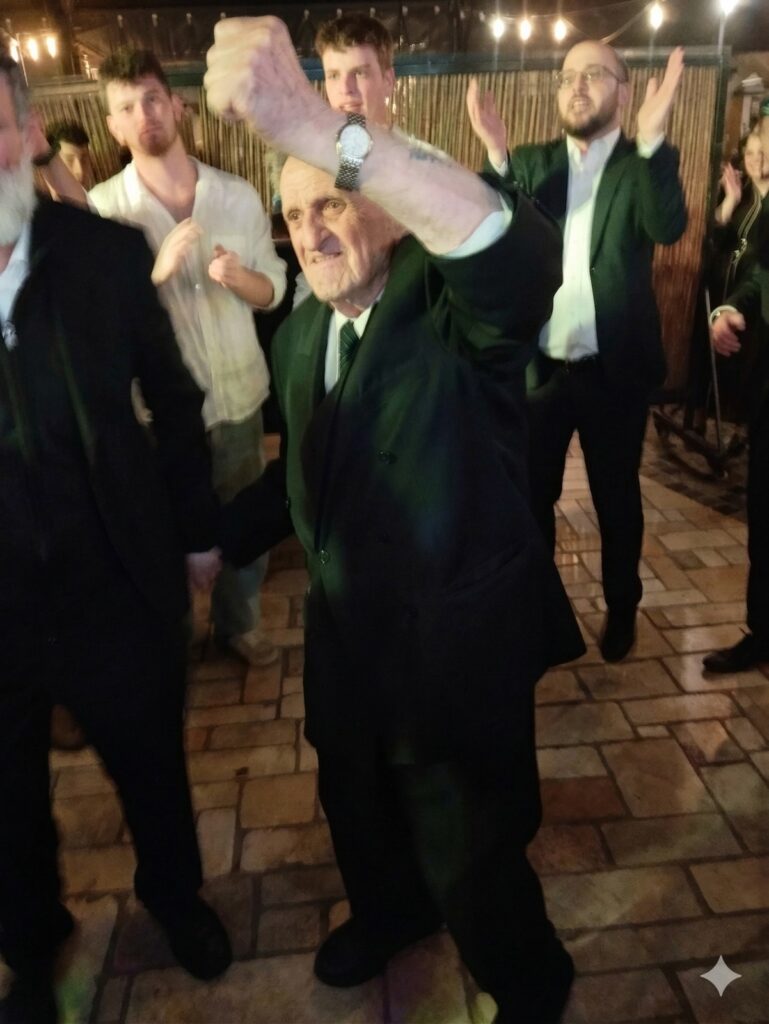
Dov Landau at the wedding of his great-grandson
During this period of the Counting of the Omer, we do not hold weddings. But the accompanying photo, taken before Pesach, shows nonagenarian Dov Landau dancing at the wedding of his eighth great-grandson.
Born in Poland, Dov survived Auschwitz and five other camps, as well as two death marches. He was eventually liberated from Buchenwald. At seventeen, he came to Israel alone, the sole survivor of his family after the Holocaust. On the day that the State of Israel was established, during the battles of Gush Etzion, he was taken captive by the Jordanians while fighting with the Haganah. Here was another former captive (in our times, that phrase sounds painfully current), and like many of those who returned from Gaza, he was filled with faith.
Dov went on to build a family, and for years he accompanied trips to Poland. He ends his lectures with the last words his father said to him before they were separated: “Remain a Jew.” But in truth, he does not end with words. He ends with song. The audience rises and sings and often dances with him.
At family weddings, Dov blesses the young couple under the chuppah and then dances with them. As is his custom, he rolls up his sleeve, revealing the tattoo on his arm from the camps. At this wedding too, Dov danced with joy, lifting his arm for all to see, showing that his father’s final wish had indeed been fulfilled. n
Translated by Yehoshua Siskin and Janine Muller Sherr.
Read more by Sivan Rahav Meir at SivanRahavMeir.com.