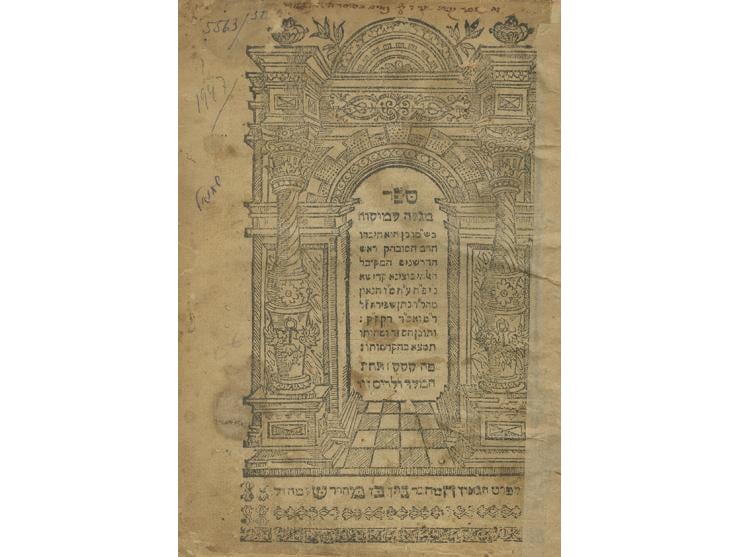

The Megaleh Amukot: The Life and Works of Rabbi Nosson Nota Shapiro of Cracow
By: Nosson Wiggins
Rabbi Nosson Nota (ben Shlomo) Shapiro was born in 1585 into one of the most prominent rabbinic families in Europe. His grandfather, Rabbi Nosson Shapiro of Hrodna (Grodno) was an illustrious rabbi and author of several important sefarim which we discussed in previous articles.
Although it’s not known who Rabbi Shapiro’s teachers were, but from a young age he was recognized as a brilliant student with a phenomenal memory. Rabbi Shapiro mastered the Talmud and poskim (halachicauthorities) by heart and his son, Rabbi Shlomo Shapiro, wrote that when his father would deliver a Talmudic lecture to his students, he would recite the Gemara, Rashi, Tosfos, Rif and Tur by heart! So great was Rabbi Shapiro’s erudition, that printers in Sudilkov attributed a halachic work titled Yismach Yisrael, (written by Rabbi Yisrael Shmuel Kalihari, a contemporary of Rabbi Shapiro in Cracow) to the Megaleh Amukos.
Rabbi Shapiro married the daughter of Rabbi Moshe Yaklish, a prosperous communal leader in Cracow. Rabbi Moshe Yaklish established a private beis midrash for his son-in-law to study and deliver shiurim. This beis midrash was called Al HaGivhah (on the hill) by the people of Cracow.
From 1617, Rabbi Shapiro served as the rabbi and rosh yeshiva of Kracow. In this position he taught many students, among them Rabbi Shabsi Kohen, author of Sifsei Kohen (Shach).
Although Rabbi Shapiro was one of the greatest Talmudic scholars of his day, he is more prominently known as a Kabbalist and a major disseminator of the Arizal’s Kabbalah. Rabbi Shapiro wrote many works, most of which have not been published. His published works include Chiddushei Anshei Sheim on the Rif and Megaleh Amukos on Chumash. Megaleh Amukos is actually the title of two separate works, one a commentary on Chumash, and the other a treatise which expounds the word V’etchanan in 252 different ways. In his lengthy and poetic foreword (with the embedded names “Natan” and “Shlomo,” the author’s father), Rabbi Shlomo offers many details about his father’s life and his other writings, including that his father initially intended to compose one thousand commentaries on the V’etchanan prayer, but he received a heavenly directive to only reveal 252. Also in his forward to Megaleh Amukot, his son R. Shlomo Rabbi of Sataniv wrote that Elijah revealed himself to his father. Rabbi Efraim Zalman Margulies also notes this fact in his preface to the Lviv edition of Megaleh Amukot, and Rabbi Yeshayahu Bassan, teacher of the Ramchal, in his famous letter to the Venice rabbis, counts the author of Megaleh Amukot as one of the special individuals who merited learning from angels.
Shapiro had seven children, three sons and four daughters. While serving as Chief Rabbi of Krakow, he refused a salary. He is buried in the Old Jewish cemetery in Kazimierz, Krakow. n
Nosson Wiggins (@jewishhistorysheimhagedolim) is the author of two books on the subject of Jewish history, “The Tannaim & Amoraim” and “The Rishonim” (Judaica Press). He researches Jewish History at the Klau Library, HUC-JIR in his hometown of Cincinnati and leads tours of Klau’s Rare Book Room. He is a passionate enthusiast of Jewish history and when he’s not in the hospital working as a nurse, he can be found researching and writing posts for his Substack, “Jewish History—Sheim Hagedolim.”