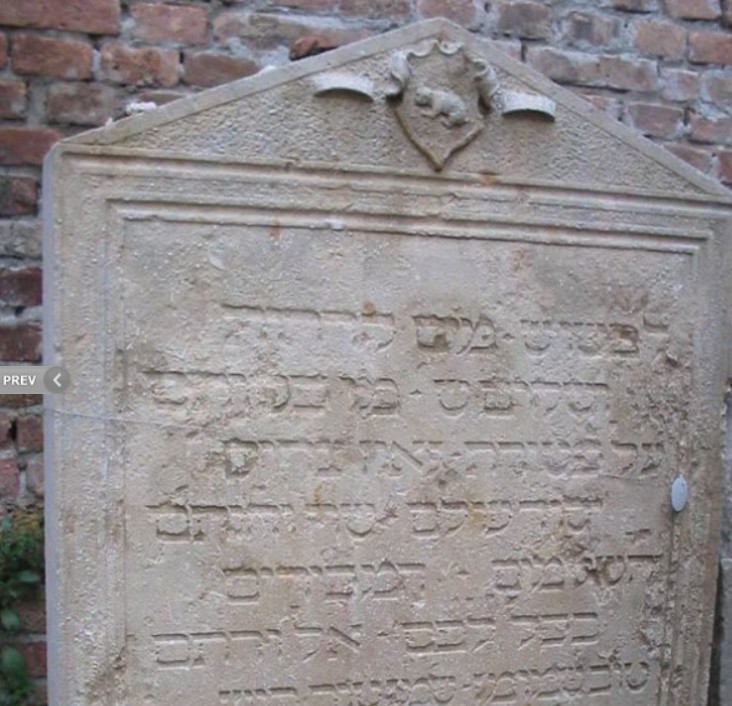

Maharam of Padua: The Life and Works of Rabbi Meir Katzenellenbogen
Guest Post By Yaakov Feldman
Rabbi Meir Katzenellenbogen was born in Prague in 1473 to a prestigious rabbinic family. His maternal grandfather was Rabbi Yechiel Luria, the great grandfather of the Maharshal, Rabbi Shlomo Luria, and the Rema, Rabbi Moshe Isserles (making him first cousins once removed with both of them). In his youth, he studied under Rabbi Yaakov Pollak, who is widely credited with innovating the learning methodology of pilpul and chilukim. A fellow talmid under Rabbi Pollak was Rabbi Shalom Shachna of Lublin, Rebbe and father-in-law of the Rema.
From Prague, Rabbi Katzenellenbogen travelled to Padua, Italy to learn at the yeshiva of Rabbi Yehuda Mintz. Known as the Mahari Mintz, Rabbi Yehudah Mintz was chief rabbi of Padua for 47 years, and enjoyed tremendous longevity, passing away at the age of 103. Rabbi Mintz was a major talmid chacham who founded his yeshiva in Padua with the German style of pilpul. Additionally, the nearby University of Padua was one of the only universities at the time to accept Jews, making Padua an attractive location for Jews.
Rabbi Katzenellenbogen married Chana Mintz, the daughter of Rabbi Avraham (who later succeeded his father as chief rabbi) and granddaughter of Rabbi Yehuda Mintz. The Maharam succeeded his father-in-law as chief rabbi in 1525, and became a well-known rabbinic figure. He corresponded with notable gedolim like Rabbi Ovadia Sforno, Rabbi Moshe Alashkar, and his cousins, the Rema and Maharshal.
The Maharam of Padua is perhaps best known for his role in a major printing debate in 1550. He wished to publish an edition of the Rambam with his own commentary, and after being rejected by the first publisher, he approached another local publisher, Alvise Bragadin, and agreed to the terms. Not long after his new edition hit the market, a nearly identical version began to be distributed, published by none other than Marc Antonio Justinian, the publisher who had rejected the Maharam in the first place. Not only that, but he was selling it for one gold coin less than the Bragadin edition.
The Maharam’s printing arrangement included a significant investment of his own money, and with this competition, the Maharam was worried about losing his investment. He decided to appeal to a prominent rabbi in Krakow, his 20-year-old cousin, Rabbi Moshe Isserles. The Rema wrote a landmark responsum (#10 in Shailos u’Teshuvos Rema) in response, analyzing whether non-Jews can be subject to Jewish business law. He also issued a cherem on anyone who buys the cheaper edition of the Rambam before all of the Maharam’s stock is sold out. The situation escalated with the publisher Justinian issuing a response of his own, and each printer accusing the other of printing heretical writings that were objectionable to the church. Before long, Pope Julius III got wind of the situation, and appointed a council of cardinals to investigate. Unsurprisingly, in August 1553 the council emerged with a ruling that all copies of the Talmud must be surrendered within eight days, along with a ten-year ban on Hebrew printing in Venice. On Rosh Hashanah of that year (September 9, 1553), the burning took place in Campo di Fiori Square in Rome, a few blocks from the Vatican. Today that area is a popular market in the old city of Rome, where a plaque was erected to commemorate the event.
The effects of the Talmud burning were long-lasting and extremely detrimental. The Maharam himself said that he is not to be relied on for a psak since the “maayan ha-Talmud” was no longer at his disposal (Shailos u’Teshuvos She’eris Yosef, end of siman 1). Rabbi Dr. Edward Reichman records that in Abraham Portaleone’s “Shiltei ha-Giborim” (on prayer and the Temple service) published around 1607, he makes multiple references to lack of accessibility to volumes of the Talmud. At one point (end of chapter 32, discussing the Lechem Hapanim) he writes: “Maybe someplace in the Gemara this is discussed, but I don’t know. As a result of the known decree, I have not been able to properly ascertain this.”
As for the Maharam’s scholarship, the “Shailos u’Teshuvos Mahari Mintz” that exist today were actually published by the Maharam in 1553, who included his own teshuvos as well. In addition to his commentary on the Rambam, he also wrote comments on the Tur and Yalkut Shimoni. The Maharam Padua passed away at age 92 in 1565. His yahrzeit is the 10th of Shevat.
Rabbi Meir Katzenellenbogen was succeeded in Padua by his son, Rabbi Shlomo Yehuda Katzenellenbogen, who later became av beis din in Venice. Rabbi Shlomo Yehuda authored Drashos Mahari Mintz, a compilation of 12 drashos modeled after the Drashos ha-Ran. Rabbi Shlomo Yehuda’s grandson was the famed Saul Wahl Katzenellenbogen, King of Poland for a day.
Yaakov Feldman is currently a student in Yeshivat Kerem B’Yavneh, and will be attending Yeshiva University in the Fall. He is the creator of theacharonim.com, an interactive map visualizing the geographic networks, correspondences, and intellectual lineages of Acharonim across early modern Europe and beyond. He can be reached at [email protected].