
Miami, 49 Years Later: A Night of Song, Nostalgia, and Legacy
By: Jonathan Paley

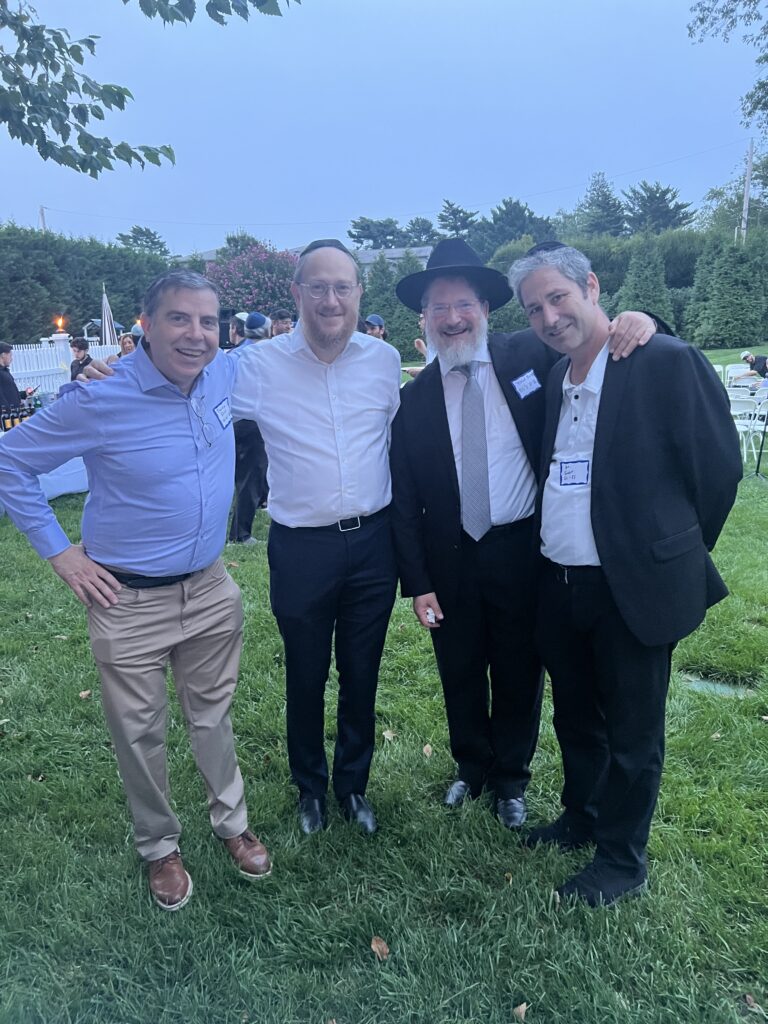
Jonathan Paley, Jordan Odinsky, Duvie Kestenbaum, and Daniel Muchnick
Oh, what a night!
Last week, nearly 100 alumni of the Miami Boys Choir gathered in Deal, New Jersey, for a unique and unprecedented event: a reunion of former choir members spanning nearly 50 years. For over three hours, we sang familiar melodies and harmonies, laughed, reminisced, and relived memories from our years in the choir.
I was a member during the early years of the group, from 1982–1985, and I was thrilled to reunite with fellow choir boys from that era, many of whom I had not seen in more than 40 years. We gathered around a crackling fire and belted out song after song, harmonizing on many of the Miami classics, as well as some lesser-known compositions by the great choir leader and brilliant composer, Yerachmiel Begun.
As I reflected on that memorable evening, I found myself thinking about what the choir meant to me personally, and what it has meant to so many others over the decades.
Regarding my own journey with MBC, when I was just seven years old, my parents recognized that I had a special vocal talent and encouraged me to join the school choir at the Moriah School of Englewood, led at the time by the great Avshalom Katz. Avshalom, father of Jewish music stars Eitan and Shlomo Katz and an accomplished chazzan in his own right, was a wonderful mentor who helped develop my vocal skills and abilities. As time went by, he realized that I had maximized my abilities within the school choir and encouraged my parents to find me a more serious musical environment where I could continue to develop my potential.
In 1982, a concert was advertised featuring the two leading boys’ choirs of the time: Amudei Shaish and the Miami Boys Choir.
Two weeks before the concert, my mother called the leader of Amudei Shaish and asked whether her son could audition for the choir. As she tells the story, he responded, “Lady, are you crazy? It’s two weeks before the concert! Give me a call after it’s over, and we’ll hear what kind of talent your son has.”
My mother remained determined. She called Yerachmiel, and after some prodding and pushing, he agreed to have me come down to a pre-concert choir practice.
Yerachmiel liked what he heard and came up with a plan. In the middle of the concert, as the choir exited the stage and he was introducing the next medley, I would walk from the audience onto the stage, tap him on the shoulder, and ask if I could join the choir.
Yerachmiel suggested I sing the classic “Would You Please Let Me Sing in the Choir.” He then asked the audience to clap if they approved my request. They concurred, I joined the choir for the second half of the concert… and the rest is history.
At the time, I was also exploring opportunities in the secular entertainment world and enjoyed a mini-career doing TV and radio voiceovers and commercials with a professional agent securing me “gigs”. My father, z’l, was very determined to make sure that my exposure to the non-Jewish industry was balanced with a healthy dose of Jewish influence.
Miami turned out to be the perfect environment. The choir was a fascinating mix of boys from very different Jewish backgrounds. Along with kids from more Modern Orthodox schools, such as myself, Yerachmiel recruited boys from more yeshivish backgrounds, including some from Chasidic yeshivot and cheders.
We practiced together, traveled the world together, played practical jokes on one another, and became close friends.
Looking back, I realize how remarkable that was. Here was a group of young Jewish boys from very different backgrounds and hashkafot, all at a critical stage of our development, coming together and functioning as one, making beautiful music.
I was fortunate to be chosen as a soloist and sang the title track of the album B’siata Dishmaya, the album that propelled the choir to a new level of fame and recognition in the rapidly growing Jewish music scene.
Eventually, my voice changed, and I left the choir and moved on with my life, ultimately pursuing a career in orthodontics. I was blessed to practice in the Five Towns and Brooklyn for close to 25 years and have now pivoted to practicing in Israel.
But music never really left me.
As an adult, I enjoyed a part-time musical career, as a keyboardist/singer and also serving as a chazzan in various communities, including the beautiful DRS minyan, where I shared the bimah with Rabbi Yisrael Kaminetsky. More recently, I have had the zechut to serve as chazzan at Yeshivat Shaalvim and have been able to share my Yomim Noraim Nusach with other budding ba’alei tefillah via YouTube.
I continue to compose songs and share them with family and friends. In many ways, that part of my life is a direct continuation of what began all those years ago in Miami.
But the choir gave me much more than a love of music.
It taught me discipline. It taught me to strive toward reaching my potential. It taught me how to work as part of a larger group to accomplish something meaningful.
And perhaps most importantly, it opened my eyes to the different paths towards Avodat Hashem. I learned to appreciate people whose backgrounds and approaches to Yiddishkeit were different from my own.
Those lessons have continued to influence my sensitivity toward others in the frum community. We may disagree about important issues and concerns, but we can still maintain the respect, friendship, and love we have for one another.
On Tishah B’Av, I traveled to Yerushalayim with my family for the NCSY “Kumsitz Around the World” and happened to bump into a fellow Miami alumnus, Jordan Odinsky (‘02-‘07). We immediately began reminiscing about our days in the choir. Despite the fact that we had been in the choir decades apart, we were surprised to discover that many of our memories and adventures were almost identical.
We exchanged contact information and promised to stay in touch.
The following week, perhaps inspired by that chance encounter, Jordan created a WhatsApp chat together with another former soloist, Eric Stern (‘91-‘97) and reached out to me, asking me to join and help recruit choir members from my era.
That little WhatsApp group has now grown to 208 members, with hundreds of video clips and thousands of messages.
Taking advantage of the excitement generated by the group, Jordan and Eric began planning a reunion kumsitz. They invited alumni from across the decades to gather at Eric’s home in Deal and spend an evening reconnecting through nostalgia and song.
The event was a smashing success. It was like a 25-year high school reunion on steroids. Each generation of choir members reconnected with old friends after many decades, while members of different generations met one another for the first time.
Apparently, there was an elaborate barbecue spread.
Most of us never noticed.
We were having far too much fun around the bonfire to leave the chevra!
And then there were the harmonies!
Nearly 100 men, young and not so young, with years of singing experience, all sharing melodies, harmonies, improvisations, and memories. We went through album after album (there have now been more than 30!) revisiting classics along with newer compositions and recalling performances from decades ago.
Among us were many soloists from throughout the choir’s history, including some who have, of course, become famous through TikTok, as well as members from the earliest days of the choir when it was still actually based in Miami.
Our WhatsApp group also includes many alumni who now live in Israel, including myself, and we are already working on a parallel event in Yerushalayim, perhaps on Chol Hamoed Sukkot.
Stay tuned…
But what struck me most that evening was not simply the music or the nostalgia.
It was the incredible diversity represented in the room.
There were men with long white beards and black suits singing alongside fellows in ponytails and shorts. I reconnected with old friends who are now rebbeim in Lakewood yeshivot, as well as fellow dentists, lawyers, businessmen, and professionals of every kind.
Different backgrounds. Different hashkafot. Different life paths.
And yet, for that evening, we were simply Miami boys.
It was indeed “Klal Yisrael Together”.
In the early stages of the chat, I shared the following thought with the group as one of the “elders” of the alumni:
“It is truly incredible to consider the impact Yerachmiel has had on generations of young men. Through music, discipline, and personal guidance, he has given hundreds of boys confidence, lifelong skills, friendships, and memories that have remained with us for decades.
The greatest testament to his legacy is seeing generation after generation of alumni look back with such warmth and nostalgia. The choir was about so much more than music: It was an experience that helped shape who we became.
Many of us have been fortunate to learn from rebbeim and teachers who dedicated decades of their lives to chinuch and education. But when you look at the names in this MBC alumni group, it is remarkable to see how many accomplished figures emerged from the choir. There are major stars in Jewish music, of course, but there are also countless others, people like me, who may never become public figures, but for whom singing and music have remained an integral part of their lives and the lives of their children and grandchildren.
It is hard to identify anyone who has had a greater influence on the world of Jewish music than Yerachmiel Begun. His legacy is not only the music he created, which is itself extraordinary.
His greater legacy may be the generations of youngsters he inspired, mentored, disciplined, encouraged, and brought together.
I think I speak for all of us in expressing our heartfelt hakaras hatov!!”
Yerachmiel was unable to join us that evening, but his son Chananya was there, and it was wonderful to hear how the choir continues to thrive, now based in the Lakewood region.
I have remained in touch with Yerachmiel, and he is already excitedly preparing for “Miami 50,” what will hopefully be a fitting celebration of the choir’s long-standing success and its impact on the wider Jewish community.
As we sat around that bonfire, singing songs that many of us had not sung in decades, I couldn’t help but think about how remarkable it is that something that began for so many of us as a group of young boys has remained such a powerful part of our lives.
Forty years later, the voices may have changed.
The hair certainly has.
But the music, and the friendships, memories, and values that came with it, remain.
And perhaps that is the real legacy of Miami.