






All Ears: Getting Your Earlobes Ready For Your Next Simcha
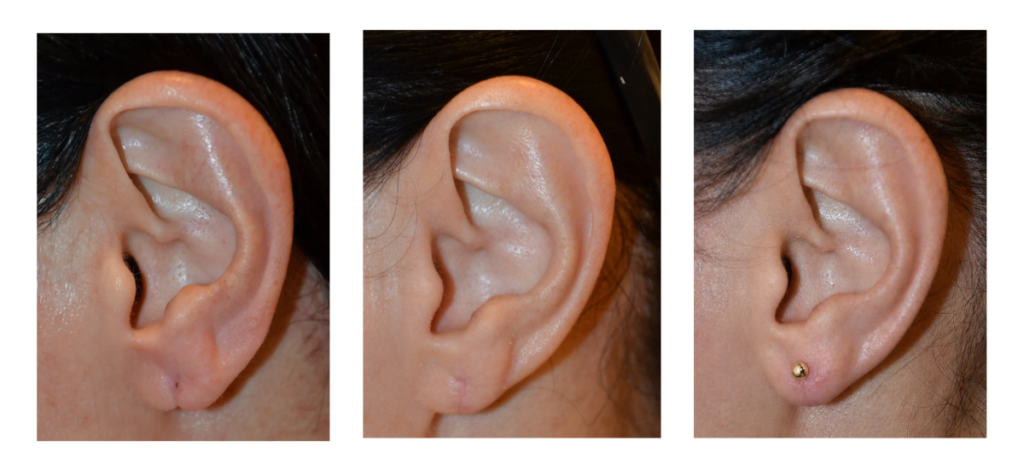
You have selected the perfect gown, booked your hair and makeup appointments, and set aside the beautiful earrings that have been sitting in your jewelry box. There is only one problem that you perhaps overlooked in all of the planning. Your earlobes no longer seem to be able to support the earrings you planned to wear. Perhaps your diamond studs point downward instead of sitting nicely against your ears. Perhaps your piercing holes have become so elongated that you are afraid your earrings will fall out, or perhaps one of your earlobes has torn completely.
Although we spend a great deal of time talking about facial rejuvenation, the earlobes are an often-overlooked part of the aging process. Unfortunately, aging earlobes can create all sorts of problems, most notably preventing you from wearing your favorite accessories! Fortunately, there are several relatively simple ways to address these concerns.
Why Do Earlobes Stretch?
Years of wearing heavy earrings, the effects of gravity, loss of collagen and volume associated with aging, and even genetics can contribute to stretching and thinning of the earlobes. Sometimes, an earring gets caught on an article of clothing, or a curious baby pulls on it, resulting in a complete tear.
Often, however, the process is gradual. Many people who come to see me with this problem report that they have never even worn heavy earrings and don’t recall a specific traumatic event. Sometimes the recurrent pressure experienced from pressing on the back of an earring out of fear that you will lose it creates excessive stress on the tissue. A perfectly round piercing slowly becomes a vertical slit, leaving less and less tissue beneath the earring until eventually the earlobe splits.
Why Can’t You Just Sew the Hole Closed?
One of the most common questions patients ask me is whether I can simply put a stitch through the elongated hole to close it. Unfortunately, it is not quite that simple. An established piercing is essentially a tunnel lined with skin. Simply sewing the two sides together would be like sewing two fingers together and expecting them to fuse. The skin surfaces will not heal together in that manner.
In order to properly repair an earlobe, the skin lining the piercing must be surgically removed, creating fresh edges that can heal together. The tissue is then carefully sutured in layers, paying particular attention to restoring the natural contour of the earlobe and avoiding a notch along its lower border.
This is typically a relatively quick procedure performed in my office under local anesthesia. Patients generally experience minimal discomfort and downtime. Believe it or not, earlobes actually aren’t that sensitive after all.
When Can I Wear Earrings Again?
This is where advance planning becomes particularly important, especially when there always seems to be another holiday, wedding, bar mitzvah, or other simcha on the horizon.
In my practice, the typical timeline for an uncomplicated earlobe repair is as follows:
Week 1: Sutures are removed approximately one week after the repair.
Week 6: Five weeks after suture removal, provided the earlobe has healed appropriately, the ear can be repierced.
Week 12: After wearing the new piercing studs continuously for another six weeks, patients can generally begin changing their earrings, starting with lightweight jewelry.
That means you should ideally allow at least three months before your next big event, and preferably a little extra time to accommodate any delays in healing. While the actual repair is a minor procedure, the biology of healing cannot and should not be rushed.
Why Can’t I Repierce in the Same Spot?
Patients are sometimes surprised when I explain that I do not recommend repiercing directly through the original piercing site. Scar tissue is not as strong as normal, uninjured tissue. Even a well-healed scar does not regain all of its original tensile strength. Piercing directly through that scar increases the risk of recurrent stretching and tearing. Instead, I carefully select a new location adjacent to the original piercing, taking into consideration symmetry, the shape of the earlobe, and the amount of healthy tissue available to support an earring. Don’t worry, your new piercing won’t be in a weird spot. The new piercing can be just a few millimeters away from the old one.
What About Thin or Deflated Earlobes?
Just as we lose volume in our faces with age, we also lose volume in our earlobes. In some patients, simply repairing the piercing does not address the underlying problem of a thin, delicate lobule. In these cases, I may recommend adding a small amount of hyaluronic acid filler to restore volume before repiercing. Another option is fat grafting, in which a small amount of a patient’s own fat is transferred to the earlobe to restore fullness. Fat grafting may offer a longer-lasting solution for appropriate patients. This can provide additional cushioning and improve the appearance of the earlobe. These treatments can also be helpful for individuals whose earrings no longer sit properly, or whose earlobes look aged because they are too thin, even if their piercing holes have not yet become significantly stretched.
Protecting Your Earlobes
Once your earlobes have been repaired, it is important to protect your investment. Reserve particularly heavy earrings for special occasions, consider supportive earring backs, and avoid sleeping in earrings that can pull or catch on bedding. If you notice your piercing beginning to stretch, address it before it becomes a complete tear.
As a plastic surgeon, I perform procedures ranging from extensive facial and body rejuvenation to very small repairs. Sometimes, however, it is the smallest procedures that bring patients an unexpected amount of happiness.
There is something particularly satisfying about being able to wear a treasured pair of earrings again, whether they were a gift from your husband, inherited from your grandmother, or purchased for your daughter’s wedding. So, if you have a simcha coming up, remember to add your earlobes to your preparation checklist. Three months of planning may allow you to enjoy those beautiful earrings for many more years of celebrations.
May we always have many simchas to prepare for! n
At Preminger Plastic Surgery, we are committed to educating our patients and providing personalized care tailored to their unique needs. For those considering plastic surgery, we offer guidance every step of the way to help you achieve your aesthetic and wellness goals. Dr. Preminger is a board-certified plastic surgeon with degrees from Harvard, Cornell, and Columbia.
For more information or to schedule a consultation, please visit premingermd.com or call 212-706-1900. Follow us on Instagram @premingerplasticsurgery.