
Ambassador Huckabee And The Eyes Of Yehoshua And Calev
By Juda Honickman
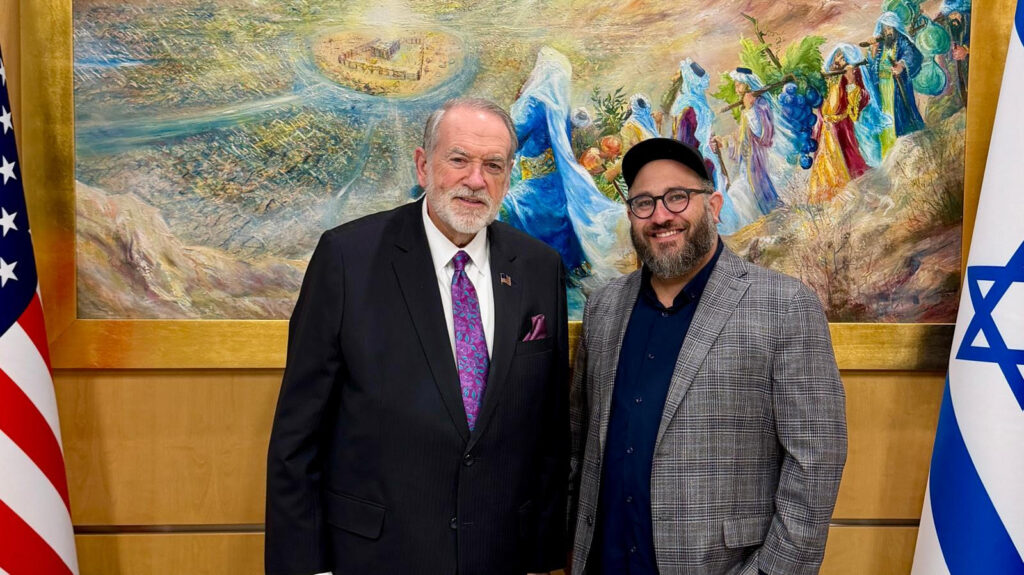
Earlier this year, I had the opportunity to sit across from Ambassador Mike Huckabee at his Jerusalem office. The conversation ranged from Israel and faith to the U.S. and Hashem; the kind of exchange that doesn’t happen often enough between a diplomat and the people they represent. But what made this meeting different from any other wasn’t what was said. It was what was hanging on the wall.
An original painting by the artist known as Huvy depicting one of the most consequential moments in all of Jewish history: The spies returning from the Land of Israel.
I had been working on placing it there for some time, on loan to the U.S. State Department for the duration of Ambassador Huckabee’s term, and I was visiting with Ambassador Huckabee to see it in its new home.
Standing there, looking at the painting on the wall, I thought there was no more fitting image for this office, in this city, at this historic moment.
Before I left, I blessed the Ambassador to always see this land through the eyes of Yehoshua and Calev.
He understood exactly what I meant.
The parashah this week in the Diaspora is Shelach. Twelve spies. Forty days in the Land. One mission, two very different sets of eyes and reports. Ten came back afraid. They saw giants. They saw fortified cities. They tallied every reason Hashem’s promise couldn’t possibly be kept. “We were like grasshoppers in our own eyes,” they said, and that smallness became a self-fulfilling prophecy.
It was that fear that destroyed an entire generation, not the giants, fortified cities, or other realities they built up in their minds.
Two came back with faith: Yehoshua and Calev. They walked the same hills, encountered the same inhabitants, and surveyed the same terrain, but they returned with something the others had lost somewhere along the way: faith in Hashem and the ability to see the land not only as it was, but as it was meant to become.
They trusted Hashem’s promise even when it wasn’t popular, easy, or safe to do so.
The consequences of those two visions took forty years to play out in the desert and in some way, they are still playing out today.
Most of the world looks at Israel the way the ten spies did: through fear, through pressure, through a lens calibrated by political correctness, convenience, and the path of least resistance.
The conflict is too complex.
The history is too contested.
The cost of standing clearly with Israel is too high.
Better to hedge.
Better to find language that offends no one and loses all meaning.
Ambassador Huckabee has never spoken that language.
Long before he held the position of Ambassador to Israel, he stood with Israel.
Not because it was strategically advantageous, but because he understood something that eludes many of the officials in Washington: this is not a political question, not in the slightest. It is a covenantal one.
He sees this country through the eyes of faith and conviction, which leads to a moral clarity that comes not from polling data but from actually believing what Hashem and the Torah says.
And now he carries something more than a personal conviction. As President Trump’s Ambassador to Israel, Mike Huckabee is the eyes and ears of the United States in the most contested and consequential piece of land on earth. The lens through which he sees this country and the reports he sends back to Washington shape policy, signal alliances, and send a message to every government watching. Just like those twelve spies, an ambassador’s report carries weight beyond the words on the page.
That is not a small thing. That is the clarity of Yehoshua and Calev. It is rarer than it should be, and it deserves to be named.
The painting hanging in Ambassador Huckabee’s office is both a blessing and a provocation. Every person who walks through that door, whether diplomat, dignitary, or journalist, will pass a depiction of that ancient fork in the road.
Two men standing apart from the ten. Two men who refused to let fear masquerade as wisdom. Two men whose names we still remember and honor 3,000 years later. While the other ten are largely forgotten. History tends to work that way.
As you sit down to read Shelach this Shabbat, the question the parashah is asking hasn’t changed: through which eyes are you looking? Not just at the land. But at what Hashem promised, what history is moving toward, and what it costs to say so out loud when the room disagrees with you.
There is a verse that needs no commentary: “I will bless those who bless you, and those who curse you I will curse.” Ambassador Huckabee has built his relationship with Israel on that verse. The painting on his wall knows exactly why it’s there.
So does he.
Juda Honickman is a writer from Woodmere who lives in Israel and is spokesperson One Israel Fund.