Musings Of A Shliach From Montana
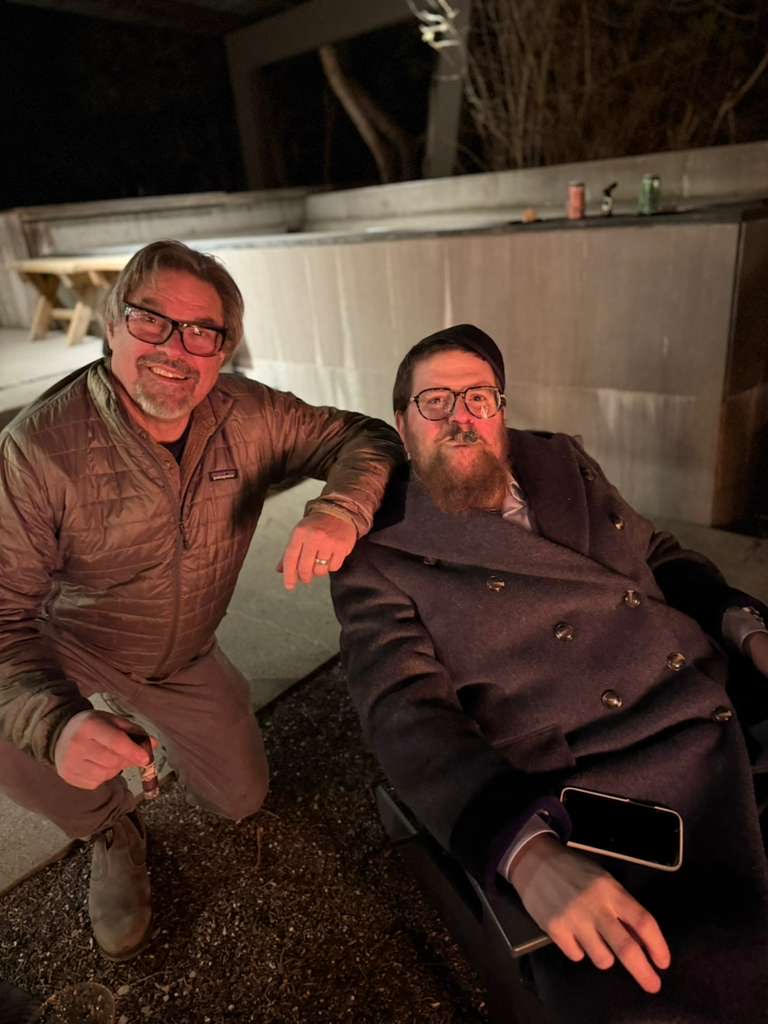
Rabbi Chaim smoking his first cigar with Larry at his side
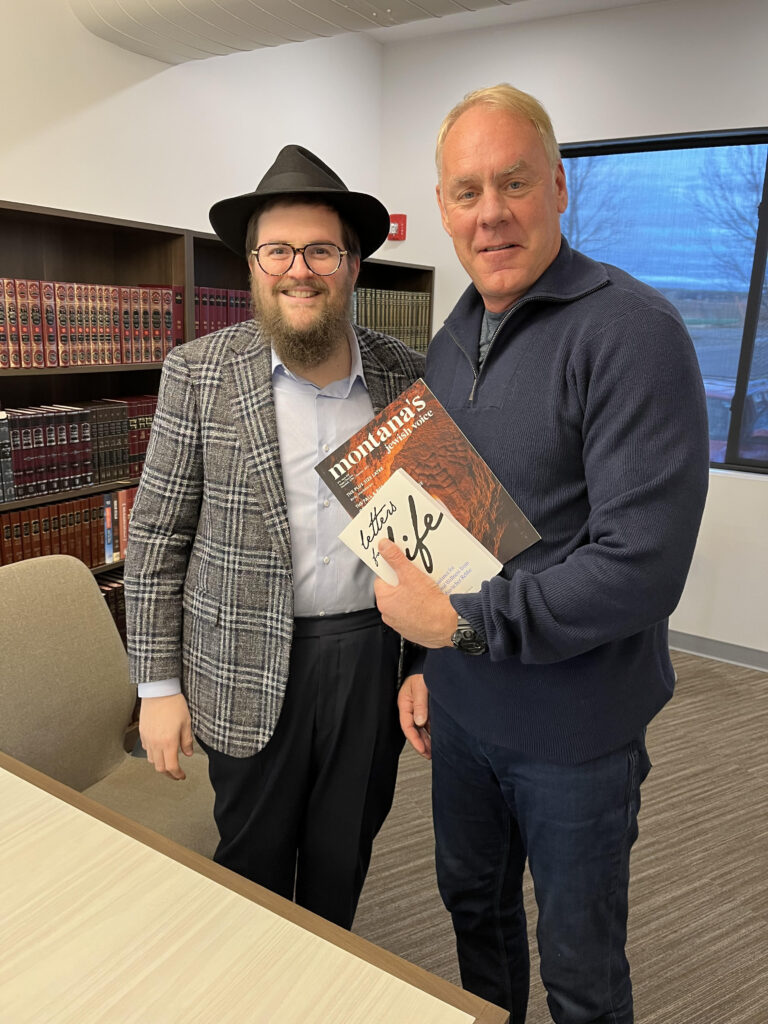
Rabbi Chaim Bruk with Congressman Ryan Zinke
Can the light be so bright that it obscures everything around it? Is there a blessing so strong that our finite minds sometimes experience it as a curse?
I have some thoughts on perception and reality.
Last Friday morning, one of Montana’s two congressmen, Rep. Ryan Zinke, visited our shul to discuss Jewish life in Montana, the issues with antisemitism on the left and right, and to chat about his upcoming trip to Israel. We also discussed the battle of good versus evil and how many Americans, even those who were good at some point, bought into the evil and lost their moral compass. It’s super disappointing when those we thought were rational and good turn out to be epic evildoers. It seems like so many of my conversations over the past 2+ years have been about good versus evil, constantly reminding those in leadership that a moral compass should never change with the winds of the media, and that being a good person doesn’t mean people will appreciate your goodness.
I know that I’m not the only person disturbed by what we are seeing in the world of politics in America and across the globe. While it’s not our job to be fearful and live with anxiety, the reality is that darkness is prevalent, and until the coming of Mashiach, we need to fight back with super doses of light. They want to scare us into submission or frighten us into thinking aliyah is our only option, but in truth, bitachon, total trust in Hashem, is not about finding a solution when the plans don’t transpire, but recognizing that we don’t necessarily know why it’s happening and how it will resolve, but we have the faith and truth in Hashem that He is in charge and He runs the world.
Posts on X shouldn’t make you question Hashem’s control of the world.
Case in point: Chavie was heading to New York for her grandmother’s shloshim. The flight was delayed by 12 hours, ensuring that she would miss it. As there were no alternative flights that would get her there in time, I rebooked her on a return flight to Bozeman, but the original airline still had her luggage. I’m dealing with getting her luggage delivered back to Bozeman as we speak. But I keep reminding myself that everyone’s healthy, Baruch Hashem, we’re okay, and b’ezrat Hashem, we will get her suitcase back. I need to believe that Hashem has a plan for everything, even Chavie’s suitcase.
In this week’s parashah, Bo, we read about Moshe confronting Pharaoh. The verse says “Bo el Pharaoh,” which translates to: “Come to Pharaoh.” But shouldn’t it say, “Go to Pharaoh” (“Lech el Pharaoh”)? Why the word “Bo” instead of “Lech”? The Baal HaTurim writes that the word “Bo” has a gematria of three (bes is 2 and aleph is 1), which alludes to the fact that at the moment when Moshe is being sent to Pharaoh, there are three more plagues left until the Jews leave Egypt. Somehow, this seems farfetched. Is there, perhaps, a deeper reason behind this odd verb choice?
The Chassidic masters taught that Hashem was telling Moshe to come along with Him to Pharaoh. Too often, Hashem sends us a mission, tells us what to do, encourages us to shine light and be a beacon of Torah values, but we don’t feel up to the task. Hashem is saying “Bo El Pharaoh.” You won’t be facing Pharaoh alone, I’m leading the way, just come along with me and I’ve got you covered. It doesn’t always feel okay. It doesn’t always seem right, but knowing that we aren’t alone, and Hashem is holding our hand the entire time, should be really encouraging.
When going with Hashem, no challenge should be daunting, but it’s hard to internalize.
Last week we hosted our first Men’s Club, “Mensch Club,” here in Bozeman. I’ve been hoping to get it off the ground for about a year and my brother-in-law, Rabbi Mendel, finally made it happen. Our friend Larry, a local architect, hosted it at his house. We had cigars (yes, I had my first cigar ever), whisky, smoked meat, and a great conversation led by Mendel on the patriarchy and matriarchy in Judaism, in particular how it relates to a child’s Jewish identity. At least half of the chevra are intermarried, and the discussion was civil, warm, insightful, and educational. We sat around the fire and had an open conversation about the Avos and how things were before Matan Torah at Sinai. We spoke about Ezra’s revolution in this realm when returning to Eretz Yisrael after the story of Purim. We spoke about why the Reform Movement decided to introduce patrilineal descent to recognize Jewish identity, and all in all, it was nice.
It’s hard to see so many Jews intermarried. These are my dear friends who have wonderful spouses, yet have chosen a life that’s out of sync with the Torah. Some simply didn’t know the halachos at the time; others didn’t care at that point in their life. Although confronting this kind of spiritual challenge is daunting, I know that giving up on those beautiful neshamos, while the easier option, would be very wrong.
We are not meant to see the spiritual challenges and run away; we must face them and shine light on them. These are my Jewish brothers, Hashem’s sweet children, and they deserve to be welcomed with love, even if, at times, we have to have difficult conversations.
So, back to Moshe. Why was Moshe scared to go to the palace? Why did Hashem have to invite him to come along with Him? After seven of the makkos (plagues) and overcoming the speech impediment issues, Moshe should have been ready to roll. But the Zohar explains regarding the words “Bo el Pharaoh” that Hashem brought Moshe into chambers within chambers to confront a great and mighty serpent, the source of numerous descending levels.
And who was this?
It was the great serpent that Moshe was afraid of, and so he only approached the rivers and the levels connected to it, but didn’t dare approach it directly since he saw that its root represented the deepest, darkest levels of evil. As an aside, when Hashem instructed Moshe to grab the tail of the serpent, it turned back into a staff (rod) in his hand. This symbolizes that when one faces their deepest fears and confronts the “root” of evil, that power can be transformed into a tool for service to Hashem (a shepherd’s staff).
When Hashem saw that Moshe was afraid and that no other messenger would approach the great serpent, He said, “Behold, I am upon you, Pharaoh, King of Egypt, the great serpent that lies in the midst of its rivers.” Hashem had to engage in battle with it. As it is written: “I am the Lord.” This means that due to the intensity of Pharaoh’s essence (referred to as the “great serpent”) in his own palace, rooted in exalted supernal roots, Moshe was afraid to enter there. Therefore, Hashem did not say to Moshe, “Go to Pharaoh,” indicating that Moses should go alone, but rather, “Come to Pharaoh,” implying that G-d would accompany him.
It’s a complex Zohar and the Rebbe, zt’l, elucidated it in great detail in the last Parashas Bo Farbrengenin January of 1992, and the gist of it is as follows: Pharaoh, like Esau and many other biblical villains, has deep spiritual light and power invested in him. The world can’t handle it, so it comes out sideways, as evil and kelipah. As the plagues progressed, Moshe started seeing the powerful light beneath the evil surface and started to worry whether he was capable and G-d told him that He’s going along and with G-d there Moshe could confront the spirituality in Pharaoh.
That’s the point: when seeing darkness, challenge, or obstacle at face value, it can be overwhelming, but when knowing that it has incredible hidden potential to take us places, we go with Hashem and take on the challenge directly, shining the light that reveals the light hidden beneath.
I still don’t know where the luggage is, but I’m certain the light will shine on this matter shortly.
Rabbi Chaim Bruk is co-CEO of Chabad Lubavitch of Montana and spiritual leader of The Shul of Bozeman. For comments or to partner in our holy work, e-mail [email protected] or visit JewishMontana.com/Donate.