
Musings Of A Shliach From Montana

The Medevac chopper landing at Bozeman Health with David on board

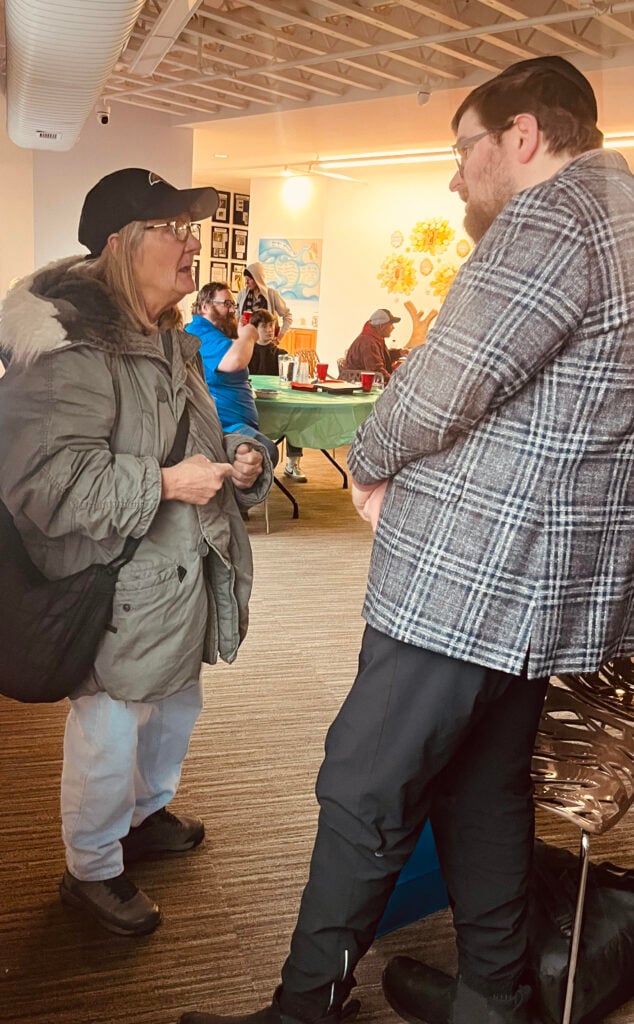
Rabbi Chaim chatting with men from California and Alabama who are currently homeless
I’m not really interested in football. It’s not that I don’t enjoy olam hazeh; I love sushi, being in nature, and comedy. I just don’t care for football.
My kids are phenomenal skiers, we enjoy horseback riding and hiking, and my son Menny has got us all involved in soccer. I hear about Ronaldo and Real Madrid every single day, I listen to soccer music in the car all the time, but between Seattle and New England, I don’t even have the slightest opinion. Yet, as we’ve done for five years now, on Sunday we hosted a Super Bowl Party at our Chabad Center for the homeless population of Bozeman. It’s a great way to bring warmth and smiles to people who don’t have a permanent home. We give them a kosher dinner, snacks, warm clothing, and they get the chance to enjoy the game at a place with people who give them the dignity that every human being craves. “Tzelem Elokim,” the recognition that every human being is created in the image of G-d, is something we take very seriously.
Spending time with the homeless, shaking their hands, giving them hugs, and listening to their stories allows me to see the human being behind the dirty clothing, the horrible body odor, and in many cases, mental illness. It’s heartbreaking because so often, if the issues were dealt with early on, they would not have become so serious. When the emotional/mental/physical health issue is nipped in the bud at its onset, if the addiction is recognized and the person gets help in the early stages, if the financial troubles are fixed early on, it would save so much pain, relieve so much angst, and keep so many families together.
It’s important to see the signs before it’s too late.
America has a failing healthcare system. Before you start screaming, “It’s better than Canada and England,” hear me out. I’m not saying it’s bad in comparison to anywhere else, just that it’s failing at the core of what healthcare is meant to do. No, we aren’t missing doctors or facilities, it’s that our healthcare system is all about fixing ailments or suppressing side effects rather than focusing on prevention. So many ailments that plague the frum community are preventable if only we changed our relationship with food and the environment. The Rebbe, zt’l, always encouraged doctors to focus on preventative healthcare, which isn’t always easy for the patients, as changing a lifestyle isn’t as easy as popping a pill, but it’s the better option.
When a person comes for an annual physical, they should be taught what choices would be better for their health, not just told “You have X, now you need these three pills.”
On the second night of Rosh Hashanah 1944, the previous Rebbe, Rav Yosef Yitzchak Schneerson, zt’l,shared the following: My grandmother, Rebbetzin Rivkah, the wife of the Rebbe Maharash (Rav Shmuel, the fourth Lubavitcher Rebbe) once had a lung ailment, and Dr. Heibental from Vitebsk gave up hope for her. Hearing this, her father-in-law, the Tzemach Tzedek, quoted the teaching of the Sages that from the phrase “verapo yerapeh” (he shall surely heal), we learn that a doctor is permitted to heal. The Tzemach Tzedek added: “A doctor is permitted only to heal; the opposite is not his business.”
He instructed his daughter-in-law to have breakfast, including bread and butter, immediately after her morning negel vasser, and he gave her his blessing for a long life. Sometime later, she dropped this routine, explaining to him that nowadays she would finish her Morning Blessings and Shacharis quickly and would then wash her hands for breakfast. He replied: “Better to eat for the sake of davening than to daven for the sake of eating.”
This idea has become fundamental to Chabad Chassidim. If the cup of coffee and a light breakfast will allow you to daven with more concentration and focus, instead of rushing through a mumbling davening because you’re starving and hoping for breakfast, then have the light breakfast. It’s better to think about Ashrei during breakfast than to think about breakfast during Yishtabach.
A key point of the story is that taking care of our health is very important and prevention is always better. At the same time, we must recognize that Hashem has given doctors the ability to heal, and as mentioned in the story, it’s a fundamental concept that originates in this week’s parashah.
In Parashas Mishpatim, we are taught that if someone injures his fellow, he’s obligated to pay the victim for a variety of negative outcomes, including compensation for his medical bills. The verse says, “Still, he must pay for his loss of work and provide for his complete recovery.” On the words “Verapo Yerapeh,” the Gemara in Bava Kama says “from here we learn that a doctor is given permission from on high to heal those who are ill.” It’s no small statement; the fact that a person becomes sick, which in many cases isn’t due to his own actions, but rather due to genetic predisposition, instead of accepting the will of Hashem, we say that a human being can and should heal the ill. This is a novel idea that only comes about through Hashem commanding this reality. Every day in Shemoneh Esrei, in the Amidah, we say the prayer “Refa’einu,” asking Hashem to heal us, so it’s an interesting balance to recognize Hashem as the healer, but also seek the intervention of those who He entrusted to heal.
Last week, a wonderful family from the New York area were skiing in Big Sky when one of the family members, David, had a skiing accident resulting in a punctured lung. I was outside my kids’ school when Reb Zvi Gluck of Amudim called me and told me what was going on and within minutes, I was Baruch Hashem able to be at the ER when the medevac chopper landed from Big Sky. Writing this article, it’s already day five of him being hospitalized in Bozeman with his wonderful family at his side, hoping and praying for a complete recovery. We helped as much as we could, and some of the family members have been staying at our Lev Lodge Hospitality Center, yet, watching David in pain, watching him undergo multiple procedures to seek healing, reinforced for me that we need amazing doctors, we need the best practitioners, and we need to daven, daven, and daven some more for a complete recovery.
Many Gedolim of yesteryear were physicians or knowledgeable about medicine. Sages like Ben Achiya in the Beis Hamikdash, who oversaw the intestinal health of the Kohanim, Shmuel, who was Reb Yehuda NaNasi and Rav’s physician, Rav Chanina, the Rambam, the Ramban, Sforno, Shiltei Giborim, and many others. While there was some debate on what medicine is acceptable and what isn’t, overall, it’s accepted da’as Torahthat we must do everything in our power to find healing. Yes, the Ibn Ezra famously opposed any healing related to internal organs and only allowed healing of external conditions, but the Rashba and most other Rishonim and Acharonim disagreed with the Ibn Ezra on this matter. To me, it’s a reminder that there are halachic debates on these matters, reminding me that doctors are something available to us, when necessary, but it’s way better to remain healthy through preventative measures.
Recently I purchased the new two volume set “Refuah B’Shabbos” written by Rav Mordechai Bistritzky, shlita, of Tzfat. It’s a fascinating sefer on the halachos of medicine on Shabbos and I think it’s something every ben Torah should have on their shelf. In the introduction, he writes about the Ibn Ezra and how the Poskimdisagree, which is why we can and should do everything possible to treat a patient with a life-threatening ailment on Shabbos and not “leave it up to G-d.”
“So, what your point, Chaim?”
My point is that we need to be grateful for Hashem’s medical messengers who bring us practical healing, but we must never forget that healing ultimately comes from Hashem and therefore follow His instructions: daven hard by Refa’einu, and try to be as preventative as possible so you don’t need to see the doctors at all. I’ve struggled with being overweight my entire life and I don’t want to do Ozempic or stomach surgeries. I want to learn to treat my body properly and I want to do it with hard work, not easy fixes. So, I’m not writing this from some high horse of awesome metabolism. I’m writing this from within the struggle, and I can still say that healthy eating, exercise, supplements, essential oils, homeopathy, emotion-code, and everything else Chavie talks about, all add to our wellbeing, ensuring that we don’t fail our own bodies.
Rabbi Chaim Bruk is co-CEO of Chabad Lubavitch of Montana and spiritual leader of The Shul of Bozeman. For comments or to partner in our holy work, e-mail [email protected] or visit JewishMontana.com/Donate.