


Musings Of A Shliach From Montana
By: Rabbi Chaim Bruk
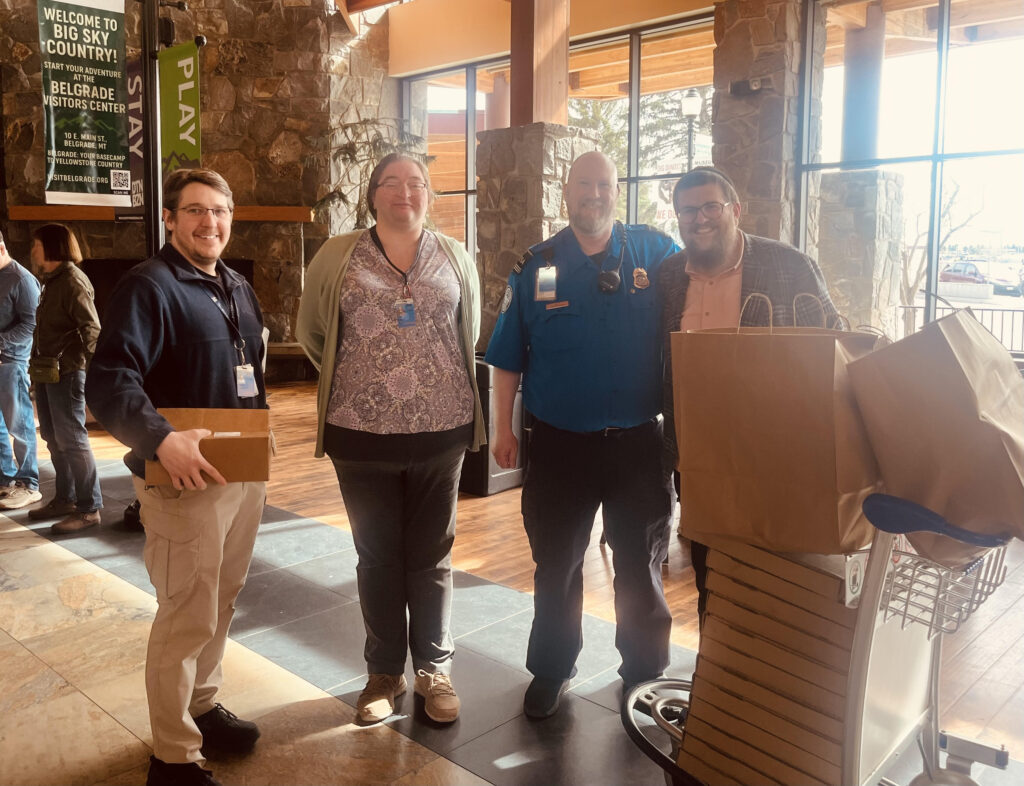
Rabbi Chaim with three leaders of Bozeman’s TSA
While we are mostly consumed by Pesach prep getting ready for Zman Cheiruseinu, along the way, we snuck in a little love for those struggling in the broader community.
Last week, I had the honor of delivering a hot lunch along with fifty $75 grocery gift cards to the TSA agents at our Bozeman Airport. It wasn’t my idea, but it was the right thing to do. A generous Jewish couple in town called me and said, “Rabbi, what can we do for the TSA agents?” and a plan was conceived. Over time, Bozeman has become aware that our Jewish community is willing and able to show up for those in need who may otherwise fall through the cracks. We have great organizations in town that deal with helping the poor, homeless, and hungry, but they can’t do it all, so we step in when necessary. Last year we refurbished the CPS room for children and also delivered toys for kids at our local hospital. For five years, we’ve hosted the Superbowl Party for the homeless people in town, so I guess they knew that if they called me we’d find a way to get it done.
The genuine gratitude expressed by the TSA team was heartwarming, and because “kindness breeds kindness,” another couple just reached out and asked me to do the same again, so we did yesterday.
We can’t solve all of the world’s issues and certainly can’t resolve DC dysfunction, but we can show up for those in our community who continue to show up to work daily, allowing our airport to operate while letting them know how much we care. Little acts of kindness make all the difference and tip the scales towards a brighter future, the “Mashiach reality” we’ve all been praying and hoping for.
This is key: To show up we must be able to see and feel the pain of others. We can choose to be numb to the woes of humanity, but it’s not the Torah way. On Sunday we celebrated what would have been the Rebbe’s 124th birthday and the Rebbe’s entire life was about sharing the love and dignity embedded in Torah to the masses. Yes, he wanted all Jews to learn Torah and do mitzvos, but above all he wanted a Mashiach world, where suffering would end and goodness would prevail and that comes about one individual at a time.
By the time you read this it will be close to Pesach or actually Pesach, a holiday in which we celebrate our exodus from Egyptian bondage. It’s an historical era that reminds us constantly that all people should be free to worship their Creator without fear or intimidation. We talk about Yetzias Mitzrayim daily in the Shema, we say in the “Sheish Zechirot,” the six daily remembrances in our Siddur, we say it in Kiddush on Shabbos. We are obsessed with Mitzrayim, with our time spent as slaves, and our ultimate redemption. The Egyptian experience taught us that enslavement, human trafficking, and tyranny isn’t natural, and we must do everything in our power to show up for those who are struggling—individually or collectively—under harsh circumstances. The entire Seder is infused with this message: Let’s contemplate and feel the pain of those who suffered, let’s envision redemption for all humanity, and let’s ensure that we don’t leave it to theory, but practice this idea by inviting and hosting all those who are hungry to join us on the journey towards a freer world. We say “Kol Dichfin” welcoming all to join our Seder meal because we need to know that our world isn’t perfect yet and we must do everything in our power to perfect it.
In a world that is plagued with so much suffering, numbness is almost natural. It overwhelms us to hear all the news and internalize it. The brutalized people of Iran who’ve been awaiting freedom for forty-seven years, the Muslim Uyghurs in China who are tortured in unimaginable ways, the Ukrainians on the run since 2022 due to Russian aggression. We hear about those affected by fire like Captain McDaniel and his family near Helena, Montana who lost their home last week from a fire that resulted from insane wind gusts. We shudder when we hear about those who deal with floods like the families at Texas’ Camp Mystic this past summer who lost loved ones, including so many children. And naturally we follow with horror the daily barrage of cluster bombs that Iran is dropping on our brothers and sisters in Eretz Yisrael, our Jewish homeland that is home to millions of Jews including my Aba and his wife Leah who live in Jerusalem.
Yet despite the pain in our hearts, despite the feeling of overwhelm, Judaism demands that we remain sensitive and responsive to the pain around us and we do everything in our power to celebrate all that we do have, and show up for those depending on our kindness in their time of need. Passover isn’t just about the past; it’s about experiencing personal redemption, which includes remaining attentive to all those who aren’t yet free. “Next year we will be free” is not just a motto in the Haggadah, it’s something we can bring about through our actions.
As I was sending this off to the 5TJT editor, I received this email:
Dear Rabbi Chaim Bruk,
My name is Patrick, and I’m a Transportation Security Officer at BZN.
I am writing to thank you for your assistance and support during this difficult period. It is truly heartening to see you and your community step up and demonstrate such incredible character.
Best regards,
Patrick
Lead Transportation Security Officer, BZN
Chag Kosher V’Sameach to all! n
Rabbi Chaim Bruk is co-CEO of Chabad Lubavitch of Montana and spiritual leader of The Shul of Bozeman. For comments or to partner in our holy work, e-mail [email protected] or visit JewishMontana.com/Donate.