




Musings Of A Shliach From Montana

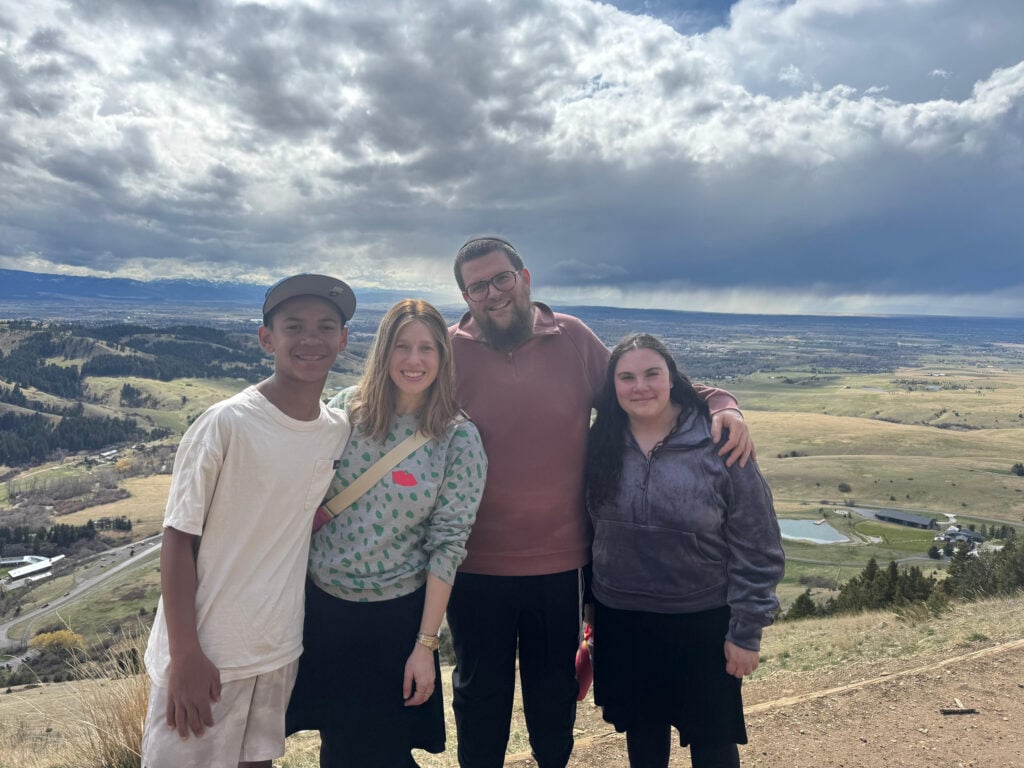
Menny and Chaim saying Shema at the top of the “M.”

Rabbi Chaim catching his breath on a bench on the way up.
What is the role of a Chabad shliach? The answer is complex because it varies from place to place. College campuses are different than the “Smile on Seniors” program, which is different from a Chabad house in a tourist location, which is different than a shliach on the mitzvah tank. What we all have in common is a desire to fulfill the Rebbe, zt’l’s mission to bring Mashiach by helping Jews while spreading the teachings of Chassidus, the Baal Shem Tov, and the Chabad Rebbes, and of course, encouraging Jews to do mitzvos. Many mitzvos.
Yet occasionally people show up at a Chabad center with unrealistic demands coated in doses of guilt and expectations that are wrong and at times, frankly weird. Imagine I was a Chabad shliach on the tiny Dutch island of Aruba way out in the Caribbean Sea and someone called me on vacation saying, “I need a bodek shatnez, do you have one?” Naturally, I would say, “Sorry, but no, we don’t have one.” Instead of internalizing the message that the tiny island of Aruba was not likely to have a full-time shatnez checker, imagine if the visitor continued to call me, asking if maybe I could “find someone” to check for shatnez, saying things like, “What am I supposed to do now? I have a suit for Pesach that wasn’t checked.”
I recently saw that the Satmar Rebbe Aron Teitelbaum fulfilled the mitzvah of pidyon peter chamor. What is pidyon peter chamor? From birth until it is redeemed, a firstborn donkey is holy, on a similar level to an animal designated as a Temple korban. Hence, you may not ride it or give it a burden to carry; it is even forbidden to use the donkey’s hair. The owner must take a sheep or goat, make the special berachah, and state that he is redeeming the donkey in exchange for the lamb, kid, or other item of value. Afterward, the sheep or goat is given to the Kohen. Once the donkey is redeemed, both it and the item it was exchanged for lose all holiness, and the respective owners can do with them as they please.
Imagine if you arrived in Geneva because you’re skiing at Chamonix. As you land you call Rabbi Pevzner, the shliach in Geneva, and ask him if he has a donkey and goat for you to purchase so that you can fulfill this mitzvah you’ve always wanted to fulfill. He’d rightfully think you’d lost your mind. We all want to fulfill the mitzvah of Ahavas Yisrael, but it’s not a spiritual concierge service one can call up like room service. We must actively practice Ahavas Yisrael; we don’t summon it on demand like a luxury spa service.
This week’s double parashah, Acharei-Kedoshim, has the most vital mitzvah of Judaism, which is “V’ahavta lereiacha kamocha—to love your fellow as yourself.” We live and breathe this every day from inspiring locals to put on tefillin, to come for a Shabbos meal, to attend shiurim, and we also deal with more difficult matters, like helping college students who are depressed and sometimes suicidal, hosting visitors who are in town for business conferences or to visit Yellowstone National Park, and we do it all with joy because we believe it wholeheartedly. Yet certain Jews don’t get it and when they land in town, they think it’s my job to drop what I’m doing and fill whatever void they are seeking to fill.
Case in point: on Sunday before Pesach, a beautiful group of Jews travelled to ski in my neighborhood. They needed 2-3 people to complete their minyan. I live a three-hour roundtrip drive from the resort. Those four days prior to yom tov, I put in 15-16 hour days delivering matzah to fellow Jews, helping Chavie in her massive prep for the Sedarim and yom tov meals, while also fulfilling the mitzvos of mechiras chometz, biur chometz, cleaning the house, the car, and keeping an eye on the mikvah project, which is wrapping up: all the regular things a Jew deals with before Pesach, but also cleaning the shul, covering all the counters, shlepping fruits and vegetables from Albertson’s, etc.
I politely told the group that there was no way I could make the round trip. I don’t have a weekday minyan as it is, so despite my happiness at having a minyan, I just couldn’t do it. I offered for them to come to Bozeman where we would have no issues making a minyan because I and others could join. They didn’t want to make the drive. They wanted me to make the drive. For me, getting Jews to have matzah for their biblical obligation on Pesach is light-years ahead of the obligation to daven with a minyan. I did try to help find and pay some local Yidden to drive up and help them, but none of my candidates were available, even for pay. However, the group did not relent. I must have spent three hours on the Sunday before Pesach dealing with their request and attempting to help them. It didn’t feel good for me. It felt very off. In fact, I felt “used.”
Yes, my Chabad center needs financial support to keep going and I am so grateful to all the Jews that support our vital work for Klal Yisrael, but I am not your vacation “schmatte.” I didn’t ask you to come on vacation. I don’t go to Monsey and demand that you provide me with my religious needs. Don’t try to guilt me on a matter where guilt is not required. I would have felt much more guilt had I given up the chance to deliver matzah to my local Yidden, denying their souls the lechem oni that the Zohar says is the “bread of faith and healing.” Their behavior and attitude didn’t leave a good taste in my mouth.
Last Sunday, while Chana Laya and Zeesy were spending time with friends, Chavie and I were busy with bar mitzvah prep, but Menny was “bored,” so I said, “Menny, why don’t we hike the M?” The M is a popular Bozeman hike where you hike up to about 6,000 feet with a 750-foot elevation. So, Chaya, Menny, and I hiked the M and enjoyed the views, the silent nature, and even a 15–20-minute downpour along the way. When we got to the top, Menny (who had brought his tefillin) laid his tefillin and publicly recited the Shema.
Imagine if, when I’d reach the top, I had called the local shul and told them I had reached the top of the M and needed a pair of tefillin so please bring one. It sounds crazy right? So, please remember that Chabad shluchim and shluchos are parents, spouses, grandparents, and caring shepherds of their community and will do as much as they’re able to support you, but are not your personal “concierge.” While 99% of the visitors to our Chabad center are kind, wonderful, grateful, understanding, and a blessing to host at our Shabbos meals, once in a while someone shows up who has a misguided understanding of our work and of how we view Ahavas Yisrael, so I’m forced to educate them. I have amazing friends in almost every Jewish community and those friendships all started around my Shabbos table in Bozeman, so my comments are directed to the one percent.
One more thing: I am not writing this out of anger or hurt. Baruch Hashem, I’m not angry or hurt and don’t think the pre-Pesach visitors were malicious, but just because people aren’t malicious doesn’t mean that they aren’t out of line. I’m writing this for my brothers and sisters in arms, fellow shluchim and shluchos who encounter such realities too, and if I could help one reader be more understanding, more considerate, and gentler, that’s a win for everyone. And for the 99% of visitors, we look forward to hosting you in Bozeman during this epic summer of 2026. L’chaim. n
Rabbi Chaim Bruk is co-CEO of Chabad Lubavitch of Montana and spiritual leader of The Shul of Bozeman. For comments or to partner in our holy work, e-mail [email protected] or visit JewishMontana.com/Donate.