
Musings Of A Shliach From Montana

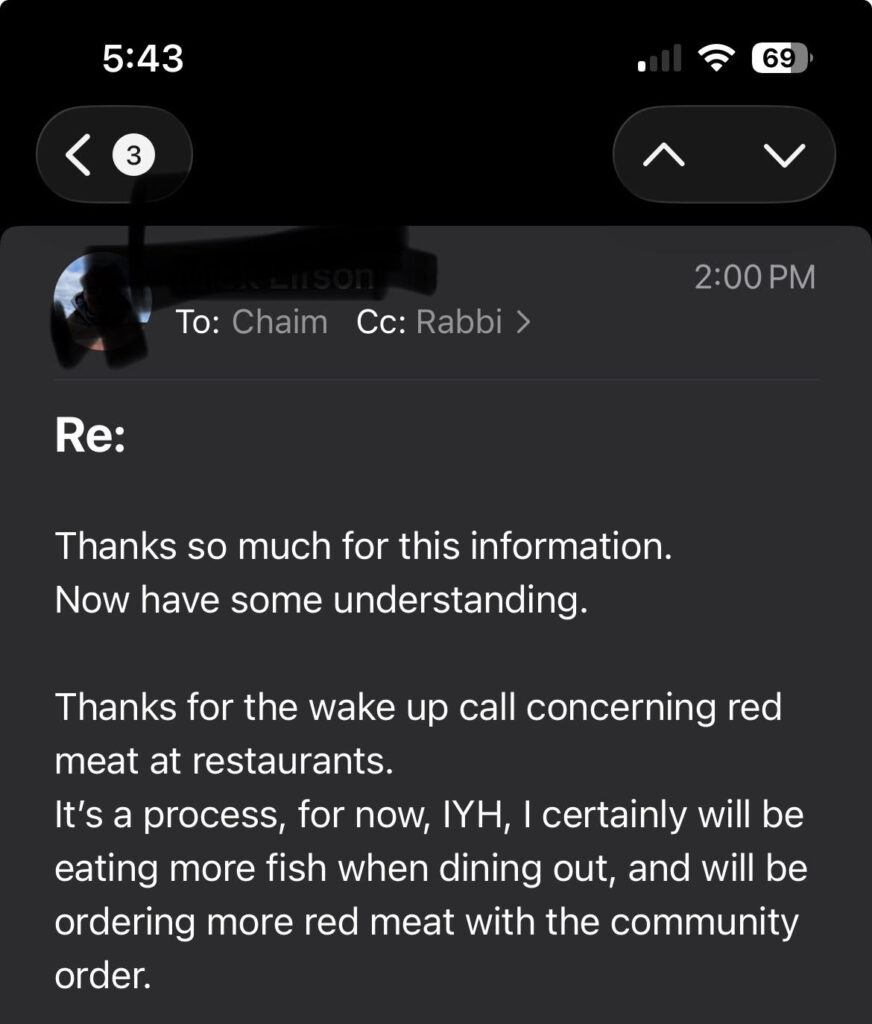
The email from a Jewish doctor about kosher meat
There’s busy and then there’s busy. Ever since Pesach, there’s been non-stop activity at our Chabad Center, so with the help of Chavie’s sister Brocha and her husband Rabbi Mendel, who held down the fort in Bozeman, we escaped last Sunday for three nights in Los Angeles for a much-needed vacation. It’s something we don’t do very often, and it was truly amazing.
After two short flights, we were in Los Angeles and enjoyed strolling along the Venice Canal, walking along Rodeo Drive, reading (something we both love), and enjoying the beautiful sounds of silence. Of course we dined at some great eateries. There was Bella’s for breakfast, Mr. Sandwich, and our beloved Lenny’s Casita for lunch, plus there’s a new place called L’Carve, and if you’re ever in Los Angeles you have to check this place out. The food at L’Carve is mouthwatering, the service is five-star, and I would go back to Los Angeles anytime just to enjoy a meal there.
While away, my friend Rabbi Avrohom Harris, who is a mohel from Seattle, performed a circumcision on a non-Jewish baby only to find out the baby was indeed Jewish and asked me if I wanted to join the simcha. Here’s the back story: about two months ago a local woman named Sarah asked me who we use for a mohel in Montana, so I told her that there’s a fellow in Seattle that flies to Montana a few times a year to circumcise non-Jewish babies and I gave her Reb Avrohom’s number. Sarah isn’t Jewish. but her husband is, though his Jewish parents joined a different faith some fifty years ago. I assumed that Sarah was asking about a non-Jew friend except…she wasn’t. Her sister-in-law, who is Jewish, has a daughter who gave birth to a boy, and that is who Rabbi Harris was circumcising. So, without planning for it or knowing Hashem’s plan, a Jewish baby entered into the covenant of Avraham Avinu. Later, Reb Avrohom Harris sent me a picture of four generations: the Jewish Zayde, his daughter, granddaughter, and great-grandson. Hashem works in mysterious ways!
They still have a long journey to return to Yiddishkeit. The parents were hippies who changed religions in the 50s or 60s before there were shluchim to shine the light of Yiddishkeit in their lives. But I believe the change will come and it will come strong, how could it not? The neshamah is on fire. I don’t know when and I’m not holding my breath, but I know from past experience that the mitzvos will bring them back home. We need to be able to look past the avodah zarah, past the kefirah, past the emunah issues, and see a neshamah that’s desperately trying to come home. When halacha talks about a tinok shenishbah, a Jew who was taken captive as a child and knows nothing about his faith, I believe it’s referring to many of the souls we are dealing with today who just need a dose of Jewish love, light, and education to get a course correction.
In our parashah, Shelach, we read about Moshe sending the Meraglim, the spies, to scout out Eretz Yisrael. The verse says, “Send agents to scout the land of Canaan, which I am giving to the Israelite people; send someone from each of their ancestral tribes, each one a chieftain among them.” The Hebrew word for “agents” used in the verse is “Anashim,” which means “men.” The Kli Yakar fascinatingly explains that “Anashim” is specific. Here are his words: “According to what our sages said (Yalkut Shimoni, Pinchas 773:27), the men hated the land and said, ‘Let us appoint a leader and return to Egypt’ (Numbers 14:4), while the women loved the land and said, ‘Give us a possession’ (Numbers 27:4). Therefore, the Holy One, Blessed be He, said: ‘According to My view, seeing into the future, it would have been better to send women who cherish the land, for they would not speak negatively about it. But for you, according to your understanding, as you believe these men are worthy and you think they cherish the land, send men.’” This is the meaning of “send for yourself” (lecha), according to your judgement, men. But according to My judgment, it would have been better to send women, as mentioned.”
Hashem wanted the women to go as scouts because He knew they would have the ability to see through the externalities, the façade, and see the holiness and beauty of the land for what it truly is. The Kli Yakar’s idea fits well with the Midrash that says later in parashas Pinchas in the context of the daughters of Tzelafchad: “The women would repair what the men would breach, as you find that Aaron said to them: ‘Remove the gold rings that are in the ears of your wives (Exodus 32:2).’ But the women were not willing, and they reprimanded their husbands, as it is stated: “All the people removed the gold rings which were in their ears…” (Exodus 32:3), but the women did not participate with them in the act of the golden calf. Likewise with the spies who disseminated slander: “They returned and caused the entire congregation to complain against him, to disseminate slander about the land (Numbers 14:36).” The edict was decreed against them, as they said: “We will not be able to ascend (Numbers 13:31).” But the women were not a party with them to that counsel, as previously written in the parashah: “No man was left of them, except Caleb son of Yefune and Joshua son of Nun (Numbers 26:65).” In this case, it says “man” but not woman, because the men did not wish to enter the land, but the women approached to seek an inheritance in the land. This is why this portion is written adjacent to the death of the generation of the wilderness, as it was there that the men breached and the women repaired.”
The Midrash is saying that the women of that generation did merit to enter Israel and only the men died in the desert. The women of those days and today can see the core, the essence, and thus ignore the outer layers. Living life with a “Tiffen Kook” as we say in Yiddish, a deeper perspective, is very much how the Rebbe, zt’l,saw the world, saw humanity, and when we operate that way, our lives are in sync with Hashem’s view of His Creation. Though it is easier to see everything superficially; it is much healthier when we see the inner core and essence.
Last Shabbos officially commenced summer tourist season. We hosted a couple from Florida, a couple from Highland Park, a couple from Lawrence, a couple from Beit Shemesh, a father and daughter from Cleveland, and two young women who grow up in Lakewood and now live in Tel Aviv and New York. It’s such a wonderful thing that Chavie and I have going, getting to meet and know Jews from all over the world and learning about their stories because everyone has a story and people are fascinating. When they are calling and emailing, it’s hard to know who they are and what’s actually going to show up, but once we welcome them into our home and shul, it changes everything and it fills my bucket with genuine love for Klal Yisrael.
While sitting at the Shabbos table on Friday night, a local doctor who we’ve known for eighteen years, was talking about his recent fishing trip and said something so beautiful: “Rabbi, after your recent sermon about non-kosher meat, I decided that on this trip, I would refrain from eating out, so instead I asked my fishing guide to help me prepare the fish I caught and I ate kosher fish instead of treif meat.” It was so inspiring. He then proceeded to ask why the blood of a fish is kosher to consume, unlike mammals and birds, whose blood is prohibited and considered abominable. It was a great question for which I didn’t have an answer, so I researched it and responded to him on Sunday.
Here’s the gist of the mystical answer that I shared, and it has to do with why fish don’t need koshershechita and on some level explains why the blood of fish isn’t problematic.
The Arizal HaKadosh, Rabbi Isaac Luria (1534–1572) taught that every creation has a “nitzutz,” a spark of divine energy that constitutes its essence and soul. When a person uses something toward a holy end, he or she releases this divine spark, actualizing the purpose for which it was created. Thus, one who makes a berachahand eats food, then uses the energy from the food to perform a mitzvah, it elevates the spark of divinity that is the essence of the food. Yet, some divine sparks are harder to get to than others. Because cattle were created from the coarse earth, they require more preparation to be elevated and must be slaughtered according to Jewish ritual. Fish, on the other hand, were created from the more refined element of water. Therefore, merely drawing them out of the water suffices, and all one needs to do to elevate the holy spark in fish is to make a blessing, and then use the energy from what you have eaten for a holy pursuit.
When I sent this explanation to the doctor via email, he responded with this: “Thanks for the wake-up call concerning red meat at restaurants. It’s a process for now. Iy’H, I will certainly be eating more fish when dining out and will be ordering more red meat with the community kosher order.” Wow!
Beneath the surface rages a fire of holiness, a high-level of kedushah, but we need to be able to hang tight until we see it and get there.
This idea fits with a beautiful teaching I read in Talelei Oros quoting the holy Kotzker Rebbe, who says that the Meraglim didn’t lie, but they also didn’t tell the whole truth and therein lies a deep lesson. It’s key because not everyone who isn’t lying is telling the whole truth. They are not the same. When the spies said that they saw many funerals in Israel, they were implying that most of the inhabitants could not survive there. With this, they created fear around entering the land. The spies weren’t lying because that is indeed what they saw, but saying the whole truth requires looking deeper, searching for the truth, and not stopping until we understand what actually happened. Had the spies wanted to glean the whole truth, they would have tried to find out why there were so many funerals there and realized that Hashem was keeping the locals busy with funerals to distract them from focusing on the spies. Yehoshua and Kalev could see through the externalities, but the others were preoccupied with their agenda to notice the truth.
The bottom line is that we should act like the women: trusting in Hashem and knowing that He has a plan and only see the good reality beneath the shallow surface.
Rabbi Chaim Bruk is co-CEO of Chabad Lubavitch of Montana and spiritual leader of The Shul of Bozeman. For comments or to partner in our holy work, e-mail [email protected] or visit JewishMontana.com/Donate.