




My Tefillin Adventure
By: Larry Gordon
One of the temporary casualties of my mostly unusable right arm is how to get my tefillin on my left arm while in shul each morning.
As I mentioned last week, I missed a step in a relative’s house and suffered a hairline fracture of the humerus bone, which is located between the elbow and the shoulder. On the X-ray it doesn’t look like much, but our bones seem to prefer being whole without any unnecessary cracks and separations.
According to my orthopedist, the damage will require six weeks to heal. That’s a long stretch. So, for the first time in my life, I wear a sling most of the day and sometimes at night. The immobility of my arm keeps it comfortable since the lack of movement seems to be facilitating the bone healing process.
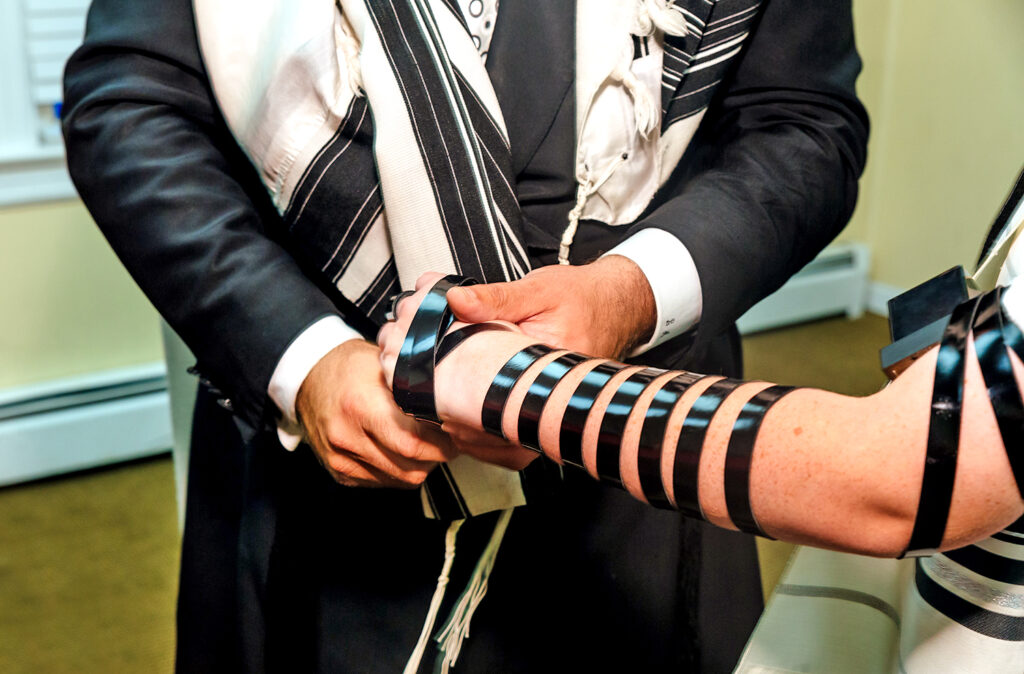
While I don’t do pushups (which I haven’t done in decades anyway), the most challenging movement of the day is getting my tefillin on in the morning. In fact, the other day a couple of neighbors were assisting me in putting on my tallis and tefillin in shul when it occurred to me that I don’t think I’m ever going to look at those tefillin stands on our streets the same way ever again.
Every part of this process that was so basic to my normal daily routine has now been broken down, so to speak, into smaller pieces, a little like my arm.
First, there’s the matter of my tallis. At first, I just threw it over my head, wrapped it around my shoulders, and made the appropriate berachah. The first time my new assistants threw the tallis over my head I instinctively wanted to reach for it, but that required raising my arms, which is just too painful.
After the first day, I told them to bypass putting the tallis over my head and just place it on my shoulders, and with that I would make the berachah on the tallis.
Then we got to putting the tefillin on, which is much more intricate than the tallis since putting the tefillinfirst on the arm and then on the head requires quite a bit of complex movements, which we ordinarily do not think twice about.
But when your arm is injured and the pain is awful anytime you move it without the help of your friends, the whole procedure for putting on your tefillin becomes quite a challenge.
As long as I was home, one of my sons would come over to the house to help me get the tallis and tefillinon. Once I made the move to recuperate in Boynton Beach, the only way to proceed was to go to shul where I was sure that at least a few people would volunteer to assist.
One of the things you discover in a situation like this is all the various ways mostly likeminded people put their tefillin on. Almost every person who helped me out this week had a nuanced difference in how they put their tefillin on.
In fact, on that first day in shul down in Boynton, as one of the good folks was helping me put on my tefillin, the first thought that occurred to me was: What is this guy doing? That’s not how I put on tefillin!
I’ve been around enough, and I know that there are a variety of ways to put on tefillin. The idea is that the straps and the knots spell the letters shin, daled, and yud. In my case, the Chabad style has the shin on the upper arm, the daled on the knot behind the head of the shel rosh, and then the yud on the fingers that have the strap rolled around it.
But other people have other ways of achieving the same objective.
One very amicable neighbor, Heshy, created two shins on my upper arm. After he was done and when davening was over, I looked down to see those two shins and couldn’t help but ask what that was about.
Everything else was pretty much the same and he told me that this was the Skver Chassidic custom of donning tefillin. Of course, I had never seen that one before, and how could I since no one has ever put tefillinon me before except me?
I was thinking that going forward, I’m going to look differently at those young men at those tefillin tables who approach people and ask them whether or not they had put on tefillin that day. One thing I know for sure now is that it’s not easy putting tefillin on someone other than yourself.
While there are more than several minhagim on how to put on tefillin, there is just one way that I’ve worn tefillin, and every other way seemed a bit strange or off to me. Even placing the shel rosh on one’s head seems a little strange, especially when considering that all of us have pretty much the same kind of head, especially on the outside more or less.
The additional odd thing here is that while this is a Chabad shul where I daven in Boynton Beach, there are probably very few people who put their tefillin on according to the Chabad minhag. Sure, there are a few aside from the rabbi, Sholom Ciment, who I thought about asking until I realized that Max was in shul and he, like me, always put on his tefillin Chabad-style.
So, there was an automatic connection there, though when it comes to my tallis, since there is no decorative crown, so to speak, each time it takes him about a minute to figure out where the top of the tallis that goes over the head is located.
And while I wind the straps of the tefillin one way, some people wind their tefillin straps in the opposite direction. It’s been almost three weeks since I fractured that bone in my arm and baruch Hashem, I’m able to move the arm with less pain than I had those first ten days.
What can I say other than one needs to be thankful for the little things they are able to do. Another thing we do is just recite one berachah on the tefillin, but then again, some recite two each time. That is, one on the shel yad and one on the shel rosh. A few times when one of those very generous men would place the tefillin on my head, they would whisper to me, “Say the berachah.” I wasn’t going to start explaining anything, so I just made the berachah.
I wish to extend my enormous gratitude to everyone out there who helped me. Yashar koach.
Read more of Larry Gordon’s articles at 5TJT.com. Follow 5 Towns Jewish Times on Facebook, Instagram, and Twitter for updates and live videos. Comments, questions, and suggestions are welcome at 5TJT.com and on Facebook, Instagram, and Twitter.