


The Ballad Of East And West
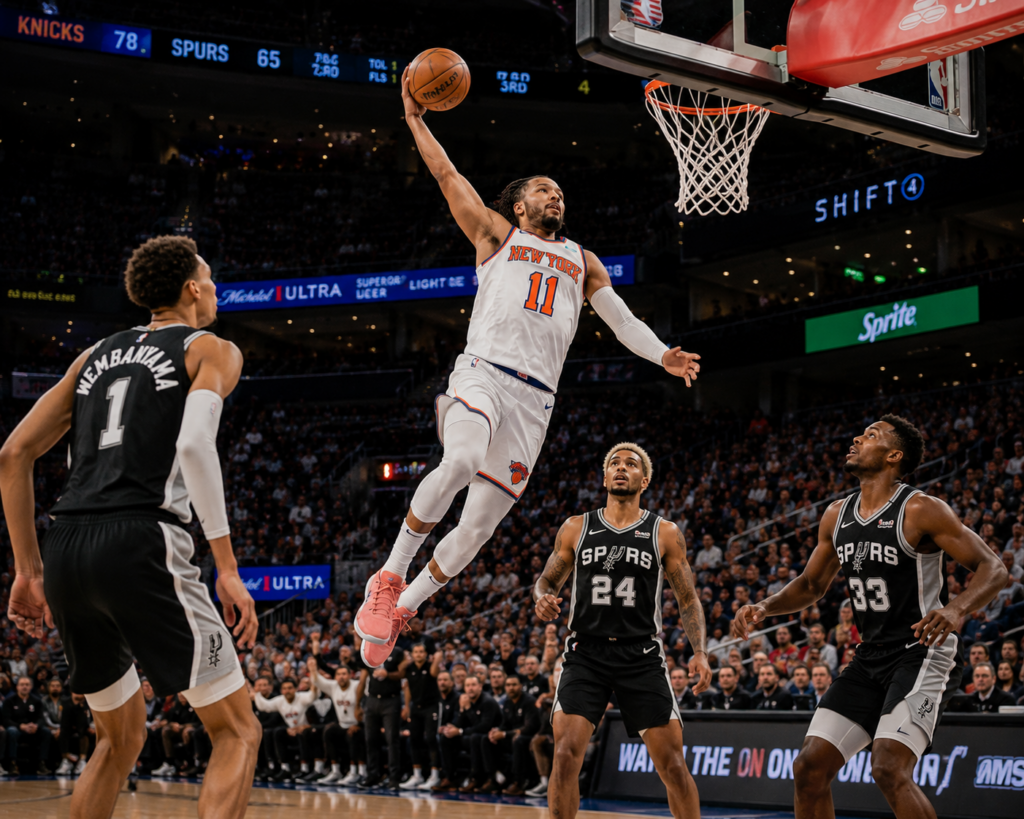
Illustration generated with artificial intelligence
By Yochanan Gordon
The Ballad of East and West was not written by me, but by Rudyard Kipling. It’s probably a good thing Kipling isn’t around today because if he were, I might have some copyright issues to contend with.
This article is not really about Kipling’s poem. Rather, it borrows the title of his poem to shed light on the rivalry between the Knicks and Spurs that has captured the attention of basketball fans as the NBA Finals get underway.
I was hesitant to write about basketball again. I know that sports fandom can amount to a tremendous waste of time—or at least that’s what my rebbeim in yeshiva would likely have told me had I asked them. Shlomo HaMelech says something similar when he describes this world as hevel havalim—vanity of vanities.
Yet, as anyone who read my article last week, “Learning From Jalen Brunson,” already knows, this is not really about basketball. It is about finding sparks of meaning within the mundane.
The Alter Rebbe, Rabbi Schneur Zalman of Liadi, would often say that a Jew must “live with the times,” meaning with the weekly parashah. I would take that one step further and suggest that everything that occurs within a given week can somehow be traced back to the parashah being read that week.
So if an NBA Finals has managed to capture the attention of a large swath of Jews living in the largest Jewish city outside the Land of Israel, perhaps instead of accusing tens of thousands of Jews of bittul zman, we ought to dig a little deeper and ask what this East–West rivalry really represents.
The verse states: “V’zarach hashemesh u’va hashemesh”—the sun rises and the sun sets. It took me a few tries to pass Earth Science, but I eventually did, and I know that the sun rises in the east and sets in the west.
Sunrise is akin to Torah. Sunset corresponds to tefillah.
Torah is associated with light—Torah Ohr. Tefillah emerges specifically from darkness and longing. The verse states: “L’hagid baboker chasdecha v’emunasecha baleilos”—to tell of Your kindness in the morning and Your faithfulness in the nights.
Chazal explain that emunah corresponds to Seder Zeraim, and the first tractate of Seder Zeraim is Berachos, which deals primarily with prayer. It is therefore fitting that Maseches Berachos begins not with the morning Shema but with Krias Shema at night, because tefillah is born from yearning, absence, and concealment.
The Gemara relates that when Rava observed Rav Hamnuna extending his prayers, he remarked: “Are you setting aside eternal life for temporal life?”
Torah is called eternal life, as the verse says: “Ki heim chayeinu v’orech yameinu.” Rav Hamnuna, in Rava’s view, was allowing prayer to encroach upon the time available for Torah study.
The Talmud goes even further.
Rabbi Shimon bar Yochai belonged to the category of individuals described as Toraso Umnaso—those for whom Torah was their primary occupation. The Gemara rules that such individuals interrupt their learning for Krias Shema but are exempt from prayer.
One of my favorite Chassidic stories concerns the Alter Rebbe’s deliberation over whether to travel to Vilna to study under the Vilna Gaon or to Mezritch to study under the Maggid of Mezritch.
The Alter Rebbe concluded, “In Vilna they teach one how to learn, and that I already know somewhat. In Mezritch they teach one how to daven.”
What always struck me about this story is how much longer the Alter Rebbe’s answer is than necessary. He could have simply said, “I know how to learn, but I don’t know how to daven.”
Perhaps what he meant was something deeper.
I know how to learn Torah. What I do not yet know is how to transform Torah into prayer.
In the revealed dimension of Torah, the times for learning and the times for prayer are separate and distinct. As Kipling famously wrote:
“Oh, East is East, and West is West, and never the twain shall meet.”
Torah and tefillah appear to occupy opposite poles of spiritual life.
Yet on a deeper level they become one.
The level of Toraso Umnaso is not merely a level where Torah takes precedence over prayer. It is a level where Torah itself becomes prayer. There is no need to interrupt one for the other because they have merged into a single avodah.
When the Jewish people stood trapped at the Yam Suf and cried out to Hashem, Rashi comments that they “grabbed hold of the craft (umnus) of their forefathers.”
The word umnus is striking. It is the very same root found in the expression Toraso Umnaso.
The craft of the Jewish people is prayer. The craft of Rabbi Shimon bar Yochai is Torah. At the deepest level these are not two crafts but one.
East and West meet.
In our analogy, New York represents the East—Torah. San Antonio represents the West—tefillah.
The ultimate victory is not East over West or West over East. The ultimate victory is the union of the two.
This idea occupies a central place in the teachings of Breslov, where one of the great spiritual goals is to transform Torah into tefillah. Torah that remains intellectual has not yet completed its journey. It must eventually become prayer, longing, and conversation with Hashem.
It is easy to get swept away by the drama of the NBA Finals. Some people treat it as a holiday unto itself. Others wager money on games and become emotionally invested in outcomes over which they have no control.
But if viewed through the proper lens, everything in this world contains sparks of Divine meaning.
The letters of Divine speech continuously sustain all existence, bringing something from nothing at every moment. Our eyes see physical reality, but beneath that reality lies a deeper truth connecting every event to its spiritual source.
The Ballad of East and West is ultimately not about geography.
It is about Torah and tefillah.
It is about sunrise and sunset.
It is about light and longing.
At first, they appear to stand at opposite ends of the spiritual spectrum. Yet on the deepest level they are one. The highest Torah becomes prayer, and the deepest prayer becomes Torah.
East and West meet after all.
And if we look carefully enough, even the NBA Finals can remind us of that.
Go New York. Go New York. Go.
Yochanan Gordon can be reached at [email protected]. Read more of Yochanan’s articles at 5TJT.com.