
The Chronicle of the Khmelnitsky Massacres of 1648-49: Rabbi Nosson of Hanover’s Yavein Metzulah
Rabbi Nosson of Hanover was born around 1620 in Ostroh, Ukraine to parents that emigrated from Hanover, Germany at the turn of the 17th century. At the time, Ostroh, in addition to being a center of commerce, had a large and prosperous Jewish community with a prominent yeshiva. During Rabbi Nosson’s early years, the yeshiva was still under the leadership of the famed Maharsha (Rabbi Shmuel Eidels), who passed away in 1631. In addition to studying the Talmud and its commentaries, Rabbi Nosson of Hanover became intrigued by the study of Kabbalah and affiliated himself with the circle of Kabbalists in Ostroh.
The Khmelnitsky Massacres
Rabbi Nosson married the daughter of Rabbi Avraham of Zaslaw and settled there after his marriage. When the Khmelnitsky Massacres began in 1648, most of the Jews of Zaslaw were slaughtered, but Rabbi Nosson managed to flee, although the details of his escape are unknown.
In Italy
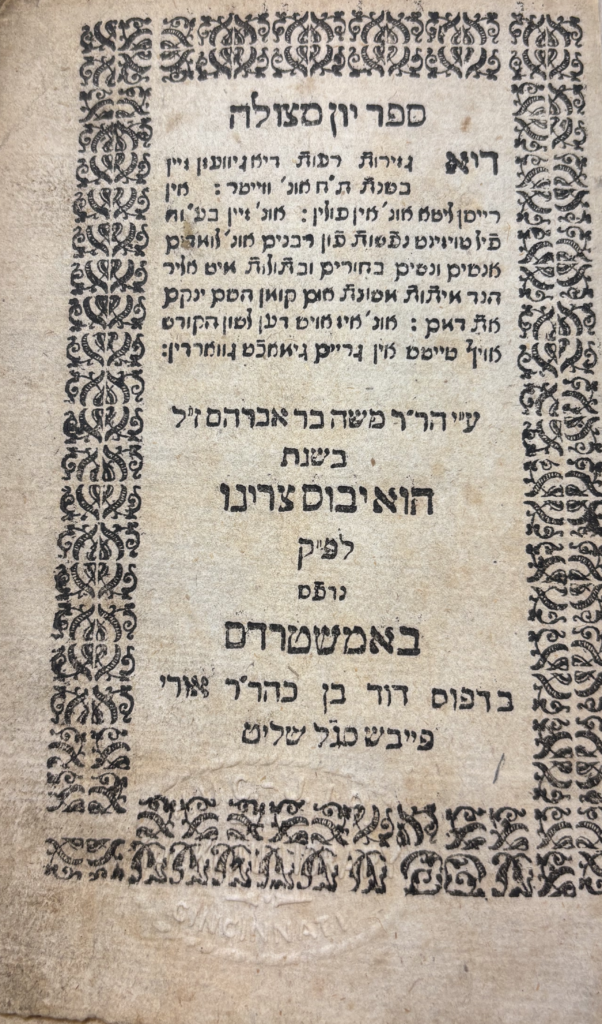
Rabbi Nosson fled west and after spending time in Germany and Holland, settled in Italy. In 1652, Rabbi Nosson published his Yavein Metzulah in Venice and a year later he was appointed as rabbi of Livorno. In Livorno, Rabbi Nosson spent time studying in the private beis midrash funded by a physician named David Valensin and developed a relationship with Rabbi Chayim ha-Kohen of Aleppo, a student of the great Kabbalist Rabbi Chayim Vital. After some time, Rabbi Nosson returned to Venice where he studied Kabbalah with the great Italian Kabbalists of that time, including the preeminent sage, Rabbi Moshe Zacuto (Ramaz).
Rabbi Nosson subsequently moved to Wallachia (in modern-day Romania) and then to Ungarisch-Brod in Moravia (eastern modern-day Czech Republic). Although Rabbi Nosson survived the Khmelnitsky Massacres, he was murdered during the Great Turkish War of 1683 when Turkish soldiers raided Ungarisch-Brod and killed many of its residents.
Rabbi Nosson’s Writings
Yavein Metzulah is the most important chronicle depicting the catastrophic events of the Khmelnitsky Massacres, also known as Tach v’Tat. Yavein Metzulah’s prominence is evidenced by the numerous times it was printed and the fact that it was translated into several different languages, including French, German, Polish, Russian, Yiddish, and English.
Safah Berurah, a dictionary in four languages: Hebrew, German, Italian, and Latin intended to help refugees like himself.
Shaarei Tzion, an anthology of tefillos.
Neta Sha’ashuim, a collection of sermons that Rabbi Nosson delivered during his career as a rabbi and darshan.
In addition, Rabbi Nosson of Hanover authored several works on Kabbalah which have not been published.
Nosson Wiggins (@jewishhistorysheimhagedolim) is the author of two books on the subject of Jewish history, “The Tannaim & Amoraim” and “The Rishonim” (Judaica Press). He researches Jewish History at the Klau Library, HUC-JIR in his hometown of Cincinnati and leads tours of Klau’s Rare Book Room. He is a passionate enthusiast of Jewish history and when he’s not in the hospital working as a nurse, he can be found researching and writing posts for his Substack, “Jewish History—Sheim Hagedolim.”