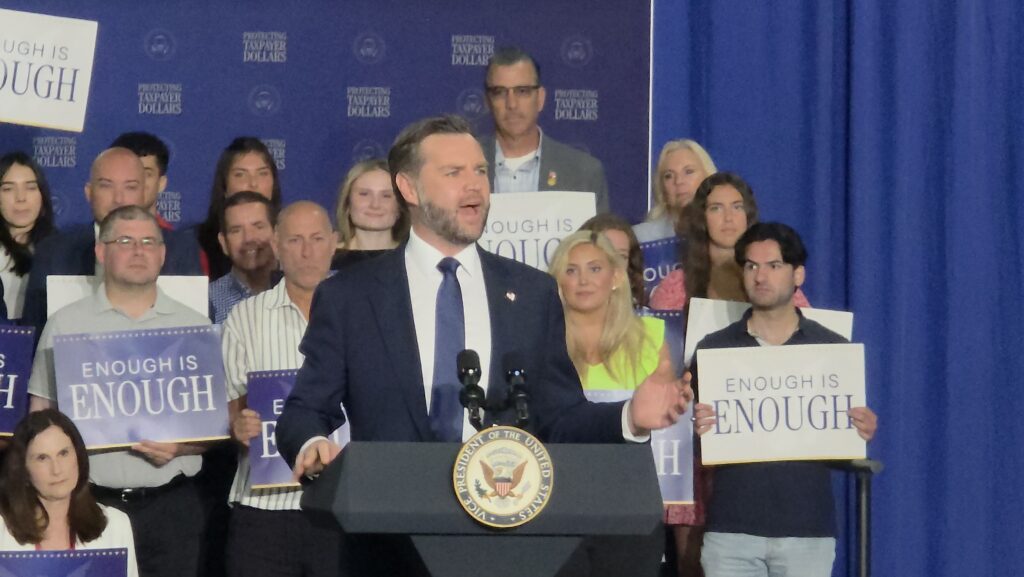

WHAT IS J.D. VANCE’S PROBLEM?
By: Larry Gordon
Why Is Israel Being Blamed for the Republican Party’s Election Defeat?
There are approximately 200 countries in the world. Some are enormous, with populations exceeding a billion people. Others possess vast natural resources, powerful economies, and military establishments that project their influence across continents.
And then there is Israel.
A tiny sliver of land along the eastern Mediterranean, with a population of approximately 10 million people, smaller than that of New Jersey and only slightly larger than New York City.
Yet somehow, in the aftermath of Tuesday’s election results, the Vice President of the United States, J.D. Vance, has identified America’s relationship with this small Jewish country as one of the major issues Republicans need to address.
Really?
Of all the challenges confronting the United States—rising living expenses, housing costs, inflation, taxes, healthcare, immigration, and an increasingly complicated international situation—our relationship with Israel has somehow emerged as one of the principal explanations for Republican electoral losses.
That is an extraordinary proposition, and one that deserves considerably more examination than it has received.
The Vice President reportedly pointed to polling of former Trump voters identifying several priorities, including ending the war, addressing inflation, putting America first, and changing America’s relationship with Israel.
The precise wording, methodology, and context of that polling need to be established before anyone can responsibly conclude that Israel was a significant factor in Tuesday’s election.
But even accepting the Vice President’s characterization, there is a fundamental question that needs to be asked.
What exactly is J.D. Vance’s problem with Israel?
And perhaps more importantly, what does he believe changing America’s relationship with Israel would accomplish?
Would it lower the price of gasoline? Reduce grocery bills? Make housing more affordable? Improve healthcare? Reduce the federal deficit?
Or is something else going on here?
I have been examining the extent of America’s military commitments around the world, particularly the number of American troops stationed in foreign countries and the billions of dollars spent maintaining those deployments.
The figures are fascinating.
The United States maintains approximately 54,000 military personnel in Japan, 35,000 in Germany, and 24,000 in South Korea. Thousands more are stationed in Italy, Great Britain, Bahrain, Kuwait, Qatar, Poland, Spain, and numerous other countries.
Consider Germany.
World War II ended more than 80 years ago. Yet the United States continues to maintain a substantial military presence there, at a reported annual cost of approximately $8.5 billion.
Why?
The explanation is that Germany serves as a major American military headquarters and logistical center for operations throughout Europe, Africa, and the Middle East. It is an important component of NATO and America’s broader strategic posture.
Fair enough.
But Germany is also one of the wealthiest countries in the world. It is hardly a helpless nation incapable of providing for its own defense.
Japan, another prosperous country, hosts tens of thousands of American military personnel at a reported annual American expenditure of approximately $5.7 billion.
South Korea, with its advanced economy and formidable military establishment, accounts for another approximately $4.3 billion.
These figures represent particular categories of American overseas military spending, not necessarily the complete cost of every operation associated with those countries. Host governments also contribute to the expense of maintaining American forces.
Nevertheless, the scale of America’s international military commitments is unmistakable.
Across ten major host countries, the Pentagon figures we examined indicated approximately $24 billion in annual expenditures.
And then there is Israel.
The corresponding figure cited for American military personnel and facilities in Israel was approximately $17.8 million in fiscal year 2025.
Million, not billion.
There is, of course, an important distinction here. Israel receives approximately $3.8 billion annually in regular American military assistance under the longstanding bilateral arrangement, including funding for missile defense. Additional emergency assistance and wartime expenditures are separate matters.
Much of that assistance is spent purchasing American military equipment, supporting American manufacturers and defense-related employment.
But there is something fundamentally different about the American relationship with Israel.
Israel fights its own wars.
Israel does not depend on 35,000 or 50,000 permanently stationed American combat troops to defend its borders.
It has built one of the most effective military establishments in the world, developed extraordinary intelligence capabilities, and pioneered technologies that benefit not only its own defense but also America’s national security.
Israel has demonstrated repeatedly that it is prepared to defend itself, even under circumstances that would overwhelm countries many times its size.
The United States benefits from Israeli intelligence, military technology, missile defense cooperation, and a regional ally capable of confronting forces hostile to American interests.
None of this means that American assistance to Israel should be exempt from examination. Every dollar spent by the federal government deserves scrutiny.
But shouldn’t that scrutiny be applied consistently?
If America’s military relationship with Israel requires fundamental reconsideration, why isn’t the same argument being made about Germany, Japan, South Korea, or the wealthy Persian Gulf countries that host American military installations?
Why does Israel occupy such an extraordinary place in this discussion?
And what does any of this have to do with the Republican Party losing elections?
I would be particularly interested in seeing the polling data that supposedly establishes a connection between Republican electoral losses and American support for Israel.
Did voters in Arkansas enter their polling places determined to punish Republican candidates because Washington maintains a close relationship with Jerusalem?
Did voters in Texas decide that their principal concern was the amount of military assistance provided to Israel?
Were suburban voters more concerned about Benjamin Netanyahu than their mortgage payments, property taxes, or grocery bills?
I find that difficult to believe.
That doesn’t mean there are no Americans who oppose military assistance to Israel or who believe the United States should reduce its involvement in Middle Eastern affairs.
There certainly are.
And opposition to an American war involving Iran is not necessarily the same thing as opposition to Israel.
That distinction is essential.
An American voter can oppose sending American troops into another foreign conflict while remaining a strong supporter of Israel.
A voter can question the wisdom of a particular military operation without questioning the strategic value of the American-Israeli alliance.
And a voter can believe that Washington should concentrate more heavily on domestic problems without harboring any particular hostility toward the Jewish state.
To combine these different positions into one broad assertion that America’s relationship with Israel helped defeat Republican candidates is intellectually questionable.
It also raises another, more uncomfortable issue.
Throughout history, Jews have repeatedly found themselves blamed for problems they did not create and circumstances over which they exercised little or no control.
In medieval Europe, Jews were accused of responsibility for economic hardship, disease, and financial instability.
During later periods, Jewish communities were portrayed as possessing mysterious influence over governments, banks, and international affairs.
The accusations changed from generation to generation, but the underlying theme remained remarkably consistent.
When something went wrong, somehow the Jews became part of the explanation.
I am not suggesting that J.D. Vance is an antisemite.
That is a serious accusation, and I am not prepared to make it simply because I disagree with his political analysis.
Nor am I suggesting that criticism of Israel is inherently antisemitic. Israel is a sovereign country, and its policies, leaders, and military decisions are legitimate subjects for debate.
But there is a historical pattern that should make us especially attentive when a small Jewish country is assigned a disproportionate role in explaining the problems of a much larger nation.
And that is precisely what troubles me about the Vice President’s remarks.
There is also the matter of Tucker Carlson.
Carlson has become one of the most prominent voices within the conservative movement questioning America’s relationship with Israel.
His criticism frequently centers on the financial and strategic costs of American involvement in the Middle East, along with his opposition to military intervention.
Those are legitimate subjects for discussion.
But Carlson’s repeated focus on Israel, and his willingness to entertain arguments that portray Israel and its American supporters as exercising excessive influence over American foreign policy, raise questions that cannot simply be dismissed.
There is a difference between examining an alliance and developing what appears to be a political obsession with one particular ally.
The former is responsible public policy.
The latter deserves closer examination.
Is J.D. Vance moving in Tucker Carlson’s direction?
Is he attempting to appeal to a growing faction within the Republican Party that regards American support for Israel as an unnecessary burden?
Or does he genuinely believe that the Republican Party’s electoral difficulties can be traced, in meaningful measure, to the American-Israeli relationship?
These are questions, not conclusions.
But they are questions the Vice President should be prepared to answer.
For decades, support for Israel has been a central feature of Republican foreign policy, although that support has never been entirely uniform.
Republican presidents and congressional leaders have generally recognized Israel as a democratic ally in a region where American interests face considerable challenges.
That relationship has survived disagreements between American presidents and Israeli prime ministers, disputes over settlements, negotiations with Arab governments, and conflicting approaches to Iran.
It has endured because both countries have generally concluded that their strategic interests overlap.
That doesn’t mean the relationship is perfect.
No international alliance is.
But if the Vice President believes it needs to change, Americans are entitled to know precisely what he has in mind.
Does he want to eliminate military assistance?
Does he want to reduce intelligence cooperation?
Does he believe America should distance itself diplomatically from Israel?
Does he want Washington to stop supporting Israel in international forums?
Or is he simply suggesting that Israel should no longer occupy the same prominent position in American foreign policy?
Each of these possibilities represents a different policy with different consequences.
The phrase “change our relationship with Israel” may sound appealing to some voters, but without an explanation, it tells us very little.
And that brings us back to the election.
Republicans suffered significant political setbacks on Tuesday. The party now faces the difficult task of determining why voters who supported Donald Trump in the past were unwilling to support Republican candidates this time.
There are numerous possible explanations.
Economic dissatisfaction is certainly one.
The cost of living remains an enormous concern for American families.
Political fatigue, dissatisfaction with individual candidates, disagreements over domestic policies, and opposition to foreign military involvement may also have contributed.
But elections are complicated events.
Voters make decisions for different reasons, and national political trends do not necessarily explain every state and local result.
That is why I would like to see actual evidence demonstrating that America’s relationship with Israel was a significant factor.
How many voters identified Israel as their principal concern?
How many changed their votes because of it?
Were those voters concentrated in particular states or congressional districts?
And did they object specifically to Israel, or were they expressing broader opposition to American military involvement overseas?
Without answers to those questions, we are left with political speculation.
There is another irony here.
Israel, despite its small size, has repeatedly demonstrated the ability to accomplish military and intelligence objectives that much larger nations would find extraordinarily difficult.
Its technological achievements have contributed to American defense capabilities.
Its intelligence services have provided information relevant to threats extending well beyond Israel’s borders.
Its military establishment has confronted terrorist organizations and hostile regional powers that also threaten American interests.
None of that makes Israel indispensable to every American strategic objective. But it certainly means the alliance has value beyond the annual amount Washington provides in military assistance.
If we are going to calculate what Israel costs America, shouldn’t we also calculate what Israel contributes?
And shouldn’t we perform that same calculation for Germany, Japan, South Korea, and every other country where American taxpayers finance a substantial military presence?
That would be a serious discussion.
It might even produce some surprising conclusions.
But singling out Israel as an explanation for Republican electoral defeats, without demonstrating the connection, is something else entirely.
I also wonder whether the Vice President appreciates the historical sensitivity of the language he is using.
For centuries, Jewish communities have had to confront the suggestion that their interests were somehow responsible for the misfortunes of the societies in which they lived.
Today, Israel is an independent nation with its own government, military, and political responsibilities.
It should be judged on its conduct, just as other nations are judged.
But it should not become a convenient explanation for unrelated American political failures.
There are approximately 10 million people living in Israel, including Jews, Muslims, Christians, and others.
The country occupies a territory smaller than many American states.
Its population is a tiny fraction of the world’s population.
Yet somehow, we are being asked to consider whether America’s relationship with this small country belongs near the top of the list of reasons the Republican Party suffered an electoral defeat.
I remain unconvinced.
Perhaps the Vice President has access to polling information that would change my mind.
If so, I would welcome the opportunity to examine it.
Perhaps he has a specific proposal for restructuring America’s relationship with Israel that would demonstrably benefit the American people.
If so, he should explain it.
And perhaps his remarks were intended to address broader American involvement in Middle Eastern conflicts rather than hostility toward Israel itself.
If that is the case, he should clarify the distinction.
Because words matter, particularly when they come from the Vice President of the United States.
And words involving Israel and the Jewish people carry historical implications that responsible political leaders should understand.
The United States has every right to reconsider its foreign commitments.
It has every right to question military expenditures, overseas deployments, and foreign assistance.
It has every right to insist that its alliances serve American national interests.
But those principles should apply to every country, not selectively to the Jewish state.
If Washington wants to examine the billions spent maintaining American troops in Germany, Japan, and South Korea, that would be a worthwhile undertaking.
If it wants to reconsider its military presence in the Persian Gulf, that too is a legitimate discussion.
And if it wants to review the assistance provided to Israel, that should be part of the same comprehensive examination.
But Israel should not be placed in a separate category simply because it is Israel.
Nor should it become a convenient explanation for the Republican Party’s inability to persuade enough Americans to vote for its candidates.
The Republican Party has problems that need to be addressed.
Some are economic. Others are political. Still others involve the direction of the conservative movement and the priorities of its leadership.
Those problems deserve serious attention.
Blaming America’s relationship with Israel, without persuasive evidence, does nothing to solve them.
And it risks introducing an entirely unnecessary and potentially damaging element into an already complicated national debate.
So I return to the question with which we began.
What is J.D. Vance’s problem?
Is it the cost of American foreign commitments?
Is it the war in Iran?
Is it a philosophical objection to American involvement overseas?
Is it an effort to accommodate the Tucker Carlson wing of the Republican Party?
Or is there something about America’s relationship with the Jewish state that troubles him in a way that our relationships with other countries do not?
I don’t know the answer.
But I believe the American people, and particularly the millions of Americans who have long supported both the Republican Party and the State of Israel, deserve one.
Because if the Vice President believes that changing America’s relationship with Israel is among the most important steps Republicans can take following Tuesday’s election, he owes us more than a vague political declaration.
He owes us an explanation.
And preferably one supported by facts.
Until then, I would suggest that the Republican Party concentrate on understanding why American voters rejected its candidates rather than suggesting that a tiny country thousands of miles away somehow belongs near the center of the explanation.
Israel did not cast a single vote in Tuesday’s American elections.
American voters did.
And perhaps that is where the Republican Party should begin looking for answers.
By Larry Gordon
Five Towns Jewish Times