
When the Siren Sounds, Not Everyone Can Move to Reach Safety


The Purple Vest Mission confronts a life-and-death question too often left unasked:
who is included in our systems of survival?
By Jamie Lassner and Michal Moked Rimon
All countries are tested in moments of crisis.
Not only by how quickly they respond, but by what those moments reveal about who we are. Because crisis does more than expose urgency. It lays bare our values, our priorities, and who our systems were truly built to protect.
And in that clarity, one truth becomes undeniable: accessibility is not a local challenge. It is a global one.
When a siren sounds in Israel, a nation moves with precision. Emergency responders deploy. Ambulances cut through traffic. Protocols unfold with discipline born of experience. For most, the directive is clear: move quickly, reach shelter, survive. But for millions of people with disabilities and older adults, in Israel and around the world, that directive is not a pathway. It is a barrier.
In the very moments when seconds determine life or death, there are those who cannot run, cannot navigate stairs, and cannot reach safety on their own. For them, the siren does not trigger movement. It confirms a reality they already understand: there is no way out. This is not a failure of compassion. It is a failure of design.
And design, in moments like these, becomes destiny.
The multi-award-winning Purple Vest Mission was built to change that reality.
Born out of crisis and forged in urgency, the model took shape within days of Russia’s invasion of Ukraine. Access Israel CEO Michal Moked Rimon, alongside Access Israel co-founder and CFO Rani Benjamini and their collaborative partner at Accessibility Accelerator, Jamie Lassner, deployed to Przemyśl, Poland. Within eight days, they were on the ground, coordinating the evacuation and resettlement of thousands of people with disabilities and older adults from one of the largest refugee centers in the region.
What they encountered was not indifference. It was something far more insidious.
The quiet, systemic exclusion of those who could not move fast enough.
In a system designed for speed, those who required time were not delayed. They were unseen.
From that moment came a commitment that now resonates deeply within Jewish values and across global communities: no one should be excluded from safety because of disability, age, or circumstance.
What began as a response became a system. What began as a system became a movement.
None of those involved could have anticipated how urgently that movement would be needed again.
On the morning of October 7, as sirens shattered the stillness of southern Israel, the Purple Vest Mission was in motion within minutes. At a time when more than 400,000 people lacked access to an accessible shelter, and over a quarter of the population lives with disabilities or age-related limitations, it stood as the only fully operational model designed specifically for them.
As alarms sounded, Ada, a woman with paraplegia visiting her daughter in Sderot, faced an impossible reality. She could not evacuate independently. The system around her had no place for her.
She reached out to Michal of the Purple Vest Mission.
She became its first evacuation.
By the next morning, she and her husband were safe in an accessible home. Not through chance. Through intention.
Today, Ada is a global volunteer and lecturer for the Purple Vest Mission, carrying forward a message born in crisis: being seen is the first step to being saved.
She tells the story of a fifteen-year-old girl in Ashdod, who sits in a wheelchair, living on the third floor of a building without an elevator, without a safe room, and without any viable path down fourteen steps. Every siren sent her into uncontrollable shaking. This was not fear of the unknown. It was fear grounded in certainty.
Within twenty-four hours of the initial conversation, the Purple Vest Mission relocated her and her entire family to an accessible hotel, not only removing them from danger but restoring something equally essential: dignity.
The difference begins with how we define the problem.
Traditional systems respond to crisis. The Purple Vest Mission responds to exclusion within crisis. That distinction is not philosophical. It is operational.
Speed cannot solve a problem rooted in inaccessibility. When a person cannot leave their home, urgency loses meaning. What is required is not improvisation. It is infrastructure.
Across Israel, more than 2.6 million people live with disabilities or age-related vulnerabilities. Hundreds of thousands lack accessible shelter. In moments of danger, they are not waiting. They are left behind.
Traditional emergency response assumes mobility. It assumes independence. It assumes that when danger comes, people can move themselves out of its path.
But what happens when they cannot?
This is not an abstract question. It is the dividing line between life and death.
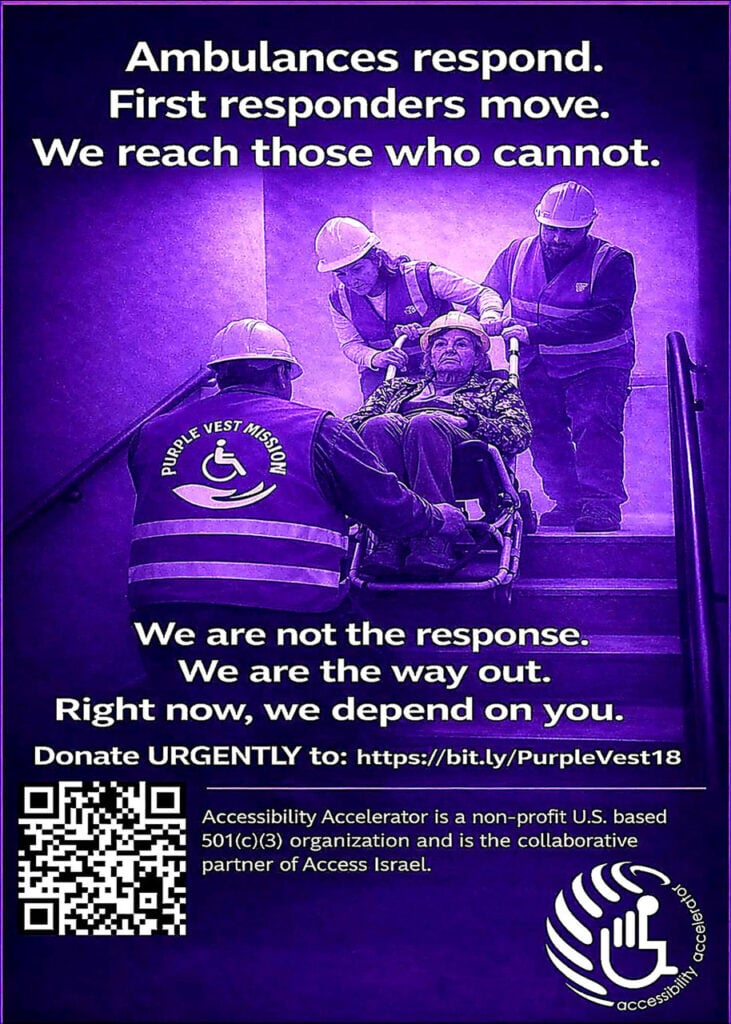
While others rely on partial solutions and accommodations, the Purple Vest Mission deploys fully accessible vehicles designed for real evacuations under real conditions. They are purpose-built, wheelchair-accessible vehicles capable of transporting individuals with complex mobility and medical needs safely and with dignity, without forcing them out of the very devices that give them independence.
Because evacuation is not simply about movement. It is about survival without compromise.
Israel has invested deeply in national emergency infrastructure. These systems are essential. They save lives every day. But scale does not guarantee inclusion.
Inclusion during a crisis, is not a value statement. It is a life-saving system.
Yet despite addressing one of the most urgent and clearly defined gaps, the Purple Vest Mission continues to rely largely on private support to sustain its work.
At the same time, the barriers remain everywhere: entrances that cannot accommodate wheelchairs, steps without ramps, shelters without handrails, and spaces designed without considering those who need them most.
These are not inconveniences. They are decisions. And in moments of crisis, those decisions determine survival.
Just days ago, a family faced an impossible choice. Their son, recently injured in a car accident, could no longer walk or support his own head. When the siren sounded, they had seconds. With no accessible option, they carried him down multiple flights of stairs, risking injury to him and to themselves.
The Purple Vest Mission intervened, providing a specialized evacuation chair. The next time the siren sounded, everything changed. The family moved together. Safely. Calmly. With dignity. No chaos. No panic. No impossible decisions.
But the work for the Purple Vest Mission does not end when the sirens fall silent.
Volunteers deliver meals, coordinate care, provide transportation, and offer something no system can replicate: human connection.
For Dani Partush, that commitment has reshaped his life. A successful caterer by profession, he now leads evacuations across Israel, most recently in Arad and Dimona.
“I would rather be in my kitchen,” he said. “But right now, caring for my brothers and sisters in their most difficult moments is nourishment for the soul.”
Mahmud carries that same calling.
A volunteer from Akko who uses a wheelchair himself, he does not flee when sirens sound. He drives toward them.
In a fully accessible vehicle, he enters active danger zones to reach those who cannot leave on their own. After a day of relentless bombardment in Kiryat Shmona, he insisted on retrieving a family with no path to safety, including a ninety-nine-year-old Holocaust survivor.
Only after delivering them to safety did he return home, after midnight, with the sirens still sounding.
When asked if he arrived safely, his response was simple: “Thank you for the opportunity. I got home with a big smile. You are my family.”
The siren will sound again.
When it does, the question will not be how fast systems respond. It will be who they were built to reach. Because in the moments that define survival, speed is not enough. Design is.
The Purple Vest Mission is advancing a clear imperative: universal design must be embedded into every stage of construction, beginning at the earliest architectural planning and pre-drawing phases.
The true measure of any society is not how efficiently it serves the majority. It is whether it was ever built to protect those who need it most.
In our tradition, we are taught that to save one life is to save an entire world.
The Purple Vest Mission strives to save many worlds every day.
Post Article Note: The Purple Vest Mission trains individuals and communities around the world to be prepared before a crisis occurs. Operating in more than 25 countries, PVM has responded to wars, natural disasters, and community emergencies, supporting the evacuation, assistance, and care of over 20,000 individuals in Ukraine and Israel alone. Its immersive, hands-on training equips participants to act immediately and effectively when it matters most. PVM training is available globally because preparedness cannot wait for a crisis to strike. For training opportunities, please contact [email protected].
Michal Moked Rimon, CEO of Access Israel, and Jamie Lassner, Executive Director of Accessibility Accelerator and a key collaborative partner of Access Israel, have led the Purple Vest Mission Global since its inception in 2022. Both are alumni of the Ramaz School and credit their principal, mentor, and cherished friend, Rabbi Haskel Lookstein, with instilling in them a lifelong commitment to serve as our sisters’ and brothers’ keepers.
To urgently donate: https://givebutter.com/AccAccWebsite Accessibility Accelerator is a nonprofit, United States-based 501(c)(3) organization and a collaborative partner of Access Israel.