
Where Memory Lives: Wall Of Tears Five Towns Holocaust Memorial Confronts The Weight Of Human Suffering With Honesty And Dignity
By: Rochelle Maruch Miller
Where Memory Lives: Wall Of Tears Five Towns Holocaust Memorial Confronts The Weight Of Human Suffering With Honesty And Dignity
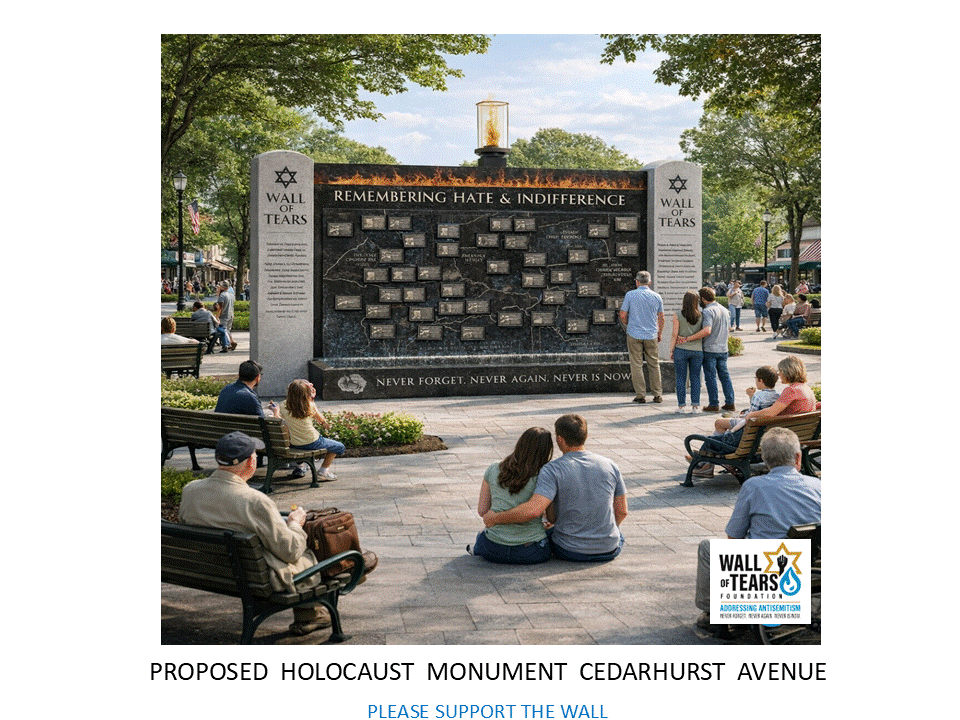
Momentum is growing throughout the Five Towns for a project rooted in memory, education, and moral responsibility. Now approved by the Village of Cedarhurst and intended for the Andrew J. Parise Cedarhurst Park, The Wall of Tears Five Towns Holocaust Memorial is more than a public monument. It is intended to become a place not only to remember history, but to encounter it.
What began as a concept developed by Norm Kaish, a successful entrepreneur who originally desired to build a Holocaust memorial behind his West Hempstead shul, expanded into something far broader: a model that could be replicated in other communities, public spaces, and college campuses to teach and open dialogue about historical antisemitism.
“Students today are growing up at a time when misinformation spreads quickly, and many are learning about the Holocaust without full context or not learning about it at all,” said Kaish. “The Wall of Tears is being designed to change that by creating a permanent, physical space where history is clearly presented and understood. The Cedarhurst Memorial is intended to be the first of many. Building here is what allows this model to expand into other communities and campuses.”
For Kaish, Founder and Executive Director of the Wall of Tears Foundation, the project is also profoundly personal. During three years of research to select stories and images, he reviewed tens of thousands of photographs and documents from Yad Vashem, and in the process, discovered something he had not expected: the names of eight men and women who shared his unusual last name.
His father’s family had no known origin in Europe. Yet among the victims was a Bernard Kaish, murdered in Ukraine, who shared the same name as Kaish’s late Uncle Bernie, a man who lived and died in New York. According to witnessed certificates of death, the eight people bearing the Kaish name were murdered in Ukraine, Poland, and Romania during the Shoah.
For Kaish, engraving their names on the side of the memorial is not symbolic; it is an act of recovery. “My family donated so their names could be engraved on the sides of the monuments, the only physical evidence that they ever existed,” he said.
That sentence captures the power of the Wall of Tears. The memorial is not merely about the enormity of six million Jewish lives taken. It is about the individual names, faces, communities, families, and futures erased by hatred. The memorial asks visitors to confront the reality that genocide is not abstract. It is measured in human beings and it starts with the lesson about antisemitism, unfortunately a problem thriving today.
The proposed Cedarhurst memorial has already begun stirring a strong response. Donations and pledges have been received through the project’s fundraising page, website, and by mail. Following a Yom HaShoah event at Beth Sholom, more than a dozen people expressed interest in having the names of their murdered relatives engraved on the Wall. Last week, a dedication was made for the Ner Tamid at $25,000, and a number of memorial plaques have been pledged at $5,000 each.
The Foundation hopes to reach more families who lost loved ones in the Shoah, with the goal of breaking ground in the fall. The Cedarhurst Wall is envisioned as the first of many such memorials across the country, making local support especially significant.
The educational mission of the Wall of Tears has also received support from major communal voices. Scott Richman, ADL New York/New Jersey Regional Director, wrote to Kaish that the monument is “a valuable tool in educating both students and the general public about the rampant antisemitism which led to the horrors of the Holocaust in Europe, as well as a cautionary tale about where that antisemitism can lead.”
Richman described the monument as thought-provoking and unique because it teaches about each country’s participation or indifference during the Holocaust, while also presenting the experiences of individuals profoundly touched by hate. He noted that the use of QR codes allow visitors to delve more deeply into the historical details and messages it presents.
That combination of physical permanence and digital depth is one of the memorial’s most important features. In an age of misinformation and limited attention spans, the Wall of Tears is designed to move the viewer with its compelling history and testimonies. A passerby may stop for a moment of reflection. A student may scan a QR code and begin a deeper encounter with survivor testimony, victims’ stories, and the consequences of unchecked hatred.
The urgency of that educational mission has only grown. ADL’s support letter referenced the rise of antisemitism and the need for bold new initiatives to help young people recognize hate in its early stages, before it escalates into violence. Richman wrote that teaching about the Holocaust helps young people spot the signs of hate and understand the importance of stopping it before it gets out of hand.
For this reason, ADL expressed support not only for community memorials, but also for placing Wall of Tears monuments on college campuses. The college setting is central to the Foundation’s broader vision. Campuses are places where ideas are shaped, challenged, and passed forward. A Holocaust memorial on or near a campus can serve as a constant reminder that education must include moral clarity.
That campus vision may soon extend to Nassau Community College. Nassau County legislators approved a $1.7 billion infrastructure plan that includes road repairs, upgrades to Nassau Community College, and major investments in the county’s sewer and stormwater systems. Among the projects included in this year’s Capital Budget is $350,000 for a Wall of Tears Holocaust Memorial at NCC.
Local officials have also voiced their support. Ed Ra, Minority Leader of the 19th Assembly District, praised the Wall of Tears Foundation’s efforts to create meaningful memorials on or near college campuses that educate students about the devastating consequences of hatred and inhumanity.
“The Foundation’s commitment to education, remembrance, and fostering thoughtful dialogue is truly important,” Ra wrote.
Howard J. Kopel, Presiding Officer of the Nassau County Legislature, also expressed strong support for construction of a Wall of Tears Memorial on the campus of Nassau Community College. “The proposed memorial powerfully communicates the Holocaust’s devastating impact on the Jewish population throughout Europe,” Kopel wrote in a letter to the college’s Board of Trustees. He added that when completed, the monument would provide students, faculty, staff, and visitors an opportunity to reflect on the brutality suffered by the Jews during World War II.
Kopel emphasized that it is critical that young people around the world learn about the atrocities committed against the Jewish people between 1938 and 1945. Together with other legislators, he urged the Board of Trustees to support the project at Nassau Community College.
His words also speak to the larger meaning of the memorial. In a recent interview with the 5TJT, Kopel noted, “A Wall of Tears Memorial is more than a form of remembrance; it’s a commitment to confront the weight of human suffering with honesty and dignity. By remembering the people and communities that were destroyed, we help to ensure that it never happens again. Building this memorial is a step toward safeguarding those memories and carrying them into the future, ensuring that they are never forgotten.
That responsibility is at the heart of the Cedarhurst effort. The Wall of Tears Five Towns Holocaust Memorial is meant to stand in a public park, at the center of a living community, where children play, families gather, and pedestrians pass on ordinary days. Its placement matters. Remembrance should not be confined to museums or once-a-year ceremonies; it belongs in the daily life of a community.
The project has drawn an enthusiastic response, but financial support is still needed. “People assume that projects like these are funded only by large donors,” said Kaish. “The truth is, major donors are important but this project moves forward through community support. Smaller donations add up quickly and make a great impact.”
That message is especially fitting for a memorial built around names. Just as each name matters, each contribution matters. The Wall of Tears is not only a monument to the past. It is an invitation to participate in the future of Holocaust education. By supporting the Cedarhurst memorial, residents can help create a permanent place of learning, reflection, and remembrance, while helping to ensure that victims whose names might otherwise disappear are given a place in public memory. They can help create a model that may one day stand in other communities and on campuses across the country.
At a time when antisemitism is visible, aggressive, and distorted by ignorance, the Wall of Tears offers a response grounded in dignity. It does not shout. It teaches. It does not reduce suffering to slogans. It restores names, context, and truth.
And perhaps that is why the memorial’s mission resonates so deeply. The Wall of Tears asks every visitor to pause, learn, and carry memory forward. It reminds us that remembrance is not passive. It is an obligation. It’s a form of vigilance. It’s a promise that the lives destroyed by hate will not be erased a second time by silence.
Donations of any size are welcome. Donations can be made directly through the Wall of Tears Foundation website. Please visit https://www.walloftears.org/5-towns-holocaust-project.html. n
Rochelle Maruch Miller is a contributing editor for the Five Towns Jewish Times. She is a journalist, creative media strategist, lecturer, educator, and writes for magazines, newspapers, websites, and private clients. She welcomes your comments at [email protected]. Read more of Rochelle Maruch Miller’s articles at 5TJT.com.