
Putting the Market’s Last Few Years In Perspective
By: Jack Strulowitz
Over the last few years, the stock market has had a remarkable run, and every few weeks there seems to be another headline announcing a new all-time high. When I sit down with clients, the question I hear more than any other is some version of whether a crash is coming, and I think that fear is completely understandable. When something has gone up for so long, it’s natural to think it will come down.
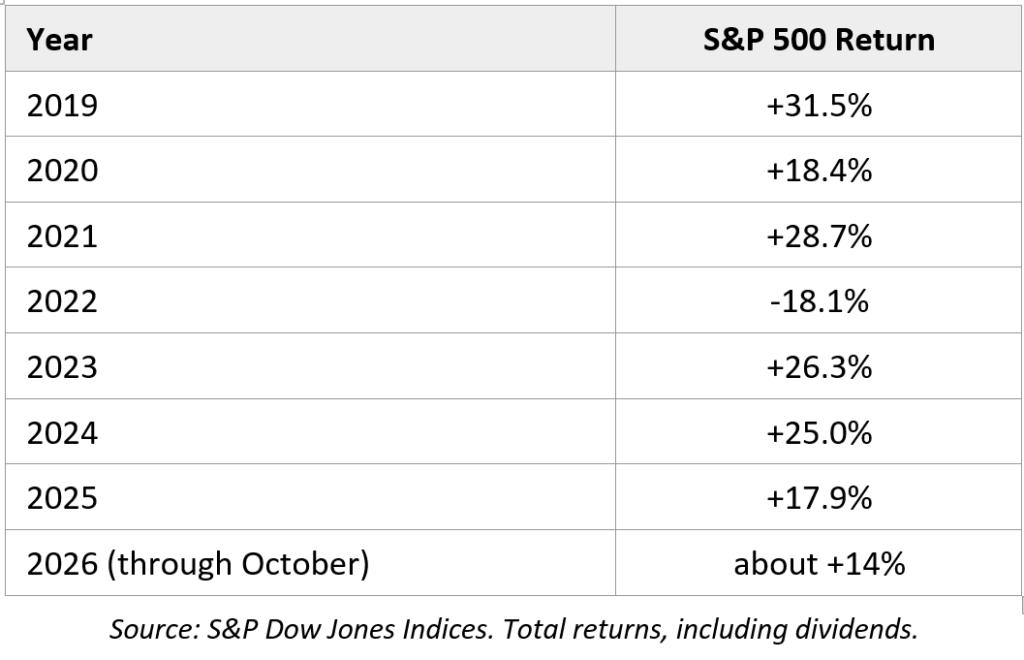
It’s part of our nature to have very short-term memory when it comes to markets and the economy. When things are going well, we tend to forget how recently they went poorly, and when things are going poorly, we tend to forget every recovery that came before. Here is how the S&P 500, including dividends, has done in each of the last several years:
It’s easy to forget that this whole run began right after the market fell 18% in 2022, only four years ago. Looking further back, years like 2023, 2024, and 2025 are less rare than they feel. Since 1928, the S&P 500 has gained 20% or more in more than one year out of every three, which is actually more often than it has had a losing year (NYU Stern School of Business). From 1995 through 1999, it gained more than 20% five years in a row, a stronger streak than the one we are in now (Morningstar).
The same is true of all-time highs. A new record sounds like a special event, but in a market that grows over time, it is simply what happens much of the time. The S&P 500 has already set 28 new all-time highs so far in 2026 (Yahoo Finance). Reaching a new high tells you that the market is higher than it has ever been, and very little about what it will do next.
Over the long run, the S&P 500 has returned about 10% a year on average since 1928, although the average hides how bumpy the ride has been, since the market almost never delivers an average year. Even so, the market has finished higher in roughly three years out of every four (Bloomberg). What has been remarkably consistent is the longer view, since there has never been a 20-year period in which the S&P 500 lost money (Crestmont Research).
None of this means a crash can’t occur. The stock market is perfectly capable of crashing, and Wall Street is notoriously bad at predicting when that may happen. A true crash—of the 1987 or 2008 kind—has come along about once a decade. The fact that we are sitting at an all-time high today after every one of those crashes shows how resilient the markets are. So long as there are capitalism, global trade, and free markets, there will be a motivation to increase profits, and the market’s growth over many decades is a reflection of that motivation and resilience. If our country were ever in a situation where your stock market investments were gone and never coming back, money would likely be the least of your problems.
If you have been sitting on cash and feel you missed the run, the right move depends on how much risk you can afford to take given your circumstances. If you have no major liquidity needs and you know you can stomach big swings in the market, I would encourage you to invest. But most people sitting on a lot of cash are doing so for a reason, and very often that reason is that they are uncomfortable with risk. If that describes you, you didn’t miss anything. Someone who isn’t comfortable with risk should not be in aggressive or risky investments, even with professional management, and who is to say that, had you invested and not “missed the boat,” you wouldn’t have panic-sold in the next down market and never reinvested?
The last few years have rewarded people who stayed invested, and history suggests that stretches like this one are an ordinary part of how markets grow over time, along with the occasional painful decline. Over the decades, the investors who have done best have generally been the ones who held an amount of risk they could truly live with, so that when the next crash came, they had no reason to sell. Finding that amount depends on your own circumstances, and it is far easier to work out while markets are calm than in the middle of a decline. n
Jack Strulowitz is a Financial Advisor at Bernath & Rosenberg in Cedarhurst, NY, where he helps high–net worth individuals and families manage their investments and build comprehensive strategies for retirement, tax, and estate planning. For questions or to schedule a consultation, please contact [email protected] or 212-221-1140, ext. 129.
The opinions voiced in this material are for general information only and are not intended to provide specific advice or recommendations for any individual.
Securities and advisory services offered through LPL Financial, a Registered Investment Advisor. Member FINRA/SIPC.