

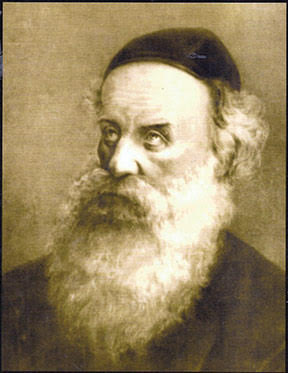

Musings Of A Shliach From Montana
By: Rabbi Chaim Bruk
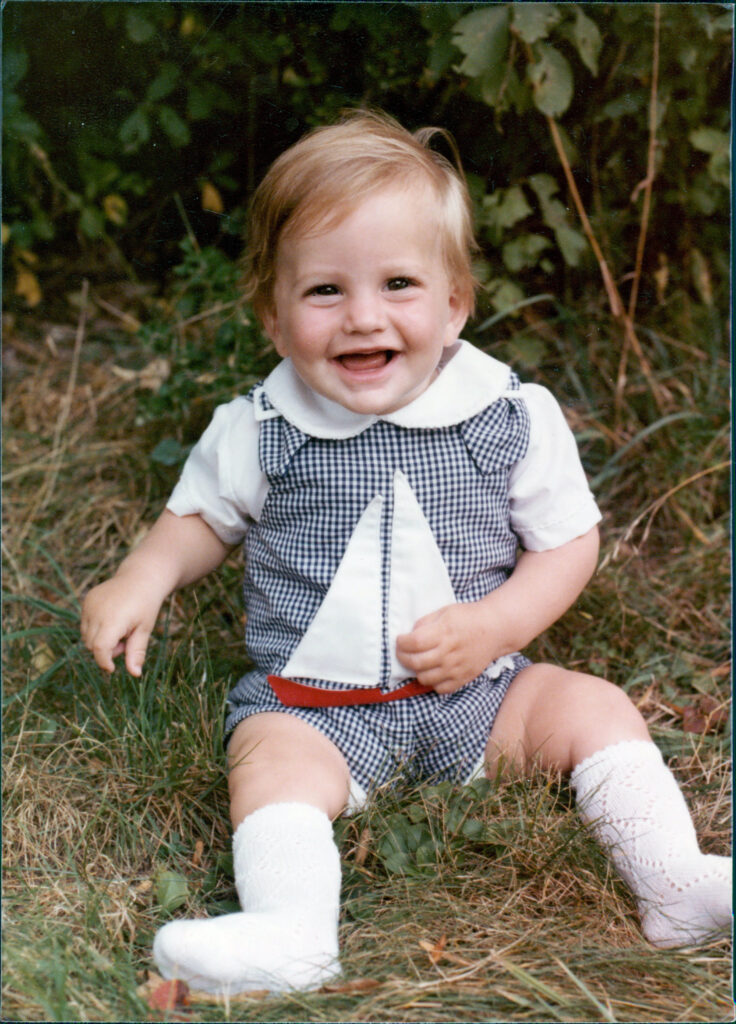
Rabbi Chaim Bruk as a toddler
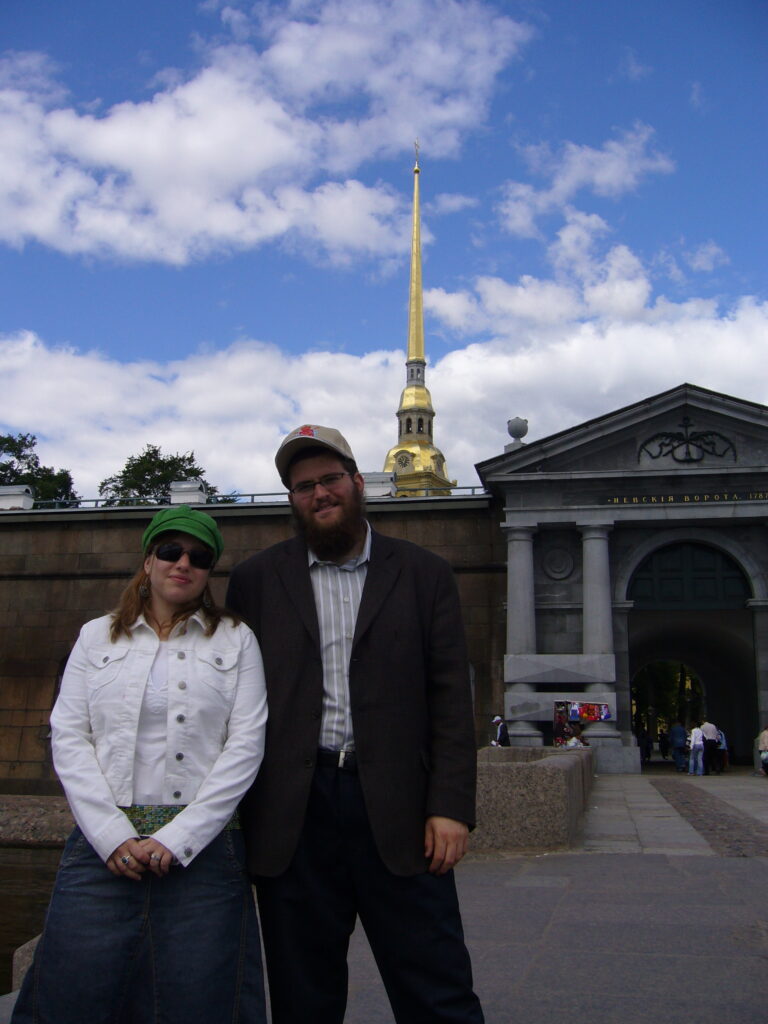
Rabbi Chaim & Chavie Bruk outside the prison where the Alter Rebbe was incarcerated, 2006
Today, the 15th of Kislev, is my 45th birthday.
The Rebbe, zt’l, made a big shturem, a big campaign, about Jewish people celebrating their Jewish birthdays with a special farbrengen with family and friends, making resolutions to grow in Torah study and mitzvah observance, giving extra tzedakah, reciting a Chassidic discourse and (for men) getting an aliyah on the Shabbos before the birthday or if on a Monday or Thursday, on the actual birthday itself.
I’ve been enjoying my birthdays for quite some time as it gives me the opportunity to reflect on the past year, think about what values are guiding me, and spiritual plan for how I’d like the new year to play out.
The Baal Shem Tov instituted a custom to recite one’s personal chapter of Tehillim each day of the year and it’s always one Psalm ahead of your age (because we recite kapitel Alef from birth until our first birthday).
In my new kapitel, 46, there are two mentions of this powerful verse: “The Lord of Hosts is with us; the G-d of Jacob is our fortress forever.” I feel like it’s a good year to ignore the political chaos and worldly challenges and dig deep into the reality of Hashem, “Misgav Lanu Elokei Yaakov Selah,” of Hashem being my fortress forever.
Yet, my birthday also brings up memories of my childhood and my beloved parents who brought me into this world and raised me and my siblings with so much love and unbreakable values. My parents were old school, they didn’t know all we know today about parenting, but they fulfilled their role with excellence, never compromising on prioritizing us 24/7. Though my dad is Israeli and my mom was from Brooklyn, they added their unique flavor to the family dynamic. I appreciate everything about my childhood. Never once did I have to wonder if I was the most important thing in the world to my parents.
Naturally, it also brings up emotions around my mom being gone since 2010. What would it be like to have a relationship with my mom at this stage of my life? What would she be like at seventy-years-old? I have lots of questions, tremendous yearnings, and lots of memories, and I’m filled with fond memories and genuine heartbreak at the same time.
Especially now, as we find ourselves at Parashas Vayishlach, a parashah that covers the untimely and gut-wrenching passing of Rochel Imeinu, our Matriarch Rachel, while giving birth to her second son, Binyomin. Rochel’s story is always hard for me. Growing up with Lavan for a father, losing her chance to marry her beloved Yaakov on round one, experiencing infertility while her sister Leah was popping out one after the other, and finally having two sons only to die in childbirth with her second. It’s so hard to understand Hashem’s ways, which is why we accept it with emunah, with trust that Hashem does it just right. As I’ve heard at many a farbrengen late at night: “If I were Hashem, I would create the world a little differently,” said a colleague of Rabbi Schneur Zalman of Liadi. To which Rabbi Schneur Zalman replied: “And if I were Hashem, I would create the world exactly as He did.”
Let that sink in. Hashem doesn’t make mistakes, even if it’s hard for us to understand what He’s thinking.
In truth, I don’t know if I’d be able to see the world the way I do without the study of Chassidus. Learning the deeper dimensions of Torah allows for me to see beneath the surface and face life challenges with more strength, courage, and joy. I’m contemplating this as Yud Tes Kislev approaches on Sunday. The 19th of Kislev is known among Chassidim as Chag HaChagim, the holiday of all holidays, or as Rosh Hashanah L’Chassidus, the Rosh Hashanah of Chassidism.
As it states on Chabad.org:
It was on this date, in the year 1798, that the founder of Chabad Chassidism, Rabbi Schneur Zalman of Liadi (1745-1812) was freed from his imprisonment in Czarist Russia. More than a personal liberation, this was a watershed event in Jewish history, heralding a new era in the revelation of the “inner soul” of Torah.
The public dissemination of the teachings of Chassidism had in fact begun two generations earlier. The founder of the Chassidic movement, Rabbi Israel Baal Shem Tov (1698–1760), revealed to his disciples some gleanings from the mystical soul of Torah which had previously been the sole province of select Kabbalists in each generation. This work was continued by the Baal Shem Tov’s disciple, Rabbi Dov Ber, the “Maggid of Mezritch,” who is also deeply connected with the date of “19 Kislev”: on this day in 1772, 26 years before Rabbi Schneur Zalman’s release from prison, the Maggid returned his soul to his Maker. Before his passing, he said to his disciple, Rabbi Schneur Zalman: “This day is our yom tov (festival).”
Rabbi Schneur Zalman went much farther than his predecessors, bringing these teachings to broader segments of the Jewish population of Eastern Europe. More significantly, Rabbi Schneur Zalman founded the “Chabad” approach, a philosophy and system of study, meditation, and character refinement that made these abstract concepts rationally comprehensible and practically applicable in daily life.
In its formative years, the Chassidic movement was the object of strong, and often venomous, opposition from establishment rabbis and laymen. Even within the Chassidic community, a number of Rabbi Schneur Zalman’s contemporaries and colleagues felt that he had gone too far in popularizing and making tangible the hitherto hidden soul of Torah.
In the fall of 1798, after false informing by fellow Jews against the Alter Rebbe, Rabbi Schneur Zalman was arrested on charges that his teachings and activities threatened the imperial authority of the Czar, and was imprisoned in an island fortress in the Neva River in Petersburg. In his interrogations, he was compelled to present to the Czar’s ministers the basic tenets of Judaism and explain various points of Chassidic philosophy and practice. After 53 days, he was exonerated of all charges and released.
Rabbi Schneur Zalman saw these events as a reflection of what was transpiring Above. He regarded his arrest as the earthly echo of a heavenly indictment against his revelations of the most intimate secrets of the Torah. And he saw his release as signifying his vindication in the Heavenly court. Following his liberation on 19 Kislev, he redoubled his efforts, disseminating his teachings on a broader scale, and with more detailed and “down-to-earth” explanations than before.
This day marks the “birth” of Chassidism, when the hidden secrets of Judaism emerged from the womb of mysticism to illuminate and transform the totality of Jewish life.
It’s hard to believe that just over 200 years ago, frum Jews were so upset at their fellow frum Jews that they were willing to invent lies and try to get a Rebbe of thousands of Chassidim arrested, incarcerated, and who knows what else. Baruch Hashem we’ve come a long way, but it’s important to remember what we had to fight for to allow the teachings of Chassidus to permeate Jewish life. Today, Tanya is taught everywhere. You can learn it in Lakewood, Bnei Brak, or Waterbury. You can find Chassidus at Olami, Aish, and kollels around the world. You can hear teachings from the Rebbe, zt’l, at Kesher Nafshi, the Agudah, and Young Israel conferences. Chassidus today is Baruch Hashem mainstream. It’s like Chabad niggunim. When I was kid, you never heard a Lubavitch niggun at a Litvishe wedding and today every chasunah in the Jewish world is infused with Lubavitch niggunim.
I have hundreds of friends in communities all over who love their style, their minhagim, their upbringing, their roshei yeshivas and Rebbes, but it’s unquestionable today that the ideals, ideas, and values of Chassidim are way more mainstream, and that is a nitzachon, a victory, for the Alter Rebbe who spent time in a Czarist jail for the crime of wanting these ideas mainstreamed, and his wish has come true.
Back to where I started.
Learning Chassidus helps me daily to shift away from the grime of reality and lift myself up to a plain of holiness where I can focus on purpose, meaning, and kedushah. I’ll leave you with one of my favorite teachings in Chassidus.
In Chassidus, there are three schools of thought:
1. The school of Mussar: the school of thought that negates preoccupation with materiality by pointing out the disgusting and abhorrent nature of all bodily and material things.
2. The school of Chakira (philosophy): the school of thought that recognizes the superiority of the “inner form” and the spiritual, the dimension of character traits and intellectuality, and instruction as to how one may come closer to attaining these.
3. The school of Chassidus: the discipline of predominance of form over matter. This school teaches the unique quality of the material when it is purified, and the unique quality of “form” when integrated with the material. The two are to be so thoroughly fused that one cannot detect where one begins and the other ends, for “their beginning is wedged into their end, and their end into their beginning.” The One G-d created them both for one purpose: to reveal the light of Holiness of His hidden power. Only both of them together will complete the perfection desired by the Creator.
Rabbi Chaim Bruk is co-CEO of Chabad Lubavitch of Montana and spiritual leader of The Shul of Bozeman. For comments or to partner in our holy work, e-mail [email protected] or visit JewishMontana.com/Donate.