




A Match Made in Eden
By: Lisa Septimus
There are countless questions to explore in Parashat Bereishit, particularly in the Torah’s account of the creation of humanity. The Torah first tells us: “Hashem created man in His image; in the image of Hashem, He created him; male and female He created them.”
The pasuk itself strangely shifts from singular to plural: He created him; male and female He created them. Then, in the second chapter of Bereishit, the Torah tells the story again, this time describing Adam as alone and Chava as created only later. Why does the Torah present the creation of man and woman in such a complex and seemingly contradictory way?
Midrashim, mefarshim, and modern scholars have grappled with these two accounts and with the ambiguity itself. Perhaps part of the message is that the Torah wants us to learn is that although we are each created as individuals with our own identity, purpose, and capacity, we are not meant to be alone. In fact, it is not enough that Adam eventually finds a companion. He first had to recognize that he needed one.
Hashem declares: “It is not good for man to remain alone.” Yet Hashem does not immediately create Chava. Instead, He brings the animals to Adam to be named. Rashi explains that through this process, Adam comes to recognize for himself that among all the creatures, there is no partner for him.
Only then does Hashem cast a deep sleep over Adam to create Chava from a part of him. There is something profound in that sequence. To enter into a true relationship, Adam must first recognize his own loneliness and he must desire connection deeply enough to give something of himself, to sacrifice, to become vulnerable, and ultimately to make room for another person.
Rav Soloveitchik in The Lonely Man of Faith sees the Torah’s two creation stories as describing two dimensions of the human experience. Man is majestic and powerful, charged with conquering the world and imitating Hashem through creativity. He seeks a partner with whom he can build and create. But man is also vulnerable, aware of an existential loneliness that accomplishment alone can never eliminate. That side of the human being seeks a different kind of companionship: Someone with whom he can share his inner world and by whom he can truly be known.
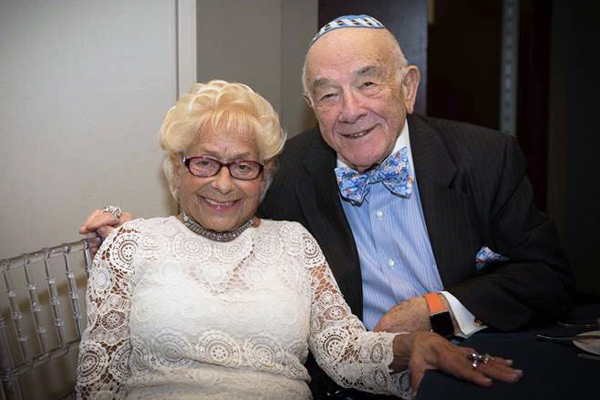
Drs. Miriam and Felix Glaubach, z’l. embodied both dimensions of partnership. They built together a business, a remarkable philanthropic legacy, a family, and eventually what Felix affectionately called “Shevet Glaubach.” But alongside all that, they accomplished something quieter and more intimate: an extraordinary bond between two people who remained unmistakably themselves.
Felix was Felix—ambitious and visionary, with his famously sharp sense of humor and an ability to imagine possibilities on a grand scale. And Miriam is Miriam—warm, engaging, spunky, quick to laugh, deeply interested in people, and happiest when she can contribute and be at the center of the action.
Their marriage did not erase their personalities. Their marriage enabled each of them to become more fully themselves while creating something far greater. Perhaps that is why the end of Parashat Bereishit adds one more dimension to the story of Adam and Chava. When Chava gives birth to Kayin, she declares: “I have acquired a man with Hashem.”
Chava recognizes that the greatest creation to emerge from their union is not theirs alone. Chazal describe the creation of a child as a partnership of three: mother, father, and HaKadosh Baruch Hu. A husband and wife join together, but the ultimate act of creation requires a third Partner.
Felix and Miriam understood that idea deeply. They built Shevet Glaubach not simply as a large family, but as a family conscious of its responsibility to partner with Hashem and to use what they have built together to build something beyond themselves. And perhaps that is the most beautiful way to understand Felix’s decision to establish the Miriam Glaubach Center at Nishmat.
Felix and Miriam understood that the partnership between husband, wife, and HaKadosh Baruch Hu is not only expressed in bringing children into the world. It is lived in the private, sacred spaces of a marriage as well. Through the observance of taharat hamishpacha, couples elevate the most intimate dimensions of their lives. But doing so requires access to Torah, sensitivity, dignity, and a place where a woman can ask the questions that are sometimes hardest to ask.
The Center that Felix created in Miriam’s honor helps make that possible. Through the Yoatzot Halacha it trains and supports, the values that defined Felix and Miriam’s own partnership enter thousands of other Jewish homes, helping couples build marriages in which Torah is not an intrusion into intimacy, but part of what sanctifies it.
Perhaps that is the most fitting tribute to Felix and Miriam Glaubach. They understood that we are each created as individuals, that we are transformed through the relationships we build, and that the greatest thing two people can create together is a life that makes room for a third Partner.
This year, as Nishmat honors Miriam and Felix together with Shevet Glaubach, we celebrate not only what they built, but the partnership that allowed them to build it, and recommit ourselves to carrying that partnership forward.
If you’d like to pay tribute to Drs. Miriam and Felix, z’l, Glaubach or to attend a gala in their honor, please visit afnishmat.org/gala.
This article is a reprint from The Jewish Link of New Jersey from Jan 1, 2025. American Friends of Nishmat shares this in honor of its upcoming gala when it will celebrate Drs. Miriam and Felix, z’l, Glaubach and the Shevet Glaubach on December 1, 2026.
Lisa Septimus is the Yoetzet Halacha of the Five Towns, host of the Dear Yoetzet podcast, and creator of @dearyoetzet on Instagram. She also serves as Assistant Principal of North Shore Hebrew Academy High School.