
And You Lifted Us Up
By: Sivan Rahav Meir
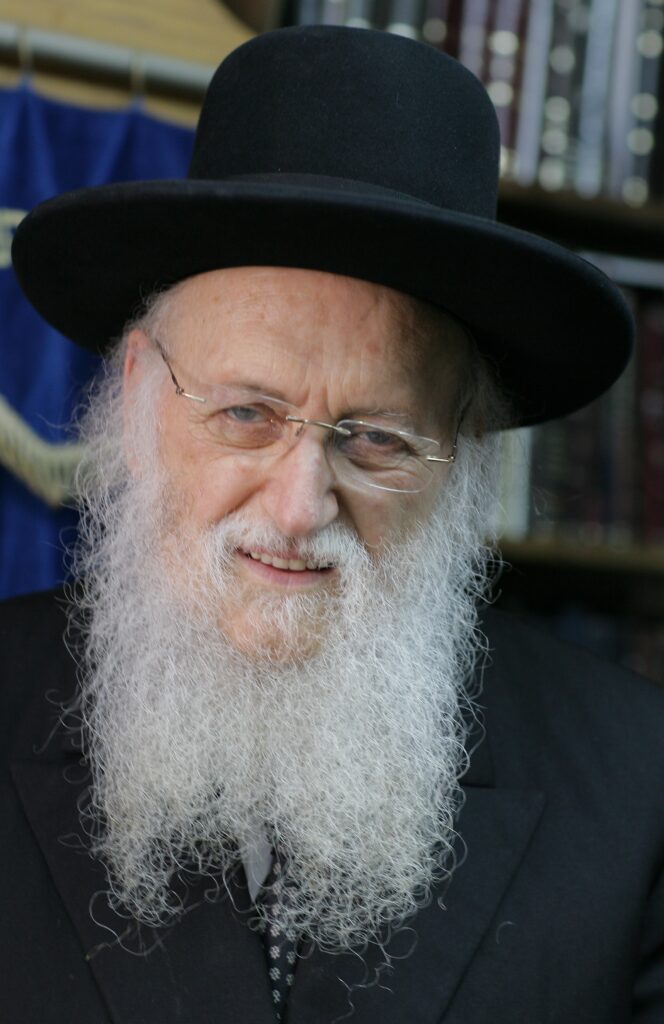
The 23rd of Iyar marks four years since the passing of Rabbi Simcha Kook, the longtime chief rabbi of Rehovot, who served in many other important roles as well. Here is one small lesson we can learn from his great personality:
He was a man of romemut, elevation. Whenever he saw something positive, he tried to enlarge it, to lift it higher. Every good deed, every mitzvah, was precious, the most important thing in the world at that moment, and we were all part of it. That’s how we felt in his presence.
When he studied and taught Torah, that was, of course, the essence. That is what the world stands on. But he carried that same sense of importance and elevation into everything else he did: When he served as sandek at a brit milah, he would bless the newborn baby and explain the meaning of the mitzvah taking place. When he welcomed a family of new immigrants who had arrived in Rehovot from Russia or when he officiated at the wedding of a couple who were beginning to build a home, he brought that same spirit as he spoke beneath the chuppah. We ourselves merited that Rabbi Simcha officiated at our wedding. He was moved when a new community was established in Eretz Yisrael. Likewise, he brought that same spirit when he affixed a mezuzah at a new store in Rehovot and when he led sharp public struggles, speaking and protesting with great emotion.
Everything was of supreme importance. Everything was the fulfillment of ancient prophecies coming back to life. Even the smallest details: a security guard at the entrance to a school he visited would receive from him a dose of elevation. “You are guarding here, and because of that the children can learn. Fortunate are you.” With a smile and gentleness, he simply gave every person a wonderful feeling. He tried to connect everything to holiness, to purpose.
We should all try to live with this awareness: to find elevation and greatness in our own lives, and to uplift those around us as well.
Five Thoughts on Yom Yerushalayim
1. This Friday, the 28th of Iyar is Yom Yerushalayim, 59 years since the liberation of Jerusalem in the Six-Day War. In 1967, the 19-year-old Jewish state faced an existential crisis, the threat of utter annihilation by its enemies. Would it continue to exist or would it be destroyed? Ultimately, the answer was that we would endure, baruch Hashem.
2. The Jewish state not only survived, but grew to three times its size. Tiny Israel recaptured the Golan Heights, Sinai, Judea and Samaria, and of course, Jerusalem. We returned to the areas where our matriarchs and patriarchs lived and where our prophets communicated their divine messages.
3. As Israel stood on the brink of war, a popular phrase circulated in the country: “The last one to leave Ben Gurion Airport should turn off the lights.” But in the end, no one shut off the lights. On the contrary, the light stayed on. An older couple from New York once told me that before the outbreak of the Six-Day War, they advised their relatives to leave Israel and seek refuge with them, but after the war, most of their children made aliyah. The tide of history had turned for the better.
4. All these extraordinary achievements were the result of a war that lasted only six days! The Arabs refer to this war as the “June War” in order to conceal the shame of their devastating defeat. Six Arab armies, including those of Iraq and Saudi Arabia, were defeated in less than a week.
5. At the time, the joy in the Jewish world was unprecedented. Unfortunately, today’s newspapers may take a different perspective, but these are the words that appeared in the left-leaning Haaretz newspaper after the liberation of Jerusalem: “There are no words to adequately express the feelings of exhilaration in our hearts today. Even the concept of our holy Temple seems to be more tangible than ever before.”
May we merit to continue our path forward. Happy Yom Yerushalayim!
Parashat Bamidbar: The Most Important Moment
Are you on your way somewhere? Are you waiting to get married, finish your degree, find work, pay off your mortgage, move to a new place?
This week we begin to read the Book of Bamidbar, which centers around the time in between. The book describes the travels of our ancestors in the desert en route to the Land of Israel. At first glance, one might conclude that perhaps it would be best to ignore this period entirely and to focus instead on the beginning of our journey and the arrival at our destination. Whatever happens along the way is of secondary importance and lesser significance. Yet there are commentators who maintain that Bamidbar is in fact the most important book in the Torah. Why? Because if you think about it, most of our life takes place in the in between stages. Or as it says in the Shema, “u’velechtecha baderech”—when you travel on the way.
Therefore, it’s important to ponder how we relate to the period “along the way.” Do we consider it important or do we wait impatiently for it to be over? Do we take advantage of the times when we find ourselves “in between” (even in the small things, like waiting in line or stuck in a traffic jam)? Do we know how to invest in transition periods, or are we simply waiting until we finally arrive at our destination?
Often, when great people were asked to identify the most important moment of their lives they replied: “This very moment!” If we could teach ourselves to stop feeling as if we’re waiting for our “real life” to begin and focus instead on what is happening right here and now, not only will we, with Hashem’s help, eventually reach our destination, we will also benefit from all the gifts that await us along the way. This is the way to approach the Book of Bamidbar as well as the many journeys of our lives.
Translated by Yehoshua Siskin and Janine Muller Sherr.
Read more by Sivan Rahav Meir at SivanRahavMeir.com.