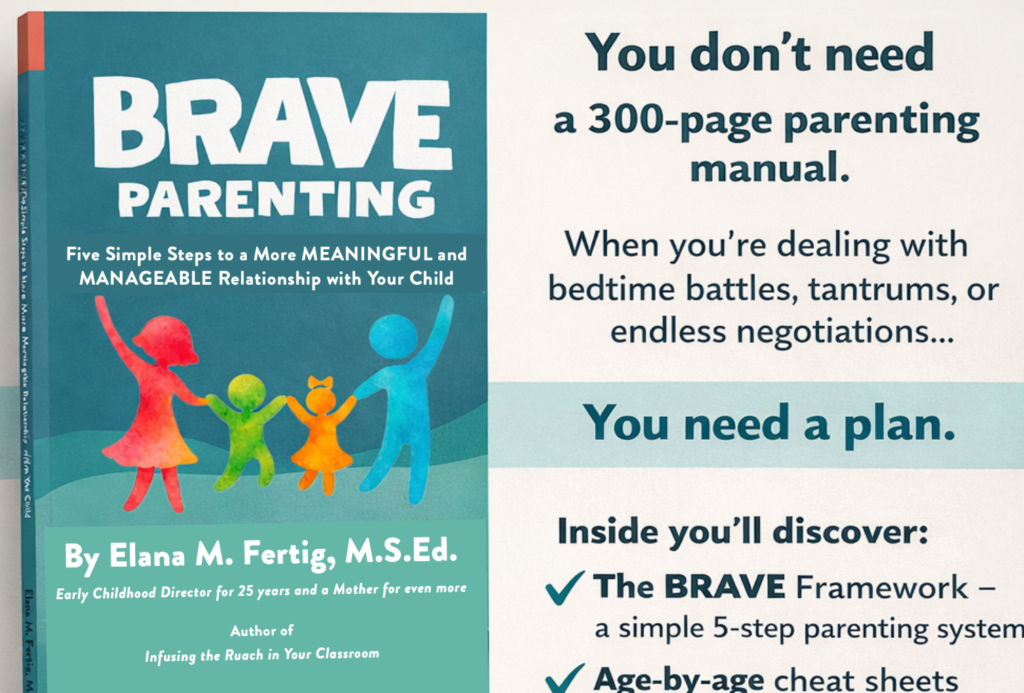

Brave Parenting
By: By Elana Fertig
By Elana Fertig
Book Review by Michele Justic
I’ll let you in on some Behind the Scenes here. This book sat on my to do list for months. Does this make me relatable or unreliable? I’m not sure. Either way on Shavuos I finally sat down to read Brave Parenting. I speak from experience—this book is a quick and easy read. But don’t let the glossy well-designed pages of this slim volume fool you: it packs a punch. The ideas, broken down into simple steps, can effect major positive change. I wish I had this when my kids were younger.
Another BTS confession: I have known Morah Elana for many years. She was the preschool director for my sons and produced an educational environment based on play and as they would say now “good vibes”. This is not a YouTuber whose smile dims when the flash turns off. Elana Fertig raised her children, directed thousands of preschool children over the years, and instructed hundreds of teachers, all with a firm but friendly ideology. The BRAVE method she codifies works because it is based on real results. Fertig has also written the “Infusing the Ruach Curriculum Series” adapted by many preschools.
It may sound too simple. BRAVE stands for Be Consistent, Read Daily Attention, Value Sleep, and (thank you for making this a priority!) Extra “Me” Time. Take time to internalize the deeper explanations and the Brave At Every Age steps, and you will finally have that relaxed feeling when you type your destination into Waze and it’s doing its magic and you can breathe easy and drive in peace. BRAVE is the map parents have wanted for years but didn’t realize.
I’ll quote from the Value Sleep Section, as an example of how little things can have a big impact:
“We saw it constantly throughout my years as a preschool director. A child who arrives anxious, short-tempered, defying teachers, lashing out at students—we’d immediately wonder if something bigger was going on: Sensory issues? Emotional dysfunction? Some crisis at home? Abuse? Then we’d discover that this child has no bedtime. They’re up late every night and need to be dragged out of bed every morning. Suddenly, it all makes sense. Before running to child specialists or doctors for diagnoses or treatment, the best place to start is by asking a very basic question: Is this child getting enough sleep?
“Researchers funded by the National Institutes of Health have found that children who regularly get less than nine hours of sleep a night are functioning at a deficit. They often have difficulty thinking clearly and experience mood shifts more frequently. They are likely struggling with self-regulation, behavioral, and attentional issues—issues all unrelated to physiological abnormalities. The child is simply tired. Unfortunately, most young children can’t understand or express why they feel or act the way they do. When you feel off because you’re sleep deprived, you have a general idea why. You also have the autonomy to grab a cup of coffee or take a walk outside for some fresh air. A four-year-old who comes to school feeling out of sorts lacks the self-awareness to understand why they feel sluggish and grouchy. Even if they do, they lack the autonomy to help themselves. Instead, they act out by throwing tantrums, getting into fights, or engaging in oppositional behaviors. Our job as BRAVE parents is to understand why this is happening and how to prevent it.”
I also wanted to bring Attention (yes, a BRAVE principle) to the section on Extra Me Time. I read my share of parenting books and do not recall other books including the mental health of the parents into the larger picture of a well-functioning home. To perform the all-encompassing job of parents, mothers and fathers, need more than a cup of coffee. Kudos to Morah Elana for making Extra Me Time a priority in the book and thereby a priority in parents’ lives.
We live in a complicated world but BRAVE Parenting shows that raising children is easier when we stick to some tried and true principles.