
Building Torah In Andalusia: The Remarkable Life Of Hasdai Ibn Shaprut
By: Nosson Wiggins
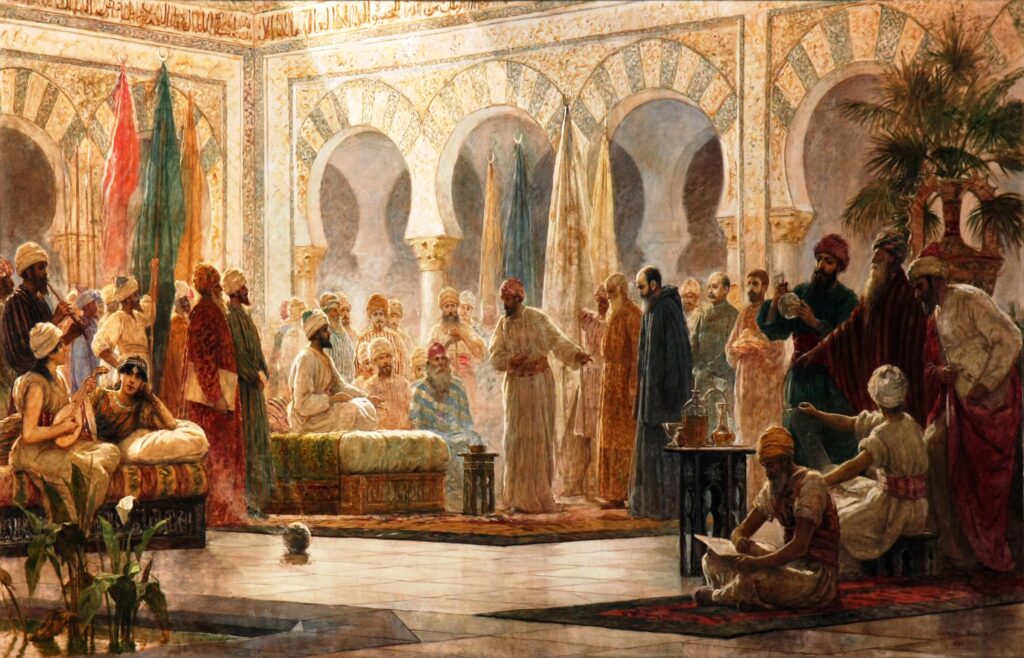
The Umayyad Caliphate was the first powerful dynasty to rule the Muslim empire. Established in 661 in Damascus, Syria, the Umayyads were defeated nearly a century later, in 750, by the rivaling Abbasids. Most of the royal family was slain during the turmoil, but a young Umayyad prince named Abd al-Rahman I fled Syria and found refuge in Spain. With Abd al-Rahman’s conquest of Cordoba in March 756, the Umayyad Caliphate of Cordoba began its illustrious reign (756–1031). The Umayyad caliphs vied with their counterparts in the Middle East to become the cultural center of the Islamic Empire. To advance their cultural society, these rulers, beginning with Abd al-Rahman I (756– 788), generously patronized scholars, scientists, and poets who settled in their land. With the influx of such individuals, Cordoba emerged as the crown of Islamic Spain and boasted sophisticated centers of art, poetry, and science. Specifically, under the rule of Abd al-Rahman III (912–961), a wise and adept monarch, Cordoba prospered greatly as a center of culture and commerce.
Under Umayyad rule, Spanish Jewry experienced outstanding growth and prosperity. During this “golden age,” the Jews of Spain were not merely tolerated, they were invited to occupy positions of prestige, influence, and power. As mentioned above, Abd al-Rahman III, the caliph of Cordoba between 912–961, was solely focused on the cultural development of his state and disregarded any religious beliefs that stood in his way. It can be said that Abd al-Rahman’s lax religious attitudes and ambitious economic and political goals ushered in the golden age of Spanish Jewry. This rich period in Spanish-Jewish history began in the mid-900s with the rise of a remarkable Jewish courtier and ended approximately 200 years later, in 1148–49, when the Almohads, a fanatically religious group of Berbers, defeated their Muslim rulers and conquered North Africa and Islamic Spain, known as Andalusia.
{Hasdai ibn Shaprut in the Royal Court
Abd al-Rahman’s lavish endowments attracted intellectuals of different faiths to his court in Cordoba. One such man was Abu Yussaf Hasdai ben Isaac ibn Shaprut, otherwise known as Hasdai ibn Shaprut. Hasdai’s father, Isaac ibn Shaprut, moved to Cordoba from Jaen in eastern Andalusia, probably to take advantage of the endowments offered by Abd al-Rahman. Isaac ibn Shaprut, a prominent Jewish leader, was appointed Nasi (head of the Jewish community) of Cordoba. His fantastic wealth, combined with his piety, led him to a career of philanthropic deeds. Isaac ibn Shaprut generously supported Torah scholars and donated funds to construct a shul in Cordoba. On the political end, Isaac ibn Shaprut was a confidant of the caliph and maintained close ties with state officials.
Born in 915 in Cordoba, Hasdai grew up in a home that was whole- heartedly dedicated to Jewish affairs in Cordoba and beyond. Isaac provided his young son with a broad education, hiring tutors to teach him Chumash, Mishnah, and Gemara, as well as the disciplines of medicine, poetry, and etymology. As a young man, Hasdai mastered Hebrew, Arabic, and Latin, the last of which was to become a vital asset in his future career as an advisor and ambassador of the state.
Hasdai’s brilliance and medical expertise, particularly his discovery of a cure for poisoning, won him favor in the eyes of Abd al-Rahman III. Hasdai was initially appointed as a physician in the king’s royal court, but once his economic aptitude was recognized, he was promoted to manage the state’s finances, trade, and taxation. In addition, Hasdai, master of several languages, had outstanding diplomatic skills and played a significant role in the state’s foreign affairs. On several occasions, he was sent as an ambassador to negotiate the terms of various enterprises and pacts with other European and Middle Eastern powers. These diplomatic tasks put Hasdai in contact with distant lands and he utilized the opportunities to inquire about the state of Jewish life in these far-flung places. Occasionally, Hasdai even used his political influence to alleviate the suffering of Jews in various kingdoms.
Hasdai ibn Shaprut’s diplomatic ingenuity and economic expertise were both well-recognized and indispensable to the state of Cordoba, and Abd al-Rahman’s son and successor, Al Hakam II, likewise employed Hasdai in his royal court. When Al Hakam II died in 976, his eleven- year-old son, Hisham II, succeeded him and enjoyed Hasdai’s services until the latter’s death in 990.
Hisham II’s ascent to the throne at the young age of eleven led to the collapse of the Umayyad caliphate and fundamentally initiated the Christian reconquest (Reconquista) of Spain. Due to Hisham’s young age, a fervent Islamic advisor named ibn Abi Amir effectively managed the empire’s affairs. As a fanatically religious Muslim, ibn Abi Amir neglected the single-minded goal of maintaining Cordoba’s status as the leading cultural center of the Islamic world and instead shifted his attention to fighting the Christians in the north. To strengthen his army, ibn Abi Amir imported Berber warriors from North Africa, but the great influx of Berbers led to a civil war that lasted from 1008 to 1031. Eventually, the Umayyad caliphate crumbled, and in its place, thirty-nine city-states emerged, further diminishing Muslim control of the region. The largest of these city-states were Malaga, Seville, Granada, Cordoba, Toledo, Valencia, and Saragossa.
Around 960, Hasdai ibn Shaprut’s career as an ambassador led him to the discovery of the Khazars, a central Asian kingdom that had converted to Judaism more than two centuries earlier, in 740. After expending much effort, Hasdai managed to establish contact with Joseph, the last king of the Khazars. The letters of correspondence between Hasdai ibn Shaprut and Joseph, King of the Khazars, that were discovered in the 16th century by Yitzchak Akrish establish the credibility of the story of the Khazars.
Like his father Isaac, Hasdai ibn Shaprut’s prestigious position in the royal court of Abd al-Rahman and his successors occupied only part of his time and energy and he too was appointed Nasi of Cordoba. Upon Isaac’s death, Hasdai inherited his father’s estate, but he also amassed his own wealth through various financial enterprises. Hasdai also inherited his father’s philanthropic nature and viewed his affluence as a means to advance and support Torah study. He patronized scholars and poets across Andalusia and beyond. One renowned scholar, poet, and grammarian, Menachem ben Saruk of Tortosa, had previously served his father, Isaac, and now returned to Cordoba as Hasdai’s personal scribe. Menachem ben Saruk penned the inscription that was engraved on the memorial wall of the shul in Cordoba that Hasdai built, and composed elegies upon the death of Hasdai’s parents. Hasdai deeply admired Menachem, and the two enjoyed a close friendship until their ties were sadly severed.
As Nasi of Cordoba, one of Hasdai’s monumental projects was the establishment of a yeshiva, which he personally financed. A pious scholar named Rebbi Nosson initially headed the yeshiva, but resigned when he recognized the eminent stature of the newly arrived Italian Gaon, Rebbi Moshe ben Chanoch. Hasdai’s charitable deeds extended beyond the walls of the yeshiva he founded. He acquired copies of the Talmud Bavli and important Geonic works from Bavel and freely distributed them to Spanish scholars in need. Hasdai’s efforts were met with great success, and Cordoba was transformed from a modest Jewish community into a thriving Torah center that was home to many remarkable Torah scholars and the most prominent yeshiva in Andalusia at the time. n
Nosson Wiggins (@jewishhistorysheimhagedolim) is the author of two books on the subject of Jewish history, “The Tannaim & Amoraim” and “The Rishonim” (Judaica Press). He researches Jewish History at the Klau Library, HUC-JIR in his hometown of Cincinnati and leads tours of Klau’s Rare Book Room. He is a passionate enthusiast of Jewish history and when he’s not in the hospital working as a nurse, he can be found researching and writing posts for his Substack, “Jewish History—Sheim Hagedolim.”