
“But I Already Heard The Shofar At Selichot”
By: Sivan Rahav Meir
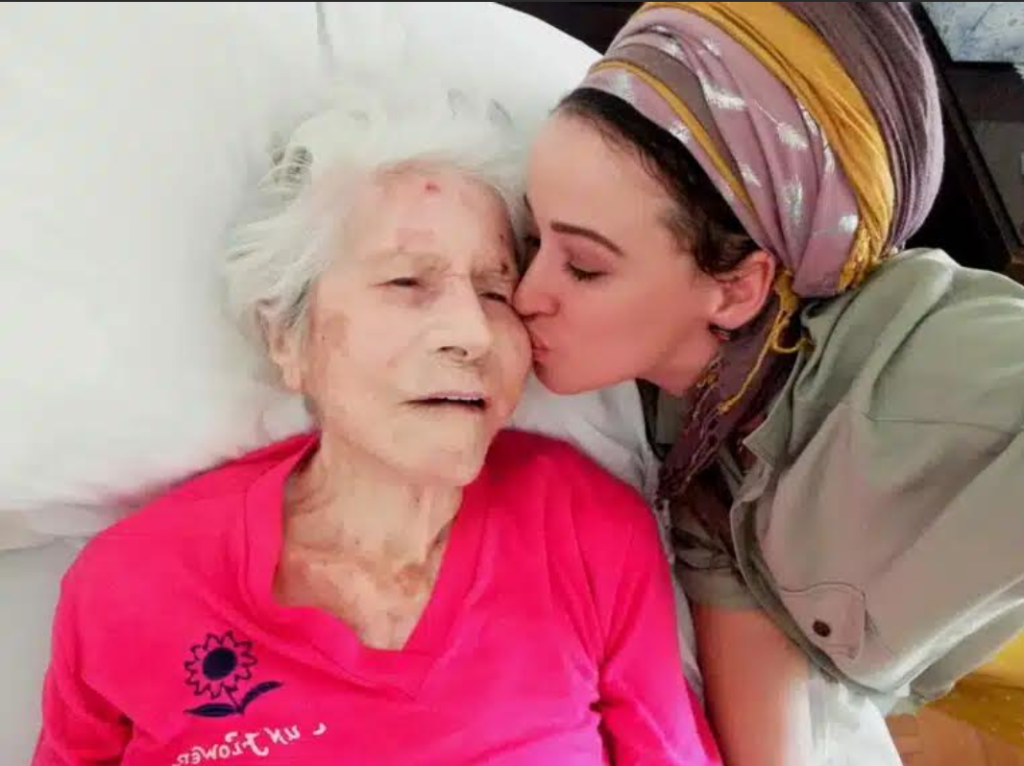
Franny Weissman with her husband’s Great-Aunt Adelle
Sharon Gelbach @ Impmedia.co.il
After a talk I recently gave ahead of Rosh Hashanah, a teenage girl came up to me and asked, “What is the most important thing my family and I should do on Rosh Hashanah?”
“Listen to the shofar,” I told her. “That’s the central mitzvah of Rosh Hashanah.”
“Oh, then we’re fine,” she said. “We already heard the shofar during Selichot at the Kotel.”
That’s when I realized I had gotten something wrong.
I had just given an entire talk filled with ideas for Rosh Hashanah—ideas about the media, social networks, self-improvement, but somehow, I had failed to explain the most basic thing of all.
Then I told her that hearing the shofar during Selichot is a meaningful custom, but it’s not the same as hearing it on Rosh Hashanah, because it is a Torah commandment to hear it on Rosh Hashanah. The ba’al tokeah recites the special berachah before he blows the shofar, and while he’s blowing it, we remain silent and simply listen.
This year, since the first day of Rosh Hashanah falls on Shabbos when we do not blow the shofar, we will only hear it on Sunday, the second day of Rosh Hashanah. The shofar is usually blown between the morning and early afternoon in shuls throughout the Jewish world. Many communities publish the times in advance, so it’s worth checking. Or you can simply come to shul for the service.
The girl thanked me and said she would tell her parents. Then she added that until now, she thought apples and honey were the main thing on Rosh Hashanah.
We are living at a time when there’s a deep desire to connect, learn, and do more, but many people are still missing basic knowledge about what it means to be a Jew.
So, with all due respect to the short ideas and inspiring messages I post every morning, sometimes, before explaining that the word shofar is connected to shipur, improvement, we need to start with something much more basic: What are we supposed to do? Where do we do it? When? And how?
Don’t be embarrassed to ask. And don’t hesitate to explain it to someone else.
Thank you to the teenage girl from Or Akiva who taught me an important lesson last night.
{No Matter How Far You Stray
If I had not heard this story with the names of actual people, I never would have believed it. But Franny Weissman shared the following tale with me which actually began more than 100 years ago:
“I came on aliyah from the United States and married Evyatar, a Sabra whose grandmother’s parents and two siblings were murdered in Auschwitz. Of all her siblings, ten survived and nine of them decided to make aliyah to Israel together, but one sister settled in the United States and never revealed to anyone that she was Jewish. This sister decided that after the Holocaust, she would not bring any children into the world and eventually she married a non-Jew, never revealing her true origins, not even to him.
“When her family tried to connect with her, she ignored them. Over and over, I heard the story of Evyatar’s Great-Aunt Adelle. There are more than 350 family members now in Israel—four generations—but she had always been the one missing piece of the puzzle.
“Two years ago, I was asked to come to the United States to recruit girls for an educational program in Israel. My husband encouraged me to take on the mission and said, ‘Even if you just bring back one soul to Israel, it will be a great success.’ They scheduled a lecture tour all across the United States, and one of the lectures I gave was in Florida. As it turned out, I was just five minutes away from the home of Great-Aunt Adelle. I couldn’t believe it. I knocked on the door and asked for Adelle Schwartz. The housekeeper said there was no one there by that name, but I realized that she had changed names. I entered and saw someone who looked a lot like her siblings. I connected them through a video chat and they began to converse in Hungarian. Soon, they were crying and sobbing. Even the housekeeper cried.
“Before we parted, I took her hand and said, ‘Adelle, Hitler is gone. The war is over. You have a large family now. You’re not alone. No matter how far away you are, you can always come back. Don’t let Hitler win. At the very least, come to Israel to be buried.’
“We parted with great emotion, and stayed in touch. Recently, we received word from an American attorney that Adelle had passed away at the age of 102. Then we learned she had changed her mind: instead of being cremated, she wanted a Jewish funeral.
“We did everything we could to bring her to Israel, the country she had tried so hard to remain distant from,” said Franny Weissman with obvious emotion. “Her funeral was held at Moshav Nir Etzion, and she was buried in the family plot. We were all there, and it was one of the most moving experiences of my life.
“We saw with our own eyes the meaning of the verse: ‘Even if your exiles are at the end of the Heavens, Hashem, your G-d, will gather you from there, and He will take you from there’ (Devarim 30:4).
“As my husband told me, ‘If you bring even one soul to Israel, it will have been a great success.’” n
Translated by Yehoshua Siskin and Janine Muller Sherr.
Read more by Sivan Rahav Meir at SivanRahavMeir.com.