


Eric Adams Exits The Stage: What His Withdrawal Means For New York City—And Why Curtis Sliwa Must Seize The Moment
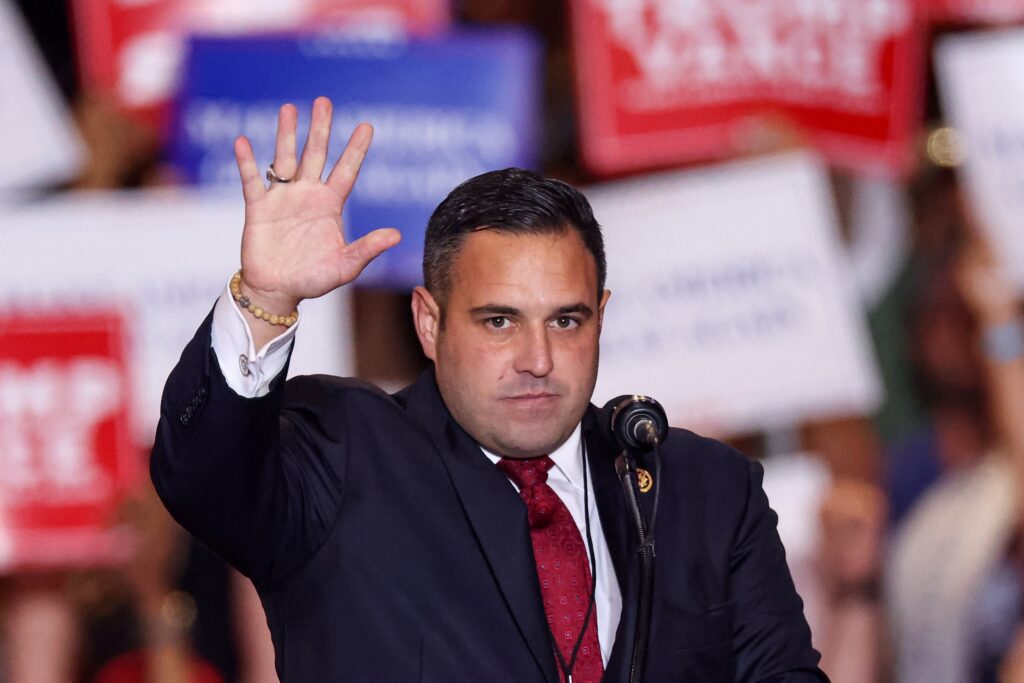
By: Congressman Anthony D’Esposito
Eric Adams Exits The Stage: What His Withdrawal Means For New York City—And Why Curtis Sliwa Must Seize The Moment
The political ground in New York City shook this week as Mayor Eric Adams announced the suspension of his reelection campaign. The decision, shocking in timing if not in inevitability, has already sent ripples across the city’s political landscape. For years, Adams branded himself as a pragmatic Democrat—a former police captain who promised to restore order and tackle crime with credibility. Instead, his tenure became defined by mounting crises, persistent scandal clouds, and plummeting public confidence.
Adams’ exit creates a rare power vacuum in the most influential city in America. But it also presents a once-in-a-generation opportunity for Republicans to redefine urban leadership. The candidate best positioned to capitalize on this moment is none other than Curtis Sliwa, the fiery Guardian Angels founder who has long been the most visible alternative to Democratic mismanagement.
While Adams cited personal and political considerations in suspending his campaign, the reality is clear: his support had collapsed. Polls consistently showed him underwater with key constituencies, including working-class families, minority voters, and suburban commuters who rely on the city’s stability. There is no question that the failure of Democrats in blue cities across the Nation hurt Adams.
On top of this, persistent ethics concerns, rumors of corruption, and the revolving door of staff departures created an aura of dysfunction. Even if no single scandal was fatal, the cumulative effect undermined his credibility. By late 2025, Adams was increasingly a lame-duck mayor, with donors retreating and allies eyeing the exits. The suspension of his campaign is less a surprise than a concession to political gravity.
Adams’ exit doesn’t just reshuffle Democratic factions—it fundamentally alters the dynamic of the race. For decades, incumbency in New York City has been an almost insurmountable advantage. Adams’ withdrawal removes that shield, leaving Democrats vulnerable. Without an incumbent to defend, the field resets, and Republicans gain a clearer contrast. Voters dissatisfied with the status quo no longer need to weigh Adams’ record against abstract promises. The choice is now between continuing Democratic policies or charting a new direction.
Curtis Sliwa is not a traditional politician—and that is precisely his strength. In an era when distrust in political insiders is at historic highs, Sliwa’s outsider persona resonates. He is brash, unapologetic, and speaks the language of everyday New Yorkers in a way few others can. Sliwa has unshakable law-and-order credibility. For decades, he has patrolled the streets and built the Guardian Angels into a symbol of community-led safety. He doesn’t need to manufacture law enforcement credentials. He embodies them. He also has a grassroots base that runs deep across boroughs. While Democrats dominate City Hall politics, Sliwa has cultivated a loyal following from Staten Island to Queens. He connects with working-class families who feel abandoned by the political elite.
Perhaps most importantly, Sliwa’s voice is authentic. In an age of carefully scripted candidates, he is blunt, unscripted, and passionate. That authenticity, while sometimes polarizing, is precisely what cuts through the noise in a crowded field. Every major issue that sank Adams—crime, migrants, corruption—plays directly into Sliwa’s strengths. He can credibly argue that Democrats have proven incapable of governing the city and that it is time for a new approach.
If Curtis Sliwa wants to translate this opportunity into victory, he must act decisively. He must frame an era of Democratic failure. His message should be simple: they have had their chance, they failed, and now it is time to give him the opportunity to fix it.
To win, he must also broaden his appeal beyond his loyal base. His hardcore supporters will always stand with him, but he needs to reach independents, moderate Democrats, and minority communities who are disillusioned with the current leadership. His authenticity can break through if he shows respect, listens, and tailors his message to those communities. Sliwa must also present bold and practical solutions. Voters do not just want rhetoric; they want results. On crime, he should double down on subway safety, expand NYPD presence, and boost police morale. On the economy, he should commit to cutting red tape for small businesses, lowering taxes, and making the city livable again. His media savvy is another critical asset. Sliwa is a natural on radio, TV, and social media. He must dominate the media cycle, offering blunt soundbites that contrast with Democrats’ bureaucratic jargon. If he owns the conversation, he defines the race.
Finally, he needs to unify the Republican Party. The GOP in New York City is often fragmented, but this is the time to rally. If Sliwa becomes the consensus candidate, he avoids a fractured vote and maximizes his strength.
To be clear, the path is not easy. New York City remains overwhelmingly Democratic. Sliwa faces an uphill climb in terms of fundraising, institutional support, and voter registration realities. Democrats will rally hard to prevent a Republican breakthrough.
Yet history shows that when conditions align—when crime, corruption, and dissatisfaction converge—New Yorkers are willing to break tradition. Rudy Giuliani’s 1993 victory came after years of frustration with Democratic mismanagement. In 2026, the same formula could apply.
Eric Adams’ suspension of his campaign has transformed the political landscape of New York City. For Democrats, it is a crisis of leadership. For Republicans, it is the opportunity they have long awaited.
Curtis Sliwa, with his unmatched street credibility, grassroots following, and blunt authenticity, is uniquely poised to seize this moment. He must exploit the failures of Andrew Cuomo and self-proclaimed communist Zohran Mandami. If he can broaden his coalition, present bold solutions, and hammer home the failures of Democratic rule, he can make history.
The road will be difficult, and the odds remain long. But Adams’ exit proves one thing beyond doubt: the political order in New York City is not as fixed as many believed. If Curtis Sliwa steps forward with vision and discipline, he may well rewrite it.
Congressman Anthony D’Esposito was nominated by President Donald Trump to serve as Inspector General of the Department of Labor. Previously, he served in Congress, representing New York’s 4th Congressional District. Anthony served as a Councilman in the Town of Hempstead after retiring from the NYPD as a highly decorated Detective. He also served as Chief of the Island Park Fire Department and helped lead the all-volunteer organization’s response to Super-Storm Sandy. The Congressman appears frequently on Fox News, Newsmax, ABC National News, and 77 WABC Sid and Friends in the Morning. To contact, email [email protected].