
Happy Chanukah
Many of our readers know that I’m about to delve into the history of my struggle with Chanukah. It stems from the sudden passing of my dad after he lit the sixth candle of the chag.
It’s now 36 years later and it feels like a brief eternity.
It was just another night of a happy Chanukah when our home phone rang at 4 a.m. Generally speaking, a call at that hour is not the way good news travels. The reality was quite the opposite.
So, I tell this story every year because it provides me and my siblings with some measure of comfort. I tend to second-guess situations, as is natural, and I often wonder how things might have turned out if life had played out differently. In other words, I challenge reality, as if I could actually do something about it. I suppose that after three and a half decades, I’ve come to the conclusion that I can’t do anything about it.
The reality is that when I begin writing these essays, I don’t know which direction these words are going to take. But right now, I’m thinking about that morning when it was still dark outside and the ground was covered with a light snow from earlier that evening.
As I drove up Ocean Avenue from Flatbush to Crown Heights, I felt a certain calm and a sense of peacefulness with a subconscious understanding that these were the moments I was destined to experience—and the occasion I would reluctantly have to rise to.
My dad told me about a decade earlier that it was his and my mother’s choice to be interred in Eretz Yisrael. I still vividly recall the time he motioned for me to come up to his bedroom where he showed me the location where he kept the deed to his “karka,” or burial plot in Beit Shemesh, about a twenty-minute drive from Jerusalem. But beyond that, we didn’t talk about it.
In fact, even though we all knew about their wishes to be buried in Israel, we didn’t discuss the matter amongst ourselves until that morning at sunrise on the sixth day of Chanukah, 1989 (5750).
The fact of the matter is that when I arrived at our childhood home, I saw two Hatzalah ambulances and an EMS ambulance double parked in front of our house. When my mom called me at 4 a.m., she said, “I can’t wake daddy up.” In a sense, on that day, as I drove up Ocean Avenue, that was the day I felt that I was now a man. I can’t explain what made me feel like that, but even as I reflect upon those events 36 years later, I still feel that despite numerous life cycle experiences, that day was the day I crossed that line, if such a line exists.
I walked into the house and there was a quiet tumult. A cousin who is a Hatzalah member was there as were my father’s sister and her husband, my aunt and uncle. I looked around and once I realized that the efforts to revive my dad (who’d had a cardiac arrest) were not going to be successful, I just said, “Okay, we’re going to Israel.”
My aunt heard me and right away displayed a look of surprise. You see, up to that point, the family members who passed away in earlier years were all buried near the resting place of the Rebbe at the Ohel in Queens.
It was a cold and wintry Thursday morning of December 28, the 30th of Kislev, Rosh Chodesh Tevet. Because Shabbos would start early the next day, Friday, Erev Shabbos Chanukah, the latest flight out of JFK to Israel was at 4 p.m.
There was no discussion, just a quiet understanding that I would be the one to go to Israel with my older brother, Binyomin, who as you know was niftar almost two months ago. As far as I can recall, the two of us traveled together to Israel several times to observe my father’s yahrzeit.
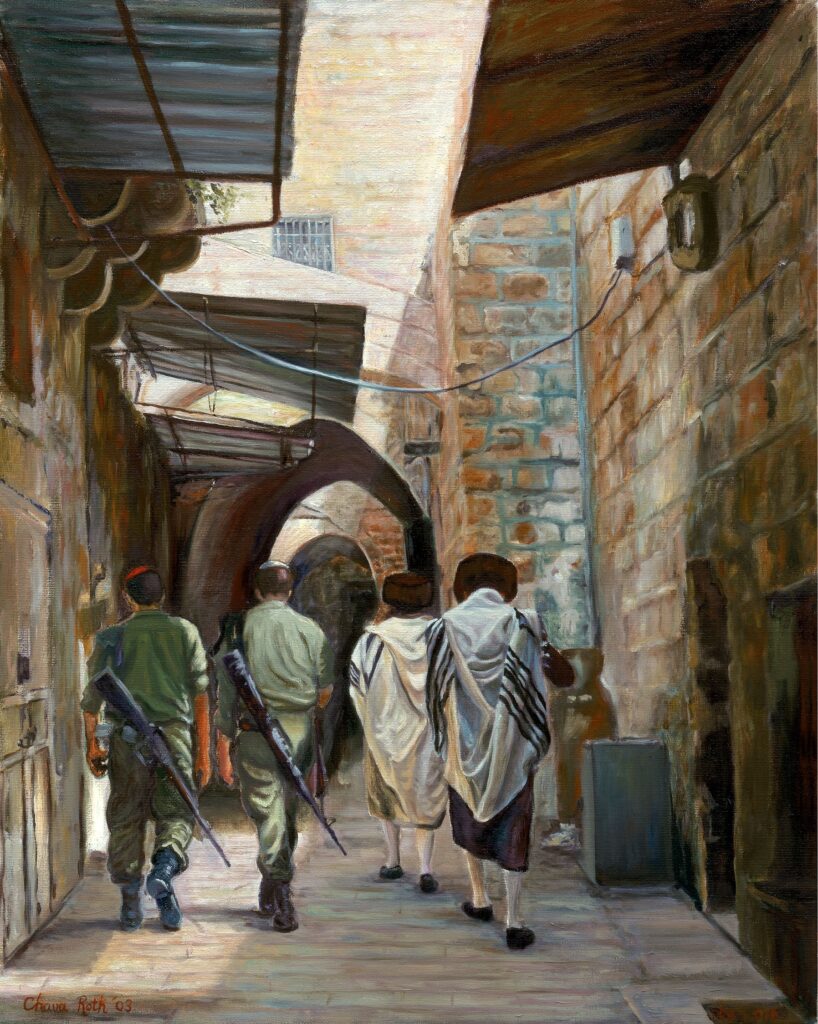
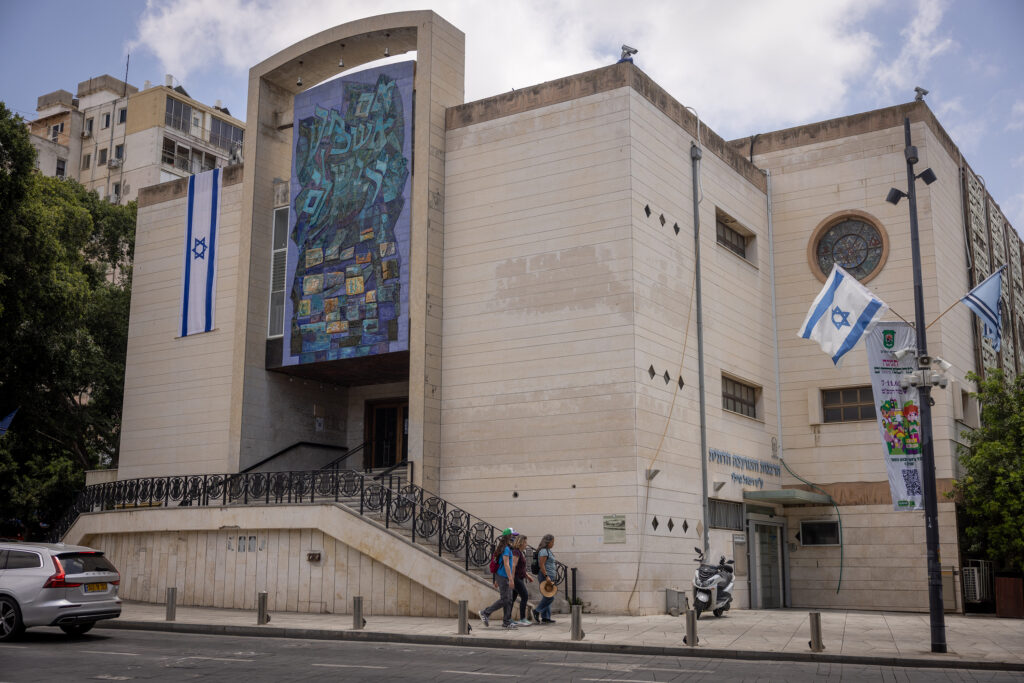
When the yahrzeit would occur on Shabbos—as it does this year—he was my partner who shared the Amud with the long and winding Shabbos Chanukah davening usually at the Tzemach Tzedek shul in the Old City of Jerusalem. That was usually followed by a Kiddush and a farbrengen with memories and niggunim as a way of celebrating my dad’s life.
Over the years, I’ve often thought about what our father left us in terms of davening on his yahrzeit. That is, when it occurs on Shabbos. There’s three Torah scrolls that are used or the usual Torah reading, plus another for Rosh Chodesh, and still another for the Chanukah reading. Then there is Hallel, Yaaleh V’Yavo, and Al Hanisim, and on it goes. It is the one week of the entire year when every word on the page is recited except for the page number.
Observing my dad’s yahrzeit was an event that moved through various phases. When my father passed away rather suddenly 36 years ago, my siblings and I had to deal with it on several levels. First off, in his will he made the specific request that one of his children visit his kever in Beit Shemesh on his yahrzeit. Of course, over these many years we’ve done that and much more.
I often wonder what he was thinking when he made that the first paragraph of his legally binding will. Did he think that perhaps we were not going to visit him at least on his yahrzeit, and as it turned out all these years later, numerous times over the course of the year?
So, I’m still guessing and imagining that he just wanted to make sure. Frankly, probably a week doesn’t go by when someone doesn’t visit his kever in Beit Shemesh or at least stands there in silent contemplation, communing in some fashion with the neshamah that we understand has a presence at the physical kever.
As mentioned earlier, this year the yahrzeit falls on Shabbos. But aside from having a Chanukah party as we did even the year he died, that event will bring the family together and will also serve as a yahrzeit seudah as we get together and remember and talk about our patriarch.
My dad wanted to make sure that he is buried in Israel, and now after all these years he (and my mom and in-laws who are inches away) will be visited near his yahrzeit by three great-grandchildren who are learning Torah in Eretz Yisrael.
Sure, you can observe a yahrzeit with a seudah, but when your great-grandchildren stand at your keversaying Tehillim, can you be more alive than that?
Earlier this week was the 141st birthday of my grandfather, Aaron Berger. He was my mother’s father, who was born in 1884 and passed away in New York in 1975. He came to the U.S. from Eastern Europe in 1912.
I don’t know the specific circumstances but his wife, our Bubby Chaya Malka, arrived in New York two years later in 1914. She was the youngest of 18 children. We were very close to both of them because as we grew up a bit, they were the ones who were our constant babysitters so my parents could spend an inordinate amount of time traveling and seeing the world.
To me, he was always Zaidy. And it was difficult for me to see or think of him as anything but an older gentleman who it seemed came to this world as a grandfather.
He was tall or at least taller than the rest of us except for my brother Binyomin, a’h, who was probably the same height as Zaidy. For so many years as we were in our teens (that is, me and Yossy), we went to shul on Shabbos morning with Zaidy. First it was a big shul on Troy Avenue where the number of congregants was quickly dwindling. Then it was the shul across from his apartment on Montgomery Street, which is still there—the Chevra Shas.
It was a beautiful and friendly shul and we knew everyone there and they knew us. I don’t have the opportunity to be there too often these days, but on the rare occasion that I am there, it conjures up great and very deep memories.
This year will be his 50th yahrzeit on the third of Tevet. As it turns out, because it is so close to my father’s yahrzeit on the 30th of Kislev and for so many years we were very exacting about being in Israel for my father’s yahrzeit, a year doesn’t go by where I do not receive a text from my sister Peshe telling me that Zaidy’s yahrzeit is coming up on the third of Tevet and that we should say Kaddish.
My grandparents had just two children, my mom and her brother Manny. Their son joined the army to fight in World War II against the Nazis. He was injured in the Battle of the Bulge and participated in the storming with tens of thousands of U.S. troops on the beaches at Normandy, France. He was injured in that battle and after recovering, he was sent back home. He was just 18 years old when he joined the military.
He died a few years ago at the age of 96. He had a military funeral that is accorded to all veterans. There is a military cemetery deep in Long Island near Riverhead where I attended the funeral along with my brother. Uncle Manny was buried in the Jewish section of the cemetery. He was buried in a coffin that was draped with an American flag which was folded as per the military protocol and presented to us as his survivors. He had no children, but a few years later, his wife of many years passed away and was buried alongside Manny.
My life as a kid with that Bubby and Zaidy was purely idyllic. Our connection was so natural and our love was just as deep. It was such a long time ago that I sometimes wonder how I can hold onto those memories. My grandfather was born in 1884, but for people who were born then, it was no different than 2025. That was their time and their life. They lived during unsettled times for Jews and we live in unsettled times for Jews as well.
Of course, it’s different. We have a strong homeland in Israel and the long reach of the IDF. You know how the spies sent by Moshe into Israel said that they saw giants and that the land was therefore impossible to conquer? Today we look around and see mental midgets like for example, Zohran Mamdani. My Zaidy loved to talk politics. When he passed away, Abe Beame had just become the first Jewish mayor of New York. My grandfather thought this was a perfect opportunity for the antisemites to blame everything on the Jews.
He didn’t understand that regardless of who the mayor of New York is, the haters are going to blame everything that goes wrong on the Jews anyway. Today nothing has to go wrong to blame the Jews, they just do it anyway. n
Read more of Larry Gordon’s articles at 5TJT.com. Follow 5 Towns Jewish Times on Facebook, Instagram, and Twitter for updates and live videos. Comments, questions, and suggestions are welcome at 5TJT.com and on Facebook, Instagram, and Twitter.