
Iran: Both Sides
By: Larry Gordon
Many of us on this side of the page would have liked to see President Trump and Prime Minister Netanyahu finish the job they started against Iran almost three months ago. There’s no question that Iran deserved whatever punishment they absorbed and would have absorbed had U.S. and Israeli military forces continued their operation.
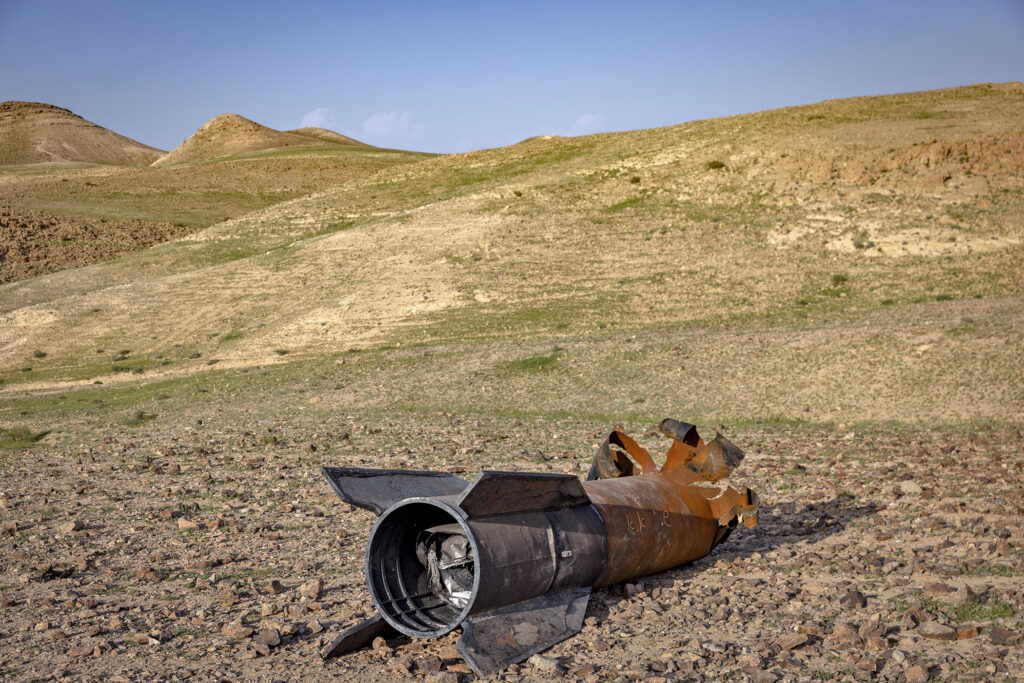
Part of Iranian ballistic missile
Credit: Chaim Goldberg/Flash90
But at this point, there were so many considerations that went into negotiating a deal with Tehran, including the fact that there are still no immediate concessions on the “nuclear issue.” At this point, the entire deal could fall apart as U.S. forces continue to launch self-defense strikes as they defend their forces during the ongoing ceasefire. Just bombing Iranian cities would translate into killing large numbers of civilians and at the end of the day, the U.S. and a few other countries would be left with the bill to rebuild this country with a population of 90 million people.
Iran is not anything like the Arab Gulf countries that only recently have come around to recognizing and on some level dealing with Israel as a formidable country in the region.
At this early stage in the Iran peace deal, President Trump is talking about anticipating the entrance of a number of Gulf countries into the Abraham Accords, which translates into some level of a diplomatic relationship and perhaps trade between these countries and Israel. Though a few days later, one by one those countries are rejecting the Trump dream.
Trump went so far last weekend as to not even discount the possibility that at some point down the road, even Iran might be able to join the Abraham Accords. Trump foresees a much different Middle East than what we’ve been dealing with for most of the last century.
What was a little imbalanced and disjointed was how the president listed all the countries in the Middle East that supported the proposed agreement with Iran, but only later in his communique added that he had also spoken by phone with Prime Minister Netanyahu and that went well too, according to Trump. It appears that even in an announcement about the prospects of peace, the name Israel could not be mentioned in the same paragraph as Saudi Arabia, UAE, Kuwait, Turkey, Jordan, and Egypt.
It’s somewhat disappointing that Mr. Trump has to go so far as to intentionally omit any mention of Israel from these not-so-distant possibilities. On Sunday night and Monday morning, the president expressed the hope that these Muslim countries will one day be amenable to joining the Abraham Accords, once the agreement with Iran is solidified.
Again, there was no direct mention of Israel alongside Saudi Arabia, the Emirates, Qatar, Pakistan, Turkey, Egypt, Jordan, and Bahrain. But the fact of the matter is that by virtue of its very nature, if you are a member of the Abraham Accords, then you automatically have a relationship on some level with Israel.
The president also stated he believed that at some point in the future, even Iran can join those accords. It’s important to note that Egypt and Jordan have had peace agreements with Israel for more than 40 years. In terms of the Abraham Accords, Bahrain and the Emirates are already member states.
Some of the countries in the Gulf region and elsewhere are quite a long distance from striking up civilized relationships with an advanced society like Israel. Take Turkey, for example. President Trump insists that he likes and has a good relationship with President Recep Tayyip Erdogan, but it seems nearly impossible for the Turkish president to utter a decent or conciliatory word about the Jewish state.
On the matter of Iran. How can a country like the U.S. be satisfied or have faith in a signed agreement with those whom Trump commonly refers to as “crazy people.” If they are indeed as crazy as the President says, how can anything they say or sign have any credence or validity?
The Iranian regime is not comprised solely of military madmen in search of expanding their borders and regional influence; they are deeply sick, religious fanatics who believe their religious obligation is to kill infidels—especially Jews, and especially those in Israel.
Most of us who have a tendency to root for the good guys over the bad would have preferred to see the Iranian regime not just toppled, but destroyed. But then again, after 84 days there has been no uprising emanating from the Iranian people. There is no one in the military or religious hierarchy that had the fortitude to overthrow the corrupt murderous dictatorship that holds the country in their grip.
So, while we may have wanted to see Trump do more militarily, it’s not a long stretch to put yourself in the president’s shoes and consider that if the Iranian people are okay with following these nutty fanatics, how is he from 5,000 miles away going to be able to convince them to see things differently?
Iran, including its dangerous military, are at the end of the day run and directed by people who subscribe to a radical, out-of-control faith that believes in killing, not only their own people, but many others.
The Mullahs and the Ayatollahs see their wild killing sprees as their ticket to paradise. At this point I have to admit that while I did not conduct extensive research on the subject, I did spend time watching eight episodes of a program called “Tehran” on Apple-TV. The people who put the program together demonstrated quite a bit of detailed and extensive research.
While this is a mostly fictionalized account of what goes in Tehran, it also depicts with clarity how committed the Iranian leadership is to murdering people, and if they’re not sure they’re killing the right person, they go ahead and kill them and deal with the fallout later.
Another important fact about how Iran operates is the extent to which both the Mossad and the CIA are deeply entrenched in the secret police and even the wild and crazy people who run the infamous Revolutionary Guard Corps.
It appears both in fiction as well as in reality that the Iranian leadership never knows who they are interacting with: their own people, the Mossad, or the CIA. There’s a story that was told about how the leadership in Iran created a commission to investigate how deeply the Mossad had infiltrated the Iranian military. As it turns out, at the end of the process they discovered that the person in charge of the investigation was indeed a Mossad agent.
How do you think it was possible that Israel managed to kill Hamas leader Ismail Haniyeh while he was in Tehran last year? He was staying in what was considered a safe house for a dangerous figure like himself. According to reports, while Haniyeh was in the shower, a bomb that had been implanted as much as a year prior was detonated, blowing up Haniyeh along with his security detail.
President Trump knows that Iran cannot be trusted to carry out any agreements they pretend to sign. Part of their religious zealotry is to deceive and double-cross. That is who they are and what everyone involved with this expects of them.
Over the last three months, at least three levels of Iranian leadership have been eliminated by a combination of the U.S. and Israeli Air Force. All of those people needed to be eliminated in order to get to a tier of leaders that might have the ability to think a bit clearer than those who preceded them.
Trump and Netanyahu believe they are getting closer to those types of people who have a small amount of interest in improving the lives of the Iranian people. We’re not there yet, but we might be inching closer. So far, it’s not yet time to turn off those jet fighter engines. Right now, it’s wait and see and be ready for anything.
Read more of Larry Gordon’s articles at 5TJT.com. Follow 5 Towns Jewish Times on Facebook, Instagram, and Twitter for updates and live videos. Comments, questions, and suggestions are welcome at 5TJT.com and on Facebook, Instagram, and Twitter.