
Musings Of A Shliach From Montana
By: Rabbi Chaim Bruk
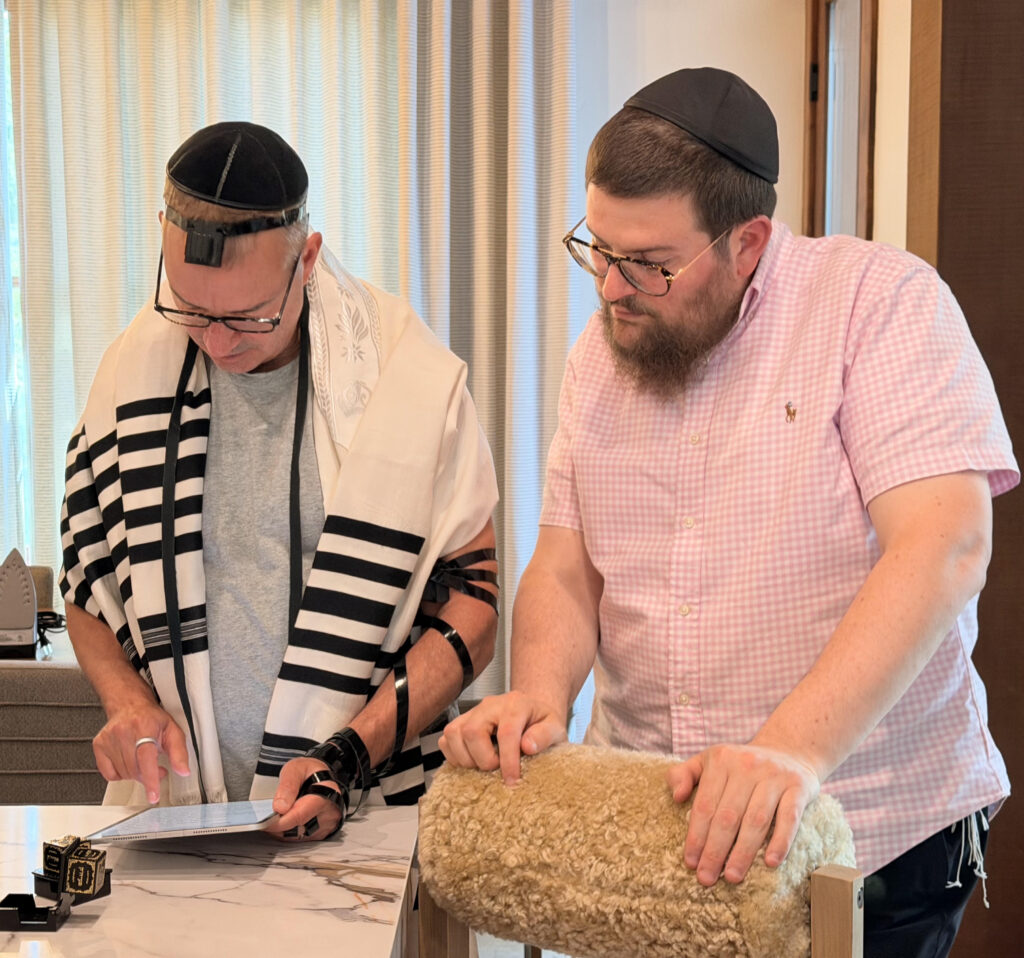
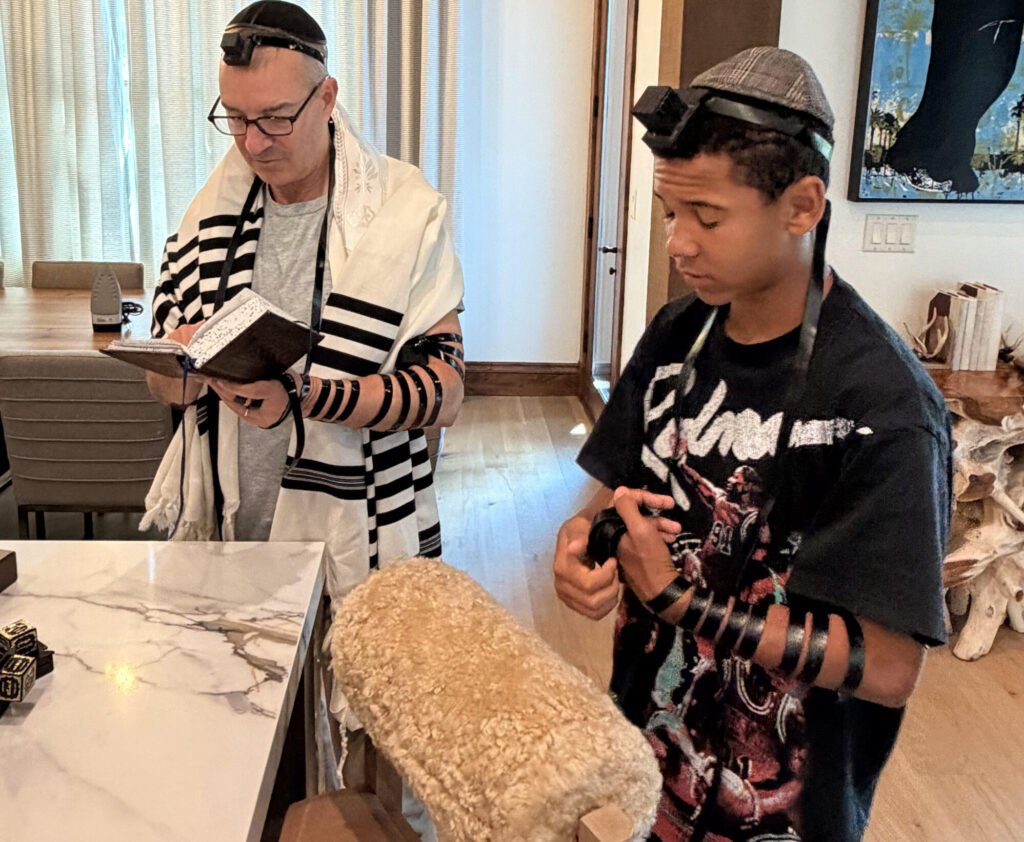
Rabbi Chaim Bruk standing alongside Dan while he recited Psalms
It’s summertime in Bozeman, the time of year when we receive hundreds of calls and e-mails about minyanim. When we give them the lay of the land and what is and isn’t available, they inevitably ask: “Why don’t you have a weekday minyan?” Or “We are three, do you think you have seven available?” or “You don’t have a minyan even during bayn hazmanim, when yeshivas are on break?”
We are happy to answer all questions, but it certainly makes me think about whether minyanim have replaced the art of tefillah, the act of praying itself.
Prayer is not about socializing and forming a community; it’s about connecting with Hashem on a personal level three times each day. Are there any benefits to praying with a minyan? Certainly. That’s why halacha guides us to pray with a quorum, a minyan of ten men. But when that technicality becomes the ikar, the foundation, and we forget about the ultimate purpose of prayer, which is connecting with Hashem, we must step back and ask ourselves how we can get back on track, back to the roots of prayer.
Last Friday, Chavie received a call from her cousin Chaya, who works for the incredible Aleph Institute that helps incarcerated Jews, and is also helping to change the conversation in our country about prison and how to create reforms for so many people who deserve compassion and understanding, despite their crimes.
One of the philanthropists who supports the work of Aleph (and many other good causes) is Dan Loeb, a special Yid who was in Big Sky for a conference, which is why Chaya called Chavie, to see if we could bring Dan some challah, wine, and candles for Shabbos.
So, with Menny in tow, I headed to Big Sky to meet Dan for the first time. Naturally, I brought a tefillinalong in case Dan hadn’t put them on yet. Dan was so excited to receive his Shabbos package and when asked about tefillin, he showed us his tallis and tefillin and asked if it was okay to daven in my presence. Menny, who hadn’t davened yet himself, asked if he could join Dan in prayer. So, both of them wrapped up and did their prayers. It was such a beautiful moment, two neshamos who never met before praying to Hashem each in his own way, joining together to say the Shema.
I learned from Dan that though he was always a proud Jew, he was fifty-eight-years-old when he really embraced Judaism. (He also founded the Simchat Torah Challenge, which you can check out online.) And his discovery of Judaism came about through his special bond with Rabbi Sholom Ber Lipskar of The Shul of Bal Harbor. For five years or so, he had the merit of studying with Rabbi Lipskar and his son, Rabbi Zalman, who has served as the Rav of Bal Harbor since his father’s passing in 2025. If every Yid adored their Rabbi like Dan adores Reb Sholom Ber of blessed memory and Reb Zalman, zol zain gezunt, and if every rabbi would devote himself to his congregants like the Lipskars do, the Jewish world would be better for it.
Dan, who is a successful businessman and does so much good for Klal Yisroel and Eretz Yisroel, was introduced to a rabbi who wasn’t just looking for a donation or for another member of his congregation, but wanted him to grow as a Jew and embrace his own Yiddishkeit. After davening, he took out his iPad and opened it to his chapter of Psalms, his Kapitel Tehillim, and recited each word in Hebrew so beautifully, having only learned Hebrew in the past few years. He asked me to correct him if he made any mistakes, so I stood alongside him while he read it. It was so sincere, so raw, so authentic. He asked Menny if he too says his own Psalm every day and Menny said “sometimes,” to which Dan responded with something like, “It brings great blessing to recite your chapter of Psalms each day.”
In this week’s Torah portion, V’etchanan, we read about Moshe and his 515 prayers in which he beseeched Hashem to allow him to enter Israel. Imagine praying for the same things 515 times and G-d responding “no” to each of these prayers! Imagine the yearning. Imagine the disappointment. Imagine the resolve to not give up on praying. Yet, Moshe was intimating to the Jew that prayer isn’t about whether you get the response you are seeking; the prayer in itself is the blessing. When we connect with Hashem, one-on-one: speaking, reporting, beseeching, yearning, and bonding, it creates a kesher, a connection that is so valuable and so precious, no matter the outcome.
We read this parashah during the week of Tisha B’Av, when we mourn the destruction of both Temples and many other devastating events in Jewish history. We’ve been praying for the Third Holy Temple for close to two thousand years, yet we will do it again. We will remind Hashem that we are still in exile and we don’t accept the galus, the dark reality of our current situation as a long-term plan, as we wait and hope for Mashiach to come and for goodness and holiness to ensue. So, does that mean we are praying in vain? Do we have to see Mashiach today or else the prayers are worthless? Of course we want Mashiach today, but no matter the outcome, our prayers are always worthwhile.
In 2016, I wrote an article for the Huffington Post entitled, “G-d’s infertility.” In it, I wrote the following: “When studying Torah, the Jewish Testament, we read of eminent couples who struggled with infertility. Abraham and Sarah, Isaac and Rebecca, Jacob and Rachel, Manoah and his wife, Elkanah and Hannah, and the Shunamite woman and her husband. I pondered, why so much righteous infertility? Is G-d sadistic to those closest to Him? What I learned was that G-d has a peculiar appreciation for the prayers of the upright. While many wonderful souls pray for health, wealth, and good kids, there is something about the prayers of those seeking children that is so raw, so deep, and so real that it connects those parents with G-d in ways that are unfathomable. In addition, on many occasions, dealing with the hardship of childlessness can bring a couple closer to each other. The cries of hearts that are truly broken can attain unadulterated wholesomeness.
“While those biblical figures eventually merited to have children like Isaac, Jacob, Esau, Samuel, Samson, and Habakkuk, it doesn’t turn out that way for everyone. Whatever the end result for Chavie and I, it has become clear to me that G-d is fascinated by the sincerity of those moments, and, as the third partner in the marriage, chooses to be infertile too so He can enjoy this unique closeness.”
That is the point. Prayer should not be explained as a mechanism for G-d to give you what you want. The word tefillah, which is translated as prayer, actually means “connecting” or “gluing together” and when shared in that way, it changes our perspective on what it’s all about. Watching Dan say his Psalm with such soulfulness reminded me that it’s not about the outcome. Moses did not end up in Israel, but each of his 515 prayers were so special and cherished by Hashem.
In a discourse of the Alter Rebbe, Rav Shneur Zalman, author of the Tanya (a discourse discovered in 1962) he tells us that his teacher Rav Dovber of Mezritch taught him in the name of his teacher the Baal Shem Tov, that a person should say their Psalm each day. So, when you’re born, it’s Psalm 1 for the first year, and when you turn 1 it’s Psalm 2, so it’s always one Psalm ahead of your age. In addition, the Previous Rebbe, Rav Yosef Yitzchak Schneerson, writes in a 1906 letter that we should also say the Psalm of our children and saying it is a blessing to keep them on a Jewish path. Does it work? I don’t know, but I do try to say the Psalms for me, Chavie, and all five kids each day.
A few years back, a Jew from Monsey reached out to me about his son who was living in Montana and was struggling spiritually and physically. He felt hopeless and for good reason. Yet, I told him that while I don’t have any out of the box ideas to help his son, I do know of the custom of saying the personal Psalm of his son. I’ve shared this with many others over the years and it’s simply a way to speak to Hashem about our children and their well-being and to connect us with our children on the deepest level in the process.
Learn from Dan. No matter how busy you are or how charitable you are, set aside a few minutes each day to say your Psalm and the Psalms of your loved ones.
Rabbi Chaim Bruk is co-CEO of Chabad Lubavitch of Montana and spiritual leader of The Shul of Bozeman. For comments or to partner in our holy work, e-mail [email protected] or visit JewishMontana.com/Donate.