


Musings Of A Shliach From Montana
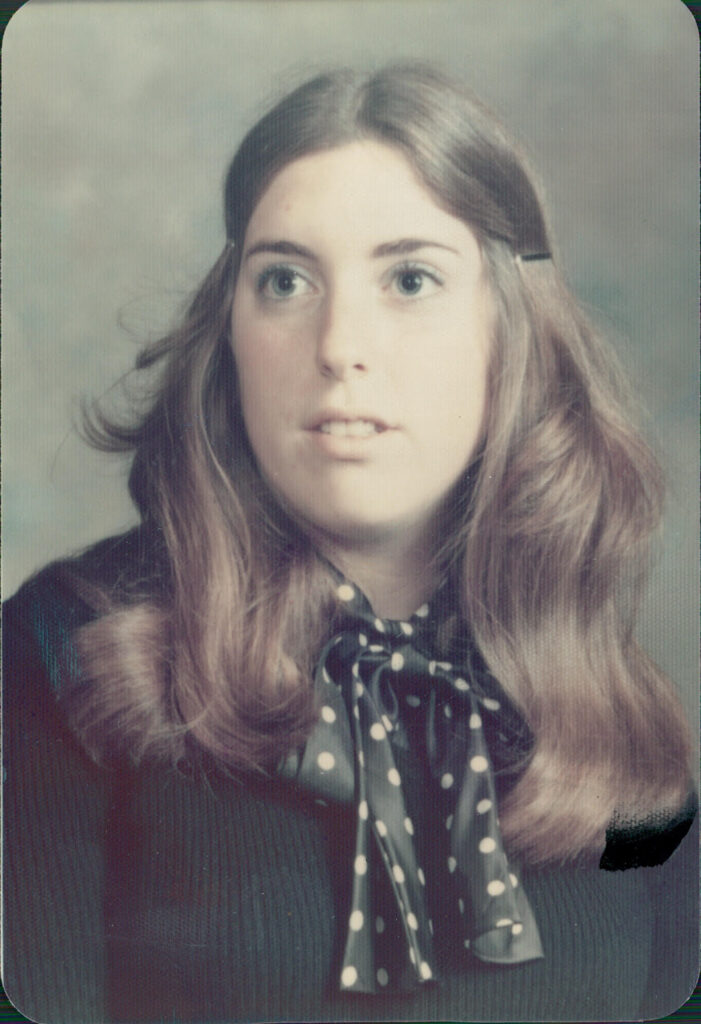
Rabbi Chaim Bruk’s mom, Chanchy, in her late teens
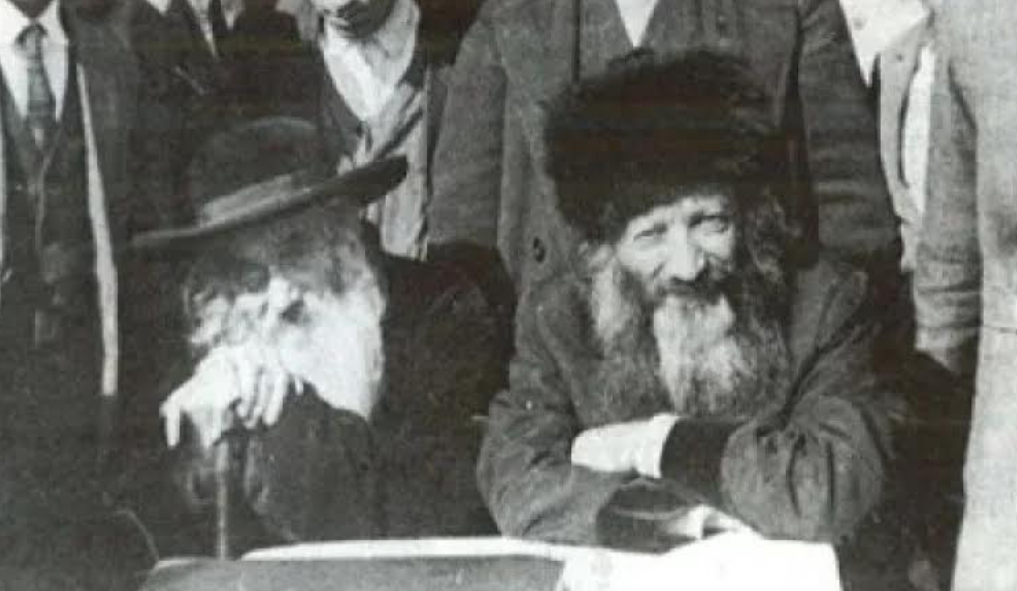
Rav Yosef Chaim Sonnenfeld and Rav Kook worked together for the furtherance ofYiddishkeit in Eretz Yisrael
It’s wonderful to be back in the saddle.
Our trip to Europe was fantastic. We enjoyed seeing the beauty of Hashem’s creation and many historical sites, but there’s nothing like home, especially when home is Bozeman, Montana. We’re already knee-deep into Tishrei preparations as the yomim tovim are right around the corner. We’re also simultaneously juggling the growing local attendance and never-ending groups of visitors during Elul.
While life is super busy, I want to pause to recognize how blessed we are that we can come back to a community that misses us and loves us. I’ve never been a rabbi anywhere but Bozeman, so I don’t know if that’s the norm, but to see the smiles and hear the kind words from our community members on our return from a family trip is really special. When Rav Yehuda says in Tractate Makkos that “I learned a lot from my teachers, even more from my colleagues, but the most from my students,” I think I can relate. When a community is so diverse, it allows its leaders to learn from so many different experiences, and for that I’m grateful.
Chavie and I have been working on something called “Avoda Pnimis,” which has its foundation in Chassidus. In short, it’s the Avoda of negating any form of Divine service that is external in nature, that is pushed onto us by society, including Lubavitch society. Instead, we are meant to focus inward. Not that we’ve ever been conformists or followers, but making changes internally, focusing on what really matters, and investing in personal transformation and positive change is extremely hard, but it leads us to think less about what we’ve being told on the outside and instead try to harness the inner strength, the G-d spark, to serve Hashem with integrity.
I think that with age I’ve become more emotionally in-tune with myself. I find myself being more grateful, more appreciative of the good I see in others, and I find that I’ve also become more nostalgic, wanting to connect with my family history and my family’s ancestral story.
On Wednesday, a couple from Monsey visited our shul and joined our Wednesday night parashah class (you’re all welcome to join on Zoom). Before class began, the husband told me that when he was six-years-old, his mom passed away and my mother, OBM, and tsu lange yorn, her closest friend, Fradel Hershkowitz (Kotlarsky), who were just 17 at the time, came to his house and taught his 12-year-old sister how to be a Balebusta. They taught her how to cook, sew, clean, and do laundry. Two high schoolers from Beis Rivkah showed up for a family in need. Getting this thank you was like getting a million-dollar donation. It felt so good, so sweet, and it was like a nod from my mom in heaven. It means more to me than it ever did before, which is probably why I stopped in Bratislava.
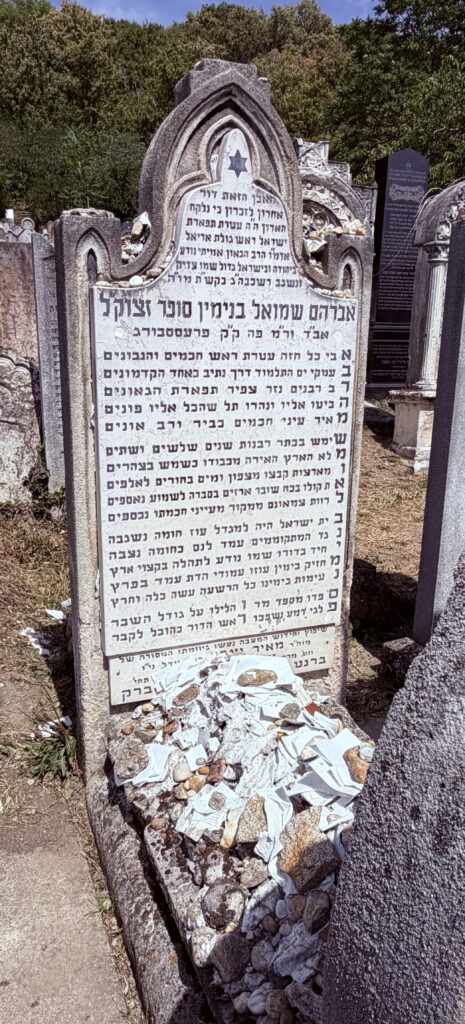
In general, when we’re traveling with the kids, we don’t shlep them to kevarim, even Kivrei Tzadikim. We use the trip to focus on family time. It’s kid-centered and my kids don’t find long drives to holy resting places enjoyable. Yet, while heading from Vienna to Budapest, I couldn’t resist stopping by to say a prayer at the resting place of the Chasam Sofer, the Ksav Sofer, and the Shevet Sofer. You see, my Aba Reb Levi Yitzchak, was the son of Chana, whose maiden name was Scheinberger. Her mother, Miriam Rochel, was the daughter of Rav Avraham Aaron Sonnenfeld, son of Rav Yosef Chaim Sonnenfeld, Zatza”l, co-founder of the Eida HaChareidis and the Chief Rabbi of Yerushalayim until his passing in 1932.
Born in the Austrian Empire in 1848, HaRav Sonnenfeld joined the yeshiva of the Ksav Sofer in Pressburg (Bratislava) in 1864 at the age of 16 and eventually emigrated to Israel in 1873, where he went on to build the frum community and fight for authentic Yiddishkeit. For me to be able to stand by the kever of the Rebbe who taught my Zayde Torah, who recognized my Zayde’s brilliance, and whom my Zayde adored was really special.
In this week’s parashah, Ki Tavo, the Torah tells us “Today, Hashem, your G-d, is commanding you to fulfill these rules and ordinances. You will safeguard them by studying how to perform them, and then perform them with all your heart and all your soul.” Rashi explains that every day “you should regard them like new, as if you had been commanded about them that very day.” The Chasam Sofer wrote that given the fact the Moshe Rabbeinu was repeating the mitzvos to the Jews at the plains of Moab before they entered Israel and before he passed away is a sign that we always need to see the Torah and mitzvos as newly invigorating and inspirational. After 40 years in the desert, it would be easy for the Jews to get stale, to serve Hashem in a spiritually stagnant way without their hearts. But Hashem wants our hearts, so now that we’ve attained the growth and wisdom of 40, it’s time to renew our connection and find the joy, enthusiasm, and zest in Judaism.
We have to always grow to keep it alive.
In this week’s parashah we’re also told that we will pay a hefty price because we didn’t serve Hashem with joyful, gladdened hearts. The Sfas Emes explains that the Torah is emphasizing the source of our harsh exile, which is we didn’t serve Hashem with sufficient joy. The only way to bring Mashiach is to serve Hashem fully invigorated with Simcha Shel Mitzvah, genuine joy in His service.
On Shabbos, Chavie and I were learning one of the Rebbe Zatzal’s drashos from Shabbos Ki Teitzei 1991, the last time the Rebbe spoke on Ki Teitzei before his stroke in the winter of 1992. The Rebbe explained that on Shabbos morning we read one parashah and on Shabbos at Mincha, we read the next week’s parashah. But if both are read on the same day, there must be a connection between the two. It was a very long mystical talk with a great emphasis on elevating ourselves individually out of the Galus mentality and into a Mashiach reality, but one thing he said that I want to share with you is this: Teitzei is about leaving, Tavo is about coming. When a Jew remembers where he came from, the highest spiritual realm, a place that pre-dates the Tzimtzum, the Divinely ordained contractions that brought about the creation of the world, and that we are ultimately going to settle in Eretz Yisrael when Mashiach comes, we don’t get bent out of shape by the challenges of the real world because we have elevated ourselves to a place where we are cognizant of our source and destination, making us unstoppable.
It’s a wonderful way to live, a sort of semi-Mashiach reality because we’ve redeemed ourselves from exile even though we haven’t been truly redeemed yet.
Nostalgia and researching our family roots are okay for the sake of feeling good. But if researching our family history guides us to be more responsible and invigorates us to carry the torch of Yiddishkeit forward so that Rav Yosef Chaim’s devotion to Torah and mitzvos and building Eretz Yisrael doesn’t stop, but continues to be actualized by his descendants, that is monumental and outstanding, allowing us to inch closer to Ki Tavo, our arrival into a tranquil Holy Land with the coming of Mashiach. Let’s make it happen.
Rabbi Chaim Bruk is co-CEO of Chabad Lubavitch of Montana and spiritual leader of The Shul of Bozeman. For comments or to partner in our holy work, e-mail [email protected] or visit JewishMontana.com/Donate.