
Musings Of A Shliach From Montana
By: Rabbi Chaim Bruk
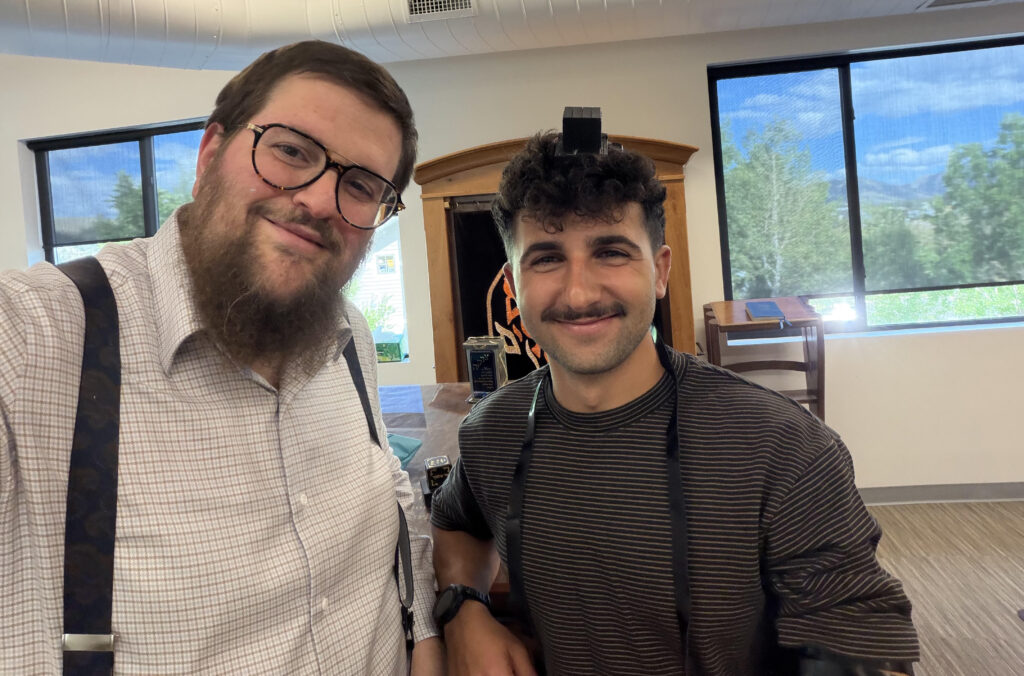
Rabbi Chaim and Harel laying Tefillin
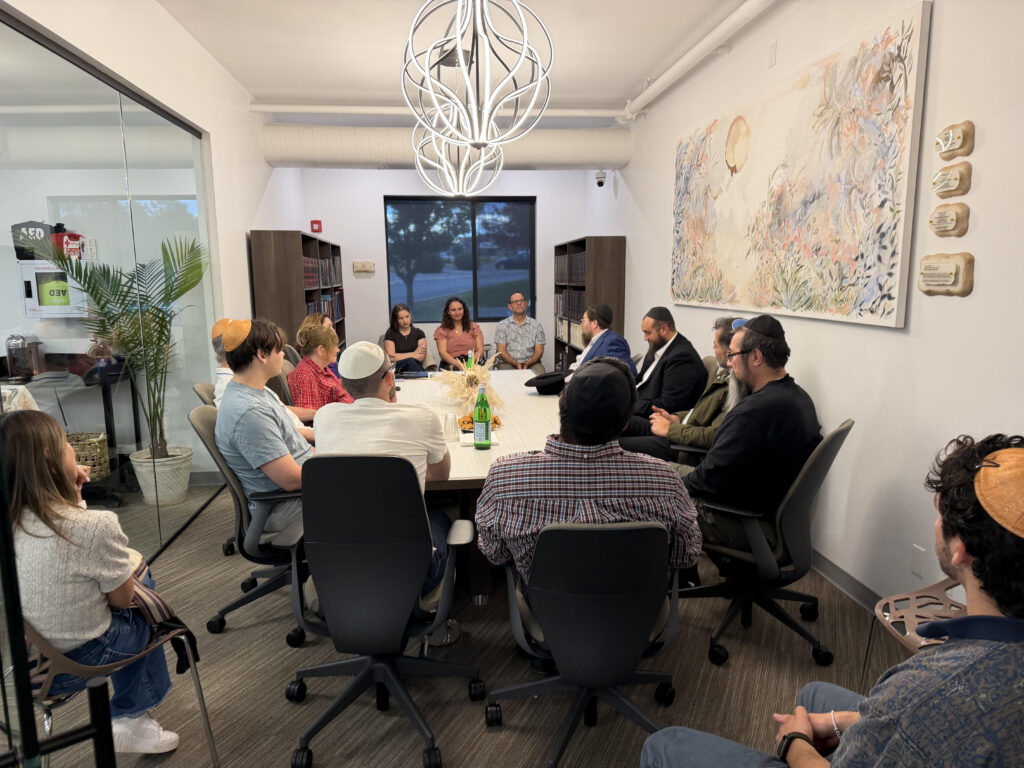
Our meeting with the Stand with Us team
With all the hustle and bustle before yom tov we somehow managed to sneak in another event, this time with Stand with Us, an organization that educates people about Israel, fights antisemitism through education, and uses the legal profession to defend the civil rights of those who align with our mission of supporting Israel and fighting antisemitism.
It’s not necessarily the role of a Chabad shaliach, but we do collaborate with other Jewish organizations on occasion, even if we don’t agree with all their philosophies and tactics. Stand with Us has been a voice of reason on college campuses and high schools for years, and they do a good job free of any politics. We are frumYidden, so obviously our foundation is Torah and theirs is modern history, geography, and doses of Judaism, but they are doing important work and we were happy to host Randy Kessler, the regional director for the Pacific Northwest office, as well as Shachar-Lee Yaakobovitz and Valerie Rutenberg-Watkins, who manage the college and high school departments in our region respectively. I wanted the community to hear what they’re doing, how things changed since October 7, and to give the parents of school-age and college-age children an opportunity to ask questions and learn how they can educate their children about the lies being propagated against Eretz Yisrael. It was educational and those who attended learned a lot, including myself. You don’t have to be a self-proclaimed secular Zionist to defend Israel and learn about its daily realities. History is important. Geography is important. Modern reality is important. U.S. laws are important. If we daven three times a day with countless mentions of Israel, Yerushalayim, and Zion, we should know everything there is to know about the beloved land that is ours.
You can’t be a practicing Yid without thinking, breathing, and praying for Israel 24/7.
On that note, this summer we’ve been flooded with Israeli visitors. Israelis are soulful; they are warm; they are pumped. Yet, we aren’t really used to it. We get hundreds and sometimes over a thousand visitors each summer in addition to speaking to hundreds of other visitors who don’t necessarily spend Shabbos with us at our shul. Yet, over the years it’s mostly been Americans with sprinkles of amazing Israelis. This year this was not the case. We had hundreds of Israelis from every part of Israel visiting our Chabad Center, perhaps a result of Israel opening its skies. We love them and host them. And if they’re soldiers, we give them housing at our guest house. But they’re not Americans, so it’s a learning curve for us. Our services include being a hostel of sorts, perhaps a staging location for their many needs.
So, six weeks ago, when Gilad, a visiting Israeli, asked me if he could leave all his camping gear at the shul so his friend, Harel, could pick it up when he comes to Montana in September, I was happy to do it. On Thursday, Harel came by to pick it up. I was on the phone with Bark discussing my daughter Zeesy’s new protected phone (Bark seems like a great option to have a safe smart phone), so I gave him the stuff and off he went. Five minutes later, I sent him a WhatsApp telling him that if he was still around, he should come back so we can lay tefillin. He happily came back. He’s 24-years-old and just finished serving five years in the IDF. He’s from Talmei Yaffe near Ashkelon, and was such a sweety. He said it was his first time laying tefillin since going to battle and he can’t wait to send his mother the picture.
We spoke about life In Israel, Jewish life in Montana, my nephew Shalom (who served in the Kfir unit in the IDF), my mother of blessed memory, and how important it is to give nachas and be in constant touch with one’s parents, and I asked him where he was going to be on Rosh Hashanah and Yom Kippur. There’s something inside of me that awakens when I perform a mitzvah with a fellow Jew, especially one who served in the IDF.
Sometimes I feel bad that with my shlichus pulling me in so many different directions, I don’t get to go out as much as I’d like to find Jews to wrap up, which is why I’m so grateful that our shluchim interns for the year, Rabbi Sholom and Chaya Mushka Ceitlin, just arrived last week to bring a heavy dose of activity, zest, and life to our Chabad Center. We’re hoping they’ll be able to reach more MSU students, children, and teach more one-on-one classes and more.
This coming Shabbos, we usher in Rosh Hashanah, the incredible new year of 5787. We crown Hashem as our King, we awaken to return to Him, and we’re judged on the Yom HaDin, the Day of Judgment. Yet it’s with the utmost confidence that we will be forgiven and excused as explained by the Tur in halacha. Part of the journey of coming back to Hashem, the Avodah, is to find joy in serving Him. Too often Judaism is a burden for people. They don’t feel or see the joy in doing mitzvos, they don’t experience kosher and Shabbos as meaningful, and they don’t appreciate what Hashem has given us in His incredibly wise Torah. But that can change and we can find joy and excitement.
I marvel at Harel, a Sephardic Jew in my congregation, who rediscovered Judaism two years ago, has been saying Selichos all Elul as per his family tradition. I marvel at the guys who come to use the mikvah one time each year on erev Yom Kippur. I marvel at the 85-year-old Yid who said the Mourner’s Kaddish with tears in his eyes for his brother after fifty years of not attending shul. I marvel at the woman who rolled into shul last week for the first time in two decades after deciding not to let some synagogue incident that happened elsewhere stop her from re-embracing her heritage. If we love our Judaism, if we celebrate the Torah, it’s addictive and encourages others to make healthy spiritual choices for their well-being.
I just came from Selichos where five locals and two visitors came together for the first night of supplications before Rosh Hashanah. To see their sincerity, heartfulness, and their effort is mamash a mechaye. It’s like the stories of the Baal Shem Tov and his secret group of tzaddikim nistarim, hidden tzaddikim, who traveled from town to town, village to village, dressed like simpletons so they could observe the simple Jews who said Tehillim with a wholesomeness born of utter devotion. Those Yidden were the best of the best, not because of their ignorance, but because of their dedication despite not having the opportunity to learn. The Baal Shem Tov and his chevrah would inspire, uplift, and encourage these holy Jews because their love for Hashem, love for fellow Jews, and love for Torah was real and pure.
The Gemara in Eruvin says: “For two and a half years, Beis Shammai and Beis Hillel disagreed. The first group said: It would have been preferable had man not been created than to have been created. The second group said: It is preferable for man to have been created rather than not created. Ultimately, they were counted and concluded that it would have been preferable had man not been created than to have been created; however, now that he has been created, he should examine his actions and seek to correct them. And some say he should scrutinize his planned actions and evaluate whether or not those actions should be performed so he will not come to sin.
In many Chassidishe sefarim it says that, for most of us, sins are easy to find, so why do we need to examine or scrutinize our activities? Shouldn’t they be readily available for us to see in our current reality? They explain that it’s not the sins we’re scrutinizing, but our mitzvos, to ensure that we don’t just do them by rote, like a burden, but out of love for Hashem with no ulterior motive. It’s so important to observe Judaism with a happy heart and not just because we have to. Hashem wants your heart, so why not give Him what He wants?
Have a sweet and rockin’ 5787. Shanah Tovah Umesukah.
Rabbi Chaim Bruk is co-CEO of Chabad Lubavitch of Montana and spiritual leader of The Shul of Bozeman. For comments or to partner in our holy work, e-mail [email protected] or visit JewishMontana.com/Donate.