
“No, I’m Not A Dermatologist”: Why My Children Have Given Up Correcting People
By: Aviva Preminger, MD, MPH, FACS
If you spend enough time around me, you’ll eventually hear someone ask, “Can you look at this mole?” It happens at weddings, at kiddush after shul, at school events, even at the grocery store. On several occasions, I’ve had someone roll up a sleeve, point to a rash, and say, “You’re a dermatologist, right?” I answer with a smile: “I’m a plastic surgeon,” to which they wave a hand and generally reply, “Oh! Same thing.” My children don’t even bother correcting people anymore. When they were younger, they would jump in immediately to set the record straight. “My mom’s not a dermatologist—she is a surgeon!” Sometimes I think they wanted to make sure I got credit for all of my long nights of trauma call, and all of the long nights and weekends that they endured too. Now they simply laugh. “Here we go again.” Apparently, according to the general public, if you are a female physician and inject Botox, you’re automatically a dermatologist. Truthfully, I understand the confusion.
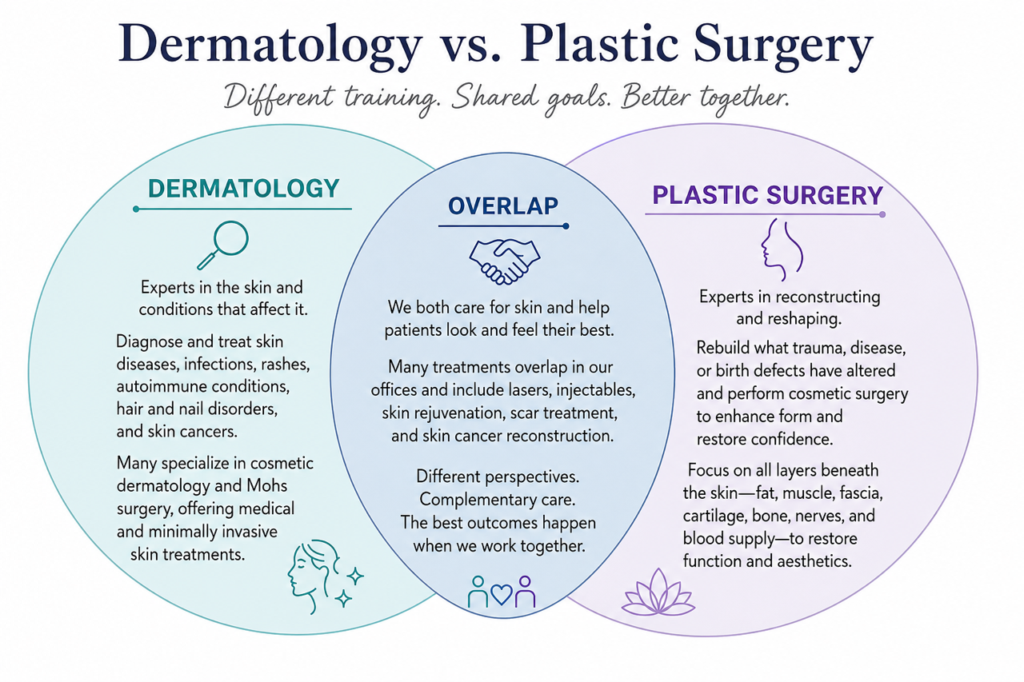
The worlds of plastic surgery and dermatology have become increasingly intertwined. We both care for skin. We both help patients look and feel their best. We both often perform procedures in offices rather than hospitals. We both offer cosmetic procedures such as lasers, fillers, and Botox, and treat skin cancer. But the overlap tells only part of the story.
I often explain it as a Venn diagram. Dermatologists are experts in diseases of the skin. Plastic surgeons usually begin with general surgery training before specializing in reconstruction and aesthetics. We rebuild what disease, trauma, or birth defects have altered. We reconstruct breasts after mastectomy, repair facial fractures, reconstruct hands after injury, close difficult wounds, and perform cosmetic surgery. Our focus isn’t simply the skin. It’s everything underneath it—skin, fat, muscle, fascia, cartilage, bone, blood supply, nerves. We often address both function and form.
Where the circles overlap is where people understandably become confused. Both specialties may offer Botox, fillers, lasers, microneedling, scar resurfacing, skin rejuvenation, chemical peels, and skin cancer treatments. From the patient’s perspective, the waiting rooms can look remarkably similar. The training behind those procedures, however, comes from entirely different perspectives. Neither perspective is better. Rather, they are complementary.
Many of my favorite patient outcomes happen because a dermatologist and plastic surgeon work together. One diagnoses the melanoma. The other reconstructs the defect. One optimizes skin health. The other restores contour. Patients benefit from both.
Ironically, some of my favorite consultations begin with a patient apologizing. “I know this isn’t really your field but…” Sometimes I happily tell them that they are correct and refer them to my trusted dermatology colleagues. Other times, the problem is reconstructive or aesthetic, and I collaborate with my dermatology colleague to treat the patient. Knowing where your expertise ends isn’t a weakness. It’s good medicine. I like to call it staying in your lane.
People are often surprised to learn that cosmetic surgery represents only one part of what plastic surgeons do. The word “plastic” comes from the Greek word “plastikos,” meaning to mold or shape. Plastic surgeons care for burn victims, children born with cleft lips, trauma patients, cancer reconstruction, hand injuries, facial paralysis, pressure sores, microsurgery, and limb salvage. Yes, we perform laser resurfacing and inject Botox and filler. But we also have the ability to surgically rejuvenate the face when filling is not enough and skin tightening and lifting are needed instead or in conjunction. We can also aesthetically surgically restore bodies after pregnancy and massive weight loss.
My kids still tease me. Every family gathering seems to produce another cousin asking me about a wart or another friend wanting me to “just freeze something off.” My kids try not to roll their eyes and do their best to stifle their giggles until the conversation ends.
I just smile. Because the truth is, the confusion reflects something wonderful about modern medicine. The lines between specialties have become collaborative rather than competitive. So, if you see me at kiddush and have a question about whether a mole looks suspicious, I’ll happily suggest an excellent dermatologist. But if you simply want it removed from a cosmetically sensitive area, you’ve found the right specialist.
If you’re newly educated from reading this article, maybe you won’t be the next person to pull me aside at camp drop-off. And, if you are, don’t worry, I will still smile and try to point you in the right direction!
My kids are probably going to get a good chuckle from this article at least….
At Preminger Plastic Surgery, we are committed to educating our patients and providing personalized care tailored to their unique needs. For those considering plastic surgery, we offer guidance every step of the way to help you achieve your aesthetic and wellness goals. Dr. Preminger is a board-certified plastic surgeon with degrees from Harvard, Cornell, and Columbia.
For more information or to schedule a consultation, please visit premingermd.com or call 212-706-1900. Follow us on Instagram @premingerplasticsurgery.