
Now You See It…
Until last Friday, I had a four-week growth of hair on my face that many people in my circles looked at quizzically and asked: “What’s up with the beard?”
The sad and unfortunate response was that it was not about a stylish new look. As I’ve chronicled in these pages, I abstained from shaving as a sign of mourning the petirah of my big brother, Binyomin Gordon, a’h.

Just typing those last few words made be stop and attempt to come to grips with the reality that my brother has moved on to the Next World and I must deal with our separation until the day comes when we are finally reunited with the coming of Moshiach and the resurrection of all those who have passed away.
I’ve thought about this during these last few weeks that Yaakov Avinu didn’t really mourn the death of his son Yosef after learning that he had been killed by a wild animal. Yaakov sensed that Yosef was alive, and although it would take 22 agonizing years, they merited to see each other once again.
While our situations are different, I have not yet fully internalized the passing of my brother. I know that one day I will see him again and I pray it is in human form down here in this world.
But this essay is about the beard I grew during the shloshim and the fact that I have now shaved it off, as I did this past Friday morning.
The day my brother was niftar was our last day in Eretz Yisrael after spending the end of Sukkos there. It was yom tov and then Shabbos and I also discovered that I did not take my shaver with me, so I just let my beard grow until we returned to New York.
It was only about twelve days, but the facial hairs were becoming significant, and even though I’m a bit past middle age, Baruch Hashem, there is still a fair amount of black hair in what is probably about 25% of my beard. On our last full day in Israel, I mentioned to Esta that I wished I could find a barber shop where I could get a shave.
Just as I said those words, she spotted a barbershop right across the Light Rail tracks on Jaffa Road. We scooted over to ask the barber if he would give me a shave and the type of shaver he used. He understood the nature of my inquiry, and assured me that all his shavers met the halachic standards of usability.
The odd thing is that he was working on another young client and asked us to sit down and wait for a few minutes. The young man in the barber chair had long payos and a full, but not long, beard. We observed as the barber moved the young man over to the sink where he shampooed and washed his payos. Then the barber trimmed his hair with scissors, at which point the young man asked the barber to shave his beard slightly.
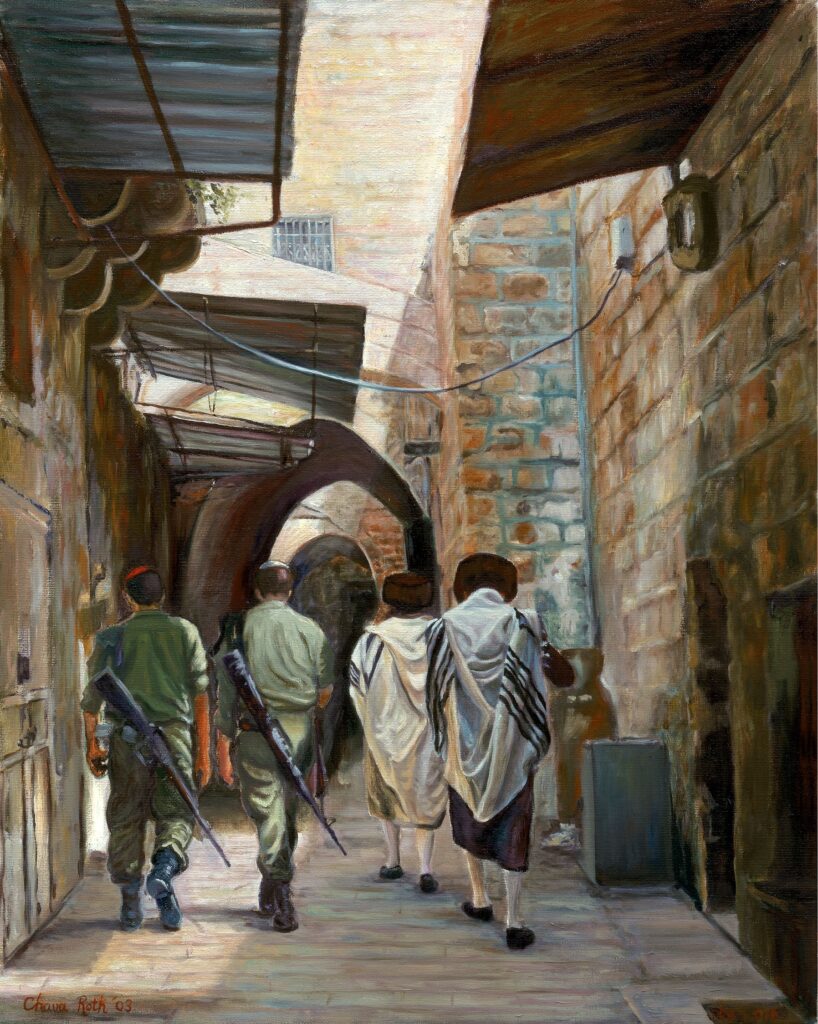
Now, it was none of my business, but this was something you don’t normally see. After the barber was finished, the young man stood up, took his long black coat or bekishe from the rack, then put on his large turned up black hat, paid, and was on his way.
About ten minutes and 40 shekels later, I was clean shaven and we were on our way also. It was later in the evening when we met Dovid Hirsch, one of my grandsons who is learning in a yeshiva outside of Jerusalem, and my phone rang with my nephew’s name flashing on the phone. I knew of course that the news was not going to be good. It was Rabbi Yossi Bennett and after I said hello, Yossi just said, “Baruch Dayan HaEmes.”
Our flight to New York was the next morning and while there was much to do and many ways to begin mourning the great loss, one trivial thought popped in my head that I would not be shaving for the next four weeks during the shloshim.
On the subject of beards, just the other day I received a note from a longtime friend, Rabbi Moshe Weiner, who for many years has served as the executive director of the Jewish Community Council of Greater Coney Island (JCCGCI). He is also the author and compiler of the 700-plus page volume Hadras Ponim Zaken, a comprehensive analysis of the cutting and growth of the beard from a halachic and Talmudic perspective, including the opinions and decisions rendered by contemporary poskim.
Reb Moshe did not call me about my shloshim beard or the lack thereof. He called about a new booklet he published called, L’Maan Yeidu, which is a compilation of responsa and clarifications on the halachic status of shaving the beard.
Among other things, Rabbi Weiner said the new booklet contains source-based refutations addressing recently published challenges and misconceptions on the halachic and spiritual foundations for maintaining a beard.
In our conversation on Sunday, I asked Reb Moshe about what he had heard regarding the spiritual aspect of having a beard and why so many especially in the Chassidic world hold that the beard contains a level of sacredness.
He explained that for a Jew, having a beard is not just a Chassidic custom, but a subject of tremendous importance going back to the days of the Chofetz Chaim and more recently, Rav Chaim Kanievsky, zt’l. In his brief explanation, he mentioned that many believe, and there are numerous sources that back this up, that a man’s beard acts as a sort of conduit for berachah and success. That’s probably why Rav Chaim was noted for always telling his visitors who were clean shaven that they should grow a beard.
Over the years, especially in my childhood in Crown Heights, I’ve seen some world-class beards, many of them in my own family. But whatever the thought process or reason, my father never grew one, and as a young child, I recall watching him shave while looking in the mirror in our bathroom.
So, I started to shave just like him when I was around 15 or 16 years old and that’s the way it has been for these many decades except for the month after my parents passed away and more recently a few weeks ago when my brother was niftar.
I’ll finish with this. For all the years we were together, my father always had a carefully groomed moustache. He always said that his mother used to say about him that, “At least he has (er hut) some hairs on his face!” n
Read more of Larry Gordon’s articles at 5TJT.com. Follow 5 Towns Jewish Times on Facebook, Instagram, and Twitter for updates and live videos. Comments, questions, and suggestions are welcome at 5TJT.com and on Facebook, Instagram, and Twitter.