One Or Two
It’s an important and serious matter. And that is the observance of the chagim while in Eretz Yisrael, as was the case this past Sukkos. The matter revolves around how many days a visitor observes as yom tov versus how many days he considers to be chol ha’moed.
Either way you look at it, this year the calendar offered us quite a chronological challenge. First of all, each of our holidays landed at midweek. But that is just one matter in terms of your usual weekly schedule. For our children and grandchildren, it’s the disappointing reality of less days of chol ha’moed, when our usual practice is to attend attractions such as ball games, theme parks, tours, etc. Occasionally, when chol ha’moed is from Monday through Thursday, you can have an entire week packed with interesting activities.
Here in Israel last week, the obvious question is whether one observes one or two days of yom tov. In the long and short of it, it’s not about shortening the chag. Yom tov is way too enjoyable on so many levels to want to make it even a day shorter.
The great debate in our community concerns our obligations while in Eretz Yisrael during a holiday. Do we observe one or two days at the start and then the last two days of Shemini Atzeres and Simchas Torah?
Here in Israel, those last two days are combined into one. Being present in Israel this year, it seems there is a greater intensity to the combination of the two days into one on some levels. In a simplistic way, there are two less extravagant yom tov meals. In another way, it feels like the davening and dancing with the sefer Torah while finishing the annual reading of the Torah and then beginning again are all there in one few-hour period.
So, the great debate with a collection of differences of opinion is whether you are a resident of the diaspora, you are halachically obligated to observe two days of yom tov or is the obligation one day at the beginning and one day at the end of the chag with a lot of chol ha’moed days in between?
Opinions vary greatly. Some of those who arrive in Israel for yom tov with the plan to observe two days on either side of the chag, the question is, what do you do Isru Chag, that is, the day after yom tov? Is it the second day of yom tov or is it the day after yom tov, when you are halachically required (if you are over bar mitzvah) to put on tefillin? And is the obligation to don tefillin something you can just deal with cavalierly, or is it something that you can pick and choose if you happen to be in Israel?
There is a custom here in Israel where travelers can pay ahead to dine in certain restaurants on what we consider the second day of yom tov, when restaurants are open for business. For Israelis, it’s chol ha’moed and businesses are open, but when it comes to dining, it creates a special and unusual circumstance.
The anomaly is that if you’re seated at one of Jerusalem’s upscale restaurants on the second night of yom tov, it’s not unusual to hear half of the customers reciting Kiddush while the other half is saying Havdalah. It’s a little odd and even a bit quirky but it’s one of the unique aspects of life in Israel.
Whether it’s the second of the first days or the second of the second days, it’s not unusual to see some people you know walking around in shorts and t-shirts, talking on their cell phone, or another person you know walking around in a suit and tie and even a stylish hat.
Just about everyone I met here made a comment along the lines of, “Oh well, you’re Chabad, so of course you only keep one day.” Others who are not Chabad can be heard explaining that they have been in Israel at least three times for the Shalosh Regalim, which means they have a chazakah of a chazakah, which means they’ve been here nine consecutive times, which means they only need to keep one day of the chag at each end with the rest of the yom tov sandwiched in between being chol ha’moed.
Of course, there are others whom we’ve encountered mumbling to themselves that for next year they will somehow try to find a heter to keep one day of yom tov. One of the cleanest and easiest ways to do that is to make aliyah and make Israel your home.
From the Chabad perspective, the idea is that when you travel to Israel with your family (that is, your wife and children), you are actually indulging in an act that acquires Eretz Yisrael, which in a way is our goal from the outset.
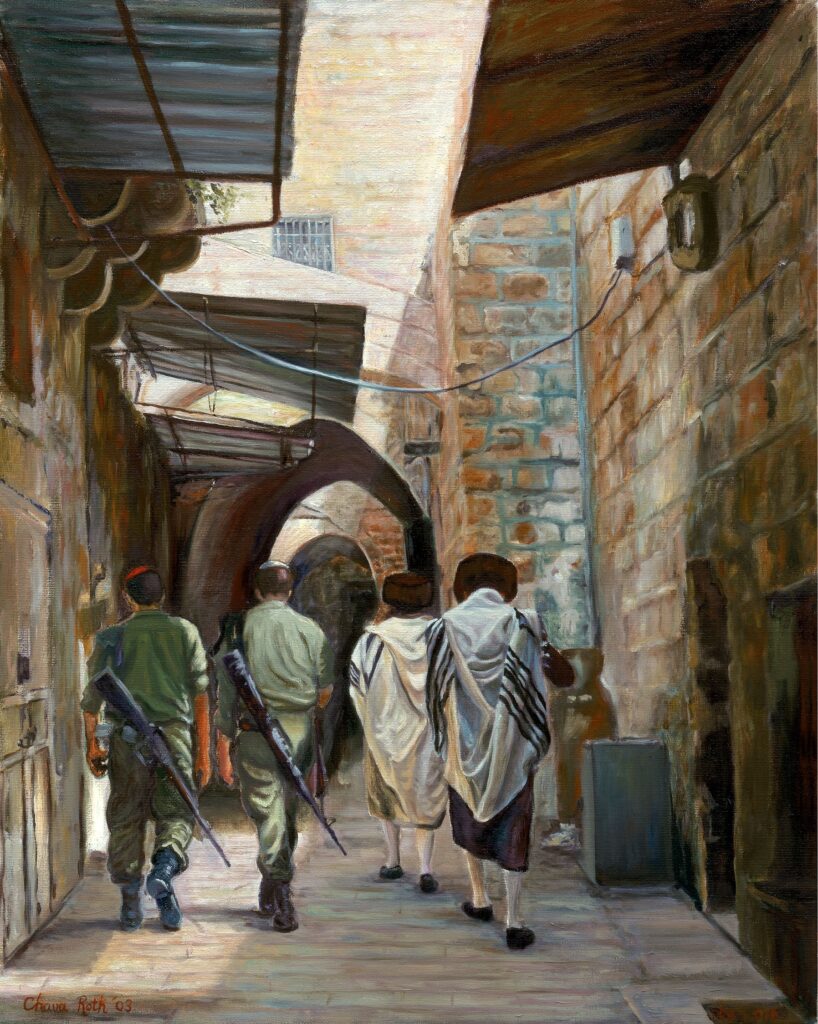
The fact of the matter is that a two-day chag in the diaspora is a beautiful thing and once you experience that in Jerusalem, walking in the Old City, davening at the Kotel, somehow it becomes more understandable how so much holiness can be packed into one full State of Israel Day.
It was a great experience to be in Israel for yom tov. Hostage Square became Freedom Square, though there are still problems with locating some of the bodies of the deceased hostages. In that case, it doesn’t matter how many days of yom tov you keep or where you reside all year long.
The long-term goal is to make this place our home. That is the true destiny of the Jewish people. The one-day, two-day business is little more than a distraction. Still, it’s something to think about and talk about, that is until erev Pesach.
Read more of Larry Gordon’s articles at 5TJT.com. Follow 5 Towns Jewish Times on Facebook, Instagram, and Twitter for updates and live videos. Comments, questions, and suggestions are welcome at 5TJT.com and on Facebook, Instagram, and Twitter.