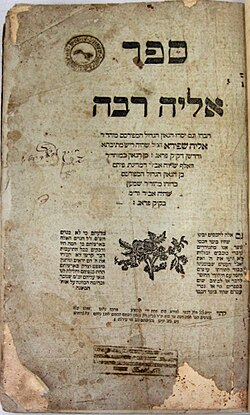

Rabbi Eliyahu Shapira: Author of Elyah Rabbah & Elyah Zuta
By: Nosson Wiggins
Rabbi Eliyahu Shapira (1660-1712) was born into an illustrious rabbinic family in Prague. His father, Rabbi Binyamin Wolff Shapira, was a prominent rabbi in the Prague Jewish Court. As a young child, Rabbi Eliyahu studied with his father, Rabbi Binyamin Wolff, and his venerated grandfather, Rabbi Ahron Yechiel Shapira. In his early teens, Rabbi Eliyahu traveled to Poland where he continued his studies under one of the foremost halachic figures of the generation, Rabbi Avraham Abli of Kalisz, author of the classic halachic work, Magen Avraham. In Rabbi Eliyahu’s writings, he refers to Rabbi Avraham of Kalisz as “the master of my youth.” Although Rabbi Eliyahu considered himself a disciple of Rabbi Avraham, he argued with him on occasion.
Upon his return from Kalisz, Rabbi Eliyahu married the daughter of Rabbi Ezriel Preimus, a wealthy and prominent member of the Prague Jewish community. After their marriage the couple settled briefly in his father-in-law’s house. Several years later, Rabbi Eliyahu was elected to the rabbinate in Tiktin, and afterwards served as rabbi in Kalin (Kalina).
By 1689, Rabbi Eliyahu had returned to Prague where he began printing his halachic writings. Despite being just 30 years old, Rabbi Eliyahu was widely respected as a great rabbi, rosh yeshiva, and posek. Under his leadership, the yeshiva in Prague flourished and students from across Europe attended his Talmudic lectures. The Chida (Devarim Achadim, sermon #32) refers to Rabbi Eliyahu Shapira as the gadol haDor haAcharon, the greatest Torah authority of the recent generation. Rabbi Eliyahu also served as the communal darshan and delivered weekly sermons each Shabbos. These sermons were transcribed but were destroyed in a fire that ravaged Prague.
Those who study halachah are certainly familiar with Rabbi Eliyahu’s two classic works on the Orach Chayim section of Shulchan Aruch: Elyah Rabbah and Elyah Zuta.
There is an interesting backstory as to how these two works evolved. In his introduction to Elyah Zuta on Orach Chayim, Rabbi Shapira writes that he initially wrote a commentary on Yoreh De’ah titled Elyah Rabbah, but as he prepared the manuscript for print, he received a heavenly message to first publish a work on Orach Chayim, the first section of Shulchan Aruch (which contains the halachic subjects pertaining to daily Jewish life).
Rabbi Shapira heeded the Divine instruction and decided to compile his halachic discussions on Orach Chayim as a commentary on the Levush (authored by Rabbi Mordechai Yaffe, 1530-1612) which in the 17th century was a widely studied text. Rabbi Shapira titled this work Elyah Zuta (the small Elyah), presumably because he considered it less intricate than his Elyah Rabbah on the complex subjects found in Yoreh De’ah. It thus emerges that the work on Yoreh De’ah, which was written as a commentary on the Shulchan Aruch itself was titled Elyah Rabbah, while the work on Orach Chayim which was written as a commentary to the Levush was titled Elyah Zuta.
Accordingly, it is perplexing how the Elyah Rabbah on Orach Chaim, a most essential and valued commentary, came to be written and published. An understanding of the publication process of Rabbi Shapira’s works both during and after his lifetime, provides us with the answer to our question.
Elyah Zuta on Orach Chaim was first printed in Prague in 1689, when Rabbi Shapira was just twenty-nine and then again in 1701. His commentary titled Elyah Rabbah on Yoreh De’ah should have been brought to the printing press shortly thereafter, but for reasons unknown it was never printed. The manuscript copy of Elyah Rabbah on Yoreh De’ah, along with many other manuscripts including sermons, responsa, and a commentary on the Tur and Tanach, were destroyed in a fire that ravaged Prague in 1754, over forty years after Rabbi Shapira’s demise. Miraculously, the first page of the manuscript survived the flames and is printed alongside the Levush on Yoreh De’ah.
Not to be confused with the above-mentioned Elyah Rabbah on Yoreh De’ah, an anonymous student of Rabbi Shapira published his master’s commentary on Orach Chayim also titled Elyah Rabbah. The student who printed this work describes its purpose based on testimony directly from Rabbi Shapira himself. Although Rabbi Shapira outlived his teacher Rabbi Avraham of Kalisz (author of Magen Avraham) whose commentary is printed alongside most editions of Shulchan Aruch Orach Chayim, nonetheless Rabbi Shapira’s writings were published before the Magen Avraham. When Rabbi Shapira later realized that much of what he wrote was in agreement with the Magen Avraham, he edited his manuscript and in brackets added the words Magen Avraham whenever they were in agreement. In addition, wherever Rabbi Shapira disagreed with the view of his master, he mentions his own position. These objectives necessitated a new commentary on the Levush Orach Chayim titled Elyah Rabbah. It remains unclear if Rabbi Shapira himself titled this second edition of his work Elyah Rabbah, or if his student chose the title. The Elyah Rabbah on Orach Chayim was first printed 45 years after the author’s death, in 1757 in Sulzbach, Germany.
Rabbi Eliyahu Shapira perished tragically in the spring of 1712 during the peak of the Great Northern War plague, a pandemic that devastated a large part of Europe. In Prague alone, 3,441 Jews died. Rabbi Shapira was just 52 years old and is buried in the Old Jewish Cemetery in Prague.
Nosson Wiggins (@jewishhistorysheimhagedolim) is the author of two books on the subject of Jewish history, “The Tannaim & Amoraim” and “The Rishonim” (Judaica Press). He researches Jewish History at the Klau Library, HUC-JIR in his hometown of Cincinnati and leads tours of Klau’s Rare Book Room. He is a passionate enthusiast of Jewish history and when he’s not in the hospital working as a nurse, he can be found researching and writing posts for his Substack, “Jewish History—Sheim Hagedolim.”