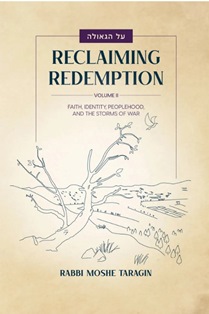

Reclaiming Redemption Vol. II: Faith, Identity, Peoplehood, and the Storms of War
Longtime 5TJT contributor Rabbi Moshe Taragin is an educator at Yeshivat Har Etzion, founded in 1968 to foster the love of G-d, of learning Torah, and of the people and the Land of Israel.
Author of To Be Holy But Human and Reclaiming Redemption, he has also written another book during these past three years of war. Through the prism of contemporary events, it reexamines questions of faith, identity, peoplehood, and redemption as the Jewish people continue their historic return to their homeland from around the world. The following excerpts from Reclaiming Redemption Vol. II: Faith, Identity, Peoplehood, and the Storms of War offer a glimpse into the book’s attempt to place today’s challenges within the broader sweep of Jewish history and Torah.
History has turned. In the leadup to the end of time, humanity has slowly recovered its divine image and is gradually readying itself to be.. [redeemed]. Over the past 500 years humanity has yanked itself out of the shadows and has launched major revolutions advancing the human condition. Science has equipped humanity with the tools to better understand and improve its world. Through its moral instinct, humanity has discovered democracy and has crafted civil societies to protect the dignity of man. In some ways the world is inching closer to a state of “readiness” to be inspired by G-d through His children.
Are we ready? Are we capable of reclaiming our universalist voice? Have we forgotten that every person possesses this divine image and divine potential, and that it is our duty to inspire them? After two thousand years of turning inward, can we now also turn outward without diluting our inner world? This shift of consciousness and of national identity may take time. However, it is a crucial shift for history to continue its moral and religious evolution.
Beyond rescuing us from suffering, redemption aims to reshape history by drawing G-d’s presence into the world.
For this reason, G-d’s redemptive hand sometimes works through politics and through human history. The miracle of Purim also reveals how Hashem operates behind the veil of history, subtly shaping the decisions of rulers and monarchs. The political promotions, demotions, selection of queens, public executions, attempted assassinations, and general palace intrigue were all part of divine redemptive design. The hearts of rulers and monarchs are in the hands of Hashem.
The [Egyptian] civil war [the night of our Exodus] sowed chaos and destruction, destabilizing Egypt from within, all as part of the divine orchestration that would ultimately lead to our liberation. Even in the decisions of ordinary people, Hashem’s hand was guiding the course of history, shaping the world toward our redemption.
Often, the redemptive force that Hashem streams through politics remains indiscernible until the morning breaks, when everything becomes clear. Don’t be fooled: headlines are also authored by Hashem; we just have to wait until the morning to fully understand them.
Faith does not mean having all the answers. The Holocaust left our people with profound, agonizing questions—questions that remain unanswered to this day. Our current trials, too, have shaken us, leaving us grappling with uncertainty.
One day, the answers will come. Until that day, we hold on to faith. We search for those who embody resilience, who illuminate the path of belief through their unwavering trust. We listen for the echoes of Jewish faith reverberating through history, drawing strength from those who came before us.
We remain loyal to them, summoning the faith that they carved out and that they expect from us. And in that strength, we find the courage to continue.
We often assume that faith is rooted in grand ideas articulated by great thinkers. We search for answers in philosophy and theology, believing that ideas alone can sustain belief. But faith, at its core, does not arise from abstract concepts but from people. It is not ideas that move us, but those who live and embody them. Ideas don’t move people; people move people. In moments of crisis, uncertainty, and perplexity, we do not cling to theories; we hold fast to those who have passed faith down to us, drawing strength from their presence and example.
Condemned to live among hostile nations determined to undermine our faith, we not only survived, but transformed the world into a vessel of monotheism, preserving the presence of Hashem on this earth.
This endurance should fill us with confidence. The mesiras nefesh (sacrifice) of Am Yisrael over the past two thousand years should infuse our tefillot with both pride and anticipation. Our prayers must weave together the raw, desperate pleas of an underserving heart with the steadfast confidence earned through millennia of mesiras nefesh.
If this is true after two thousand years of galus, it is all the more so after the past two years. Mi Ke’amacha Yisrael. We have courageously defended our land, our people, and Hashem’s prophecies at great cost.
The image of a ben sorer u’moreh (rebellious child) reminds us that even in our rebellion, we remain Hashem’s children. [The Torah] …also describes the consequences of an unfaithful wife: she is sent away from her husband…One might expect a similar fate for the wayward son: that he, too, should be sent away, cast out like an unfaithful wife. Yet this is not an option. A child is always a child. The fates of parents and children are inextricably linked.
By referring to us as a ben sorer u’moreh, Jeremiah offers a deeply compassionate perspective on Jewish failure. Though the image may sound harsh and castigating, it pulses with ahavas Yisrael: no matter how far we stray or how rebellious we behave, a child can never be severed from the parent. Even in our failings, our bond with Hashem as our Father remains unbroken.
Kalman Lipskind, a columnist for Makor Rishon, insightfully observed that [a political] press conference was little more than a theatrical sideshow distracting from the real divide tearing through Israel. The true fault line, he argued, is not between political left and right but between those who sleep soundly at night and those who cannot.
Families of hostages, bereaved families, those caring for injured soldiers, and anyone with a loved one serving on the front lines rarely find rest. In contrast, those untouched by the harsh realities of war sleep peacefully, shielded from the agony others bear.
Perhaps it’s time for ideological passion to be tempered by compassion.
How did we pull off this miracle? What tools did Hashem empower us with to outlast this historical struggle?… our nation was selected by Hashem because of two national tendencies. Firstly, we possess an uncanny ability to process supernatural information, such as Torah and prophecy. Secondly, we are a very stubborn people, unwilling to listen to others or bend in the face of adversity.
During the first 1,300 years of Jewish history our stiff-necked stubbornness repeatedly sabotaged us. However, once we entered our dark galus, everything changed. Our national shortcoming became our forte. Facing a hostile world, we refused to abandon our ancient faith and our ancient traditions. Witnessing newfangled religions distort our Torah and ascend to the forefront of the historical stage, we were not dispirited, clinging to our faith in the divine voice we alone heard at Sinai.
And our stubbornness prepared us for one final epic act of heroism. Having recovered from the Holocaust, the greatest horror to ever plague humanity, we were immediately tasked with returning to our homeland and rebuilding it in the face of unending hostility and international disapproval.
A nation of lesser valor and of lesser intransigence could not possibly have survived the darkness of the past two thousand years. Hashem was wise to select us and our stiff necks.
Reclaiming Redemption Volume II : Faith, Identity, Peoplehood, and the Storms of War is available in bookstores and at mtaraginbooks.com or https://kodeshpress.com/products/reclaiming-redemption-volume-ii