
Orthodox Union Unites Bikur Cholim Leaders at First-Ever Nationwide Conference
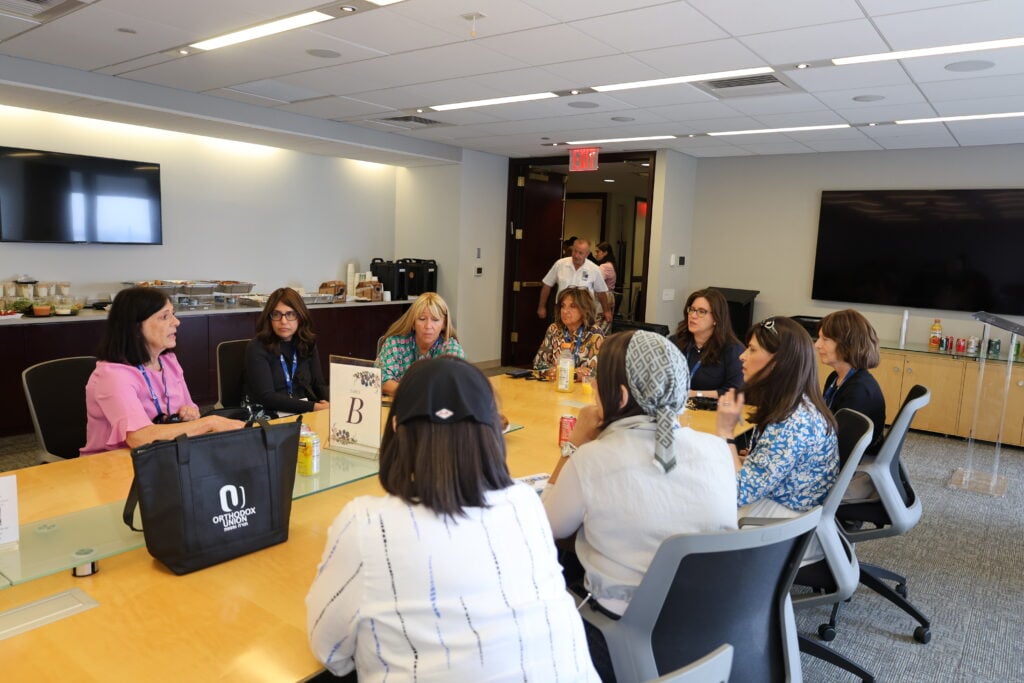
It spanned just six and a half hours, but for 70 heads of North American Bikur Cholim organizations, the Orthodox Union’s inaugural National Bikur Cholim Conference 2025 in New York’s Financial District was nothing short of transformative.
For leaders whose work is often carried out in isolation, the conference offered a rare chance to connect with peers who truly understand the weight and privilege of providing comfort, logistical help, and emotional support to patients and families at their most vulnerable.
Recognizing this shared reality, the OU’s Department of Synagogue Initiatives—part of the OU’s Department of Community Engagement—created the conference as a space for bikur cholim leaders to collaborate, exchange ideas, and build networks of mutual support. The department plays a vital role in providing vision, leadership, and programs that strengthen Orthodox communities and congregations across North America.
Participants bonded over shared experiences, challenges, strategies, and achievements, leaving with practical tools and significant chizuk to propel them through the months ahead.
“It’s hard to describe the power of what we witnessed at this gathering,” reflects OU National Director of Synagogue Initiatives Rabbi Adir Posy, who organized the event. “Dozens of women and men from across North America came together not for recognition, not for resources, but for responsibility. They are the quiet heroes who open their homes, fill hospital rooms with comfort, and ensure that no Jew ever feels alone in their time of need. To see these individuals from such diverse communities united by a shared mission of chesed was nothing short of breathtaking.”
OU Managing Director for Community Engagement Rabbi Yaakov Glasser notes the conference reflected the Orthodox Union’s broader vision, to serve as a unifying space for those supporting every dimension of communal life.
“Through connecting, sharing best practices, and confronting challenges with creativity and compassion, we can elevate the impact of all who serve and support our community,” he says. “The OU is uniquely positioned to bring together such a diverse range of geographic, demographic, and ideological segments of our community, all in the service of strengthening Klal Yisrael.”
Program sessions included “Collective Purchasing & Shared Resources,” “Strengthening Bikur Cholim Through Technology,” and “What Keeps Us Up at Night and What Gets Us Out of Bed.”
The latter was led by Audrey Siegel, executive director of Bikur Cholim of Greater Washington (BCGW), which serves 12 hospitals, operates a hospitality house, stocks seven hospital pantries, runs a kosher kitchen, and offers numerous communal programs.
“For me, as for many participants, one worry is how to keep pace financially with our community’s growing needs and the ways BCGW works to meet them,” she says. “Knowing how essential our work is, and the positive impact it has on so many individuals, gives me the energy each morning to rise, engage in our mission, and hopefully inspire others to do the same.”
The program also included two facilitated small-group sessions, “What We Do and What We Need” and “Volunteers & Sustainability,” giving leaders a chance to exchange best practices, share common hurdles, and explore long-term solutions.
“The facilitators were excellent, and we managed to share practical advice in a very short amount of time,” says Siegel. “I came away feeling less alone and more a part of a dynamic team of people throughout the world, all working toward the same goals. Our communities differ, as do the specifics of what we offer, but we are united in our mission to help Klal Yisrael when it’s needed most.”
Among the session facilitators was Dr. Nina Butler, founding director of Bikur Cholim of Pittsburgh, which supports local and out-of-town patients and their families facing medical challenges. The organization provides home hospitality, kosher meals, transportation to hospitals, airports, and appointments, and assists with a variety of personal requests.
“As the discussion leader, I invited each participant to share a bit about their city and what makes their bikur cholim unique,” says Butler. “Those simple prompts sparked genuine interest and rich, organic conversation. The amount of learning that emerged from just listening to one another was remarkable. There are so many selfless people doing chesed as a full-time profession that anyone would be inspired. Each person had a story, and a lesson to share. It was priceless.”
Bikur Cholim of Far Rockaway and the Five Towns (Bikur Cholim FR & 5T) provides comprehensive support to those facing illness and their families. From meals, visits, medical equipment loans, and transportation, to subsidizing medical costs—including often-uncovered mental health therapies—the group addresses a wide range of needs. It also offers respite care, senior programming, and educational outreach through community lectures and preventive health initiatives.
“When I saw an ad for the conference, I was very curious,” says Bikur Cholim FR & 5T’s president Leah Fink. “I had actually spoken with my organization about doing a Bikur Cholim Expo to learn from each other’s experiences. The OU National Bikur Cholim Conference accomplished a lot of what I envisioned, and I was thrilled to see it on a much larger scale than I had imagined.”
In addition to forging new connections, Fink deepened relationships with two leaders she had only previously met by phone. Since the conference, she has followed up with various bikur cholim organizations to discuss innovative ideas, seek advice on implementing certain practices, and exchange forms and protocols.
She was especially inspired by the achievements of bikur cholims in smaller communities.
“Our community is huge—we have 100 shuls here,” Fink notes. “I was moved by smaller communities, whose bikur cholims operate on a large scale. Our population is over 10 times the size of the community in Passaic-Clifton, New Jersey, for example, and they send out an astounding number of meals. After the conference, my message to our bikur cholim was, ‘We need to increase our volume and reach more people. We need to find the cholim, by ramping up our marketing efforts and community outreach.’”
In the short time since the event, Bikur Cholim FR & 5T has connected with local shul rabbis to help spread the word about their services. They also plan to advertise to all the local schools, update their website, and expand their social media presence.
Like Fink, Siegel left the conference energized and ready to expand her organization’s reach.
“At the conference, we created a WhatsApp Group and established relationships that have already been helpful,” she says. “Thanks to these new relationships, I was able to help two families requiring assistance in another city to connect with the best bikur cholim contact in that area. I am grateful to the OU for introducing me to so many other bikur cholim organizations, and facilitating such powerful collaborations.”
The conference attendees give Rabbi Posy faith in the future of Am Yisrael. “At a time when the world feels fractured, these leaders are stitching it back together with acts of incredible kindness,” he reflects. “This gathering reminded me that the Jewish people are in extraordinary hands.”
BIG HEADLINE: {IDF Reservists Embark on Healing OU Relief Mission to India
{IMG Mission participants organized engaging team building activities for the children of Mokhada Villages in Maharashtra, India
{Caption Mission participants organized engaging team building activities for the children of Mokhada Villages in Maharashtra, India.
Like many of his peers fresh out of the IDF, Gershon D. of Beersheva set off for Asia soon after completing his reserve duty in August. Since first enlisting in March 2018, he has served as a paratrooper and later as a communications officer—a role he continued while serving as a reservist with the Golani Brigade in Gaza from May to August 2025.
But instead of heading for a tropical Asian beach resort, Gershon—now a second-year Economics and Accounting student at Ben Gurion University (BGU)—embarked on a very different journey: volunteering in some of India’s poorest areas. He was one of 12 members of BGU’s JLIC—many of whom had recently served in Gaza—who took part in a weeklong relief mission to Mumbai, organized by the Fred and Rose Distenfeld Orthodox Union Relief Missions in partnership with Gabriel Project Mumbai (GPM).
Since 2005, more than 5,000 teens, college students, young professionals, adults, and retirees have participated in over 300 OU relief missions spanning more than 25 national and international locations—from Israel and India to Romania, Rwanda, Kentucky, Texas, New Orleans, and Puerto Rico.
To maximize its impact, the Fred and Rose Distenfeld OU Relief Missions works closely with local communities, schools, nonprofit, and other OU divisions, like JLIC. JLIC empowers Jewish students and young professionals through mentorship, Torah learning, leadership opportunities, and meaningful communal engagement. The program serves more than 8,000 students annually on 35 campuses across the U.S., Canada, and Israel.
This was JLIC’s third OU Relief Mission to India, and the OU’s fourth mission in partnership with GPM. Launched in 2012 by Israeli Jacob Sztokman, GPM serves Mumbai’s underserved urban neighborhoods and Maharashtra’s historically marginalized rural tribal villages, including the Mokhada Villages, home to about 150,000 people, primarily from the indigenous Adivasi tribes.
“In supporting communities around the world, the message from the Orthodox community is profound,” says Sztokman. “It is showing that it cares, that it wants to connect with others, and that it’s ready to help in any way it can. As the division of the Orthodox Union creating deep and lasting change in so many communities, the Fred and Rose Distenfeld OU Relief Missions truly embodies that message.”
Fred and Rose Distenfeld OU Relief Missions Founding Director Rabbi Ethan Katz notes that the mission was particularly therapeutic for IDF soldiers who recently served in Gaza.
“This trip highlighted the essence of the Jewish People: our concern for tikun olam and helping others,” he says. “As Jews, we plant, we grow, we contribute. We went to teach and build toward a better tomorrow.”
Rabbi Idan Rakovsky, co-director of BGU JLIC, adds, “The past two years have been extremely challenging for our chayalim. They have served in Gaza and Lebanon under complex circumstances. In India, they devoted a full week to giving, building connections with everyone they met, and demonstrating that we are all created b’tzelem Elokim, in Hashem’s image.”
The BGU JLIC team focused on projects designed to create systematic, lasting change, one of GPM’s core objectives. They worked with women’s manufacturing collectives and helped farmers develop sustainable, organic farming methods. Participants also visited GPM’s safe drinking water facility, the Mokhada Community Healthcare Center clinic, and the Mokhada Rural Hospital, where they saw an oxygen tank for babies donated by GPM, IsraAID, and other humanitarian organizations.
“For mission participants, it was eye-opening to see how a few thousand dollars can be applied to life-altering solutions,” says Rabbi Katz. “Hopefully they will be inspired to pay it forward in their own communities in small ways.”
JLIC’s Executive Director Rabbi Josh Ross underscores the broader impact of the mission: “It creates a generation of Jewish leaders who understand that our responsibilities are universal and that our capacity to make a difference extends to the furthest corners of the earth. This is Jewish education in its most profound form: learning through doing, growing through giving.”
In addition to large-scale projects, the volunteers focused on educational engagement. With guidance from local staff, they designed and led STEM and art activities for students in grades one through four at the Joshua Greenberger Learning Center, as well as at a nearby public government boarding school.
“Different mission groups volunteer every few months,” says Sztokman. “Among their contributions, they run informal educational programs that emphasize fun, creativity, and out-of-the-box thinking, introducing the children to new learning experiences and the wider world. One group from the U.S. even taught the children about air travel—many thought they had traveled by rickshaw. The kids were fascinated to learn they had flown across an ocean.”
Sztokman notes that informal education is critical, because many of the children later transfer to schools where students have been exposed to different teaching methods.
“Our primary goal is to show the children that they matter—that people have come from around the world to be with them and to teach them,” he says. “Over the years, they become confident in their learning and believe that they can succeed in life.”
Gershon reflects, “Feeling the children’s energy, finding ways to connect without relying on language, and witnessing their genuine joy in everyday experiences was incredible.”
Yet, his most profound experience came during a visit to a villager’s home.
“What touched me most was when we visited a woman and saw firsthand how she lives,” he says. “It hit me that we weren’t at a museum or a show—people truly live like this, with nothing. And yet they are happy because they choose to be. Five years from now, when I complete my degree, my wife and I will probably have children. Even if we face what we perceive as challenges, they will all be relative. That woman will still live there with her husband and two daughters, and they will still be happy. That’s the lesson I’m taking with me: to choose peace and contentment over endless pursuit.”
Beersheva young professional Kiara G. also joined the mission. A yoga instructor who works with schoolchildren and at the local Absorption Center for new immigrants, Kiara previously served as a combat fitness trainer for the Israeli Air Force’s Talpiot unit, designing and leading advanced physical training programs for both combat and non-combat soldiers from 2020 to 2022.
Among her most memorable experiences were meeting children at their schools and spending time with families in their homes.
“I realized that even though we look different on the outside, we share many similarities—like the ways parents communicate with their children and how classmates interact in school,” she says. “At the end of the day, whether Jewish or Indian, American or Israeli, we are all bound by our tzelem enosh, our humanity.”