
The Face Of Survival: Antisemitism, Identity, And The Origins Of Plastic Surgery
By B. Aviva Preminger, MD, MPH, FACS
The recent Bondi Beach menorah lighting turned into a horrific massacre. On college campuses today, many Jewish students are making calculations their great grandparents once made instinctively: Is it safe to be visibly Jewish? Is it wise to speak up? Should I wear a Magen David, a kippah, or a sweatshirt that signals that I am proud of who I am—or is it better to blend in? As antisemitism rises unbridled and in spaces that once promised tolerance, we Jews are again confronting the uneasy space between safety and identity.
This instinct to hide is not new. It is not shame. It is survival.
Modern plastic surgery, particularly aesthetic surgery, has roots intertwined with this tension. One of the founding figures of the field, Dr. Jacques Joseph—often called the father of modern rhinoplasty—was a German Jewish surgeon practicing in the late 19th and early 20th centuries. Joseph developed refined techniques to reshape the nose, not for vanity, but for social survival. At a time when Jews were caricatured, excluded, and openly discriminated against based on appearance alone (the devilish Jew with the large, hooked nose), altering a facial feature could mean access to education, employment, or safety.
Joseph famously argued that psychological suffering was a legitimate medical indication. Healing, in his view, was not limited to restoring physical function, but extended to providing psychological reassurance. That philosophy laid the groundwork for modern aesthetic surgery.
This history has always resonated personally. My grandparents were Holocaust survivors. They lived in a world where Jewish visibility was a mortal risk. Survival often depended on silence, passing, or disappearance. Growing up with her stories, I learned early that identity could be both a source of pride and a source of danger.
Years later, as an undergraduate at Harvard (when Harvard was a very different place), I studied the History of Science, including the early development of plastic surgery. Learning about Jacques Joseph through that academic lens gave language to something I had always felt intuitively: that medicine does not exist in a vacuum. It is shaped by fear, by prejudice, and by the social forces surrounding it. Plastic surgery, and rhinoplasty in particular, was not born out of frivolity—it was, in part, a response to antisemitism.
That reality matters today, especially as Jews everywhere once again find themselves weighing whether visibility is worth the cost. When a college campus becomes a place where Jews feel safer removing symbols of identity, changing names, or shrinking themselves, the problem is not Jewish insecurity—it is societal failure.
As a plastic surgeon, this history imposes responsibility. Our field was created, in part, to protect people from harm inflicted by prejudice. But it also forces us to confront a painful ethical line: when does adaptation preserve dignity, and when does it reinforce the idea that certain faces—or identities—are unacceptable?
There is a critical distinction between choice and coercion. Jacques Joseph’s patients did not seek to erase their Jewishness; they sought relief from persecution. Today, when Jews feel pressure to hide who they are—whether on campus or in public life—that pressure is not a personal failing. It is a warning sign.
The tragedy is not that Jews once altered their appearance to survive. The tragedy is that they had to. History has taught us that trying to “pass” will not save us from those who seek to persecute us.
The lesson is that no student, no professional, no Jew anywhere should feel compelled to hide his or her identity to earn safety and that hiding our identities will not save us. We are far better off standing proud and fighting for our survival. The history of plastic surgery reminds us of the great impact of antisemitism—and how we must ensure that our survival no longer requires disguise.
Rhinoplasty is a powerful tool in the plastic surgeon’s armamentarium and can significantly alter one’s appearance and confidence for the better. However, it should never have to be performed, as it originally was, to hide who we are. I will leave the question of whether the “Jewish nose” actually even exists for another time. [For further discussion and sample offensive pictures, visit Aish.com/bradley-coopers-fake-jewish-nose]
At Preminger Plastic Surgery, we are committed to educating our patients and providing personalized care tailored to their unique needs. For those considering plastic surgery, we offer guidance every step of the way to help you achieve your aesthetic and wellness goals. n
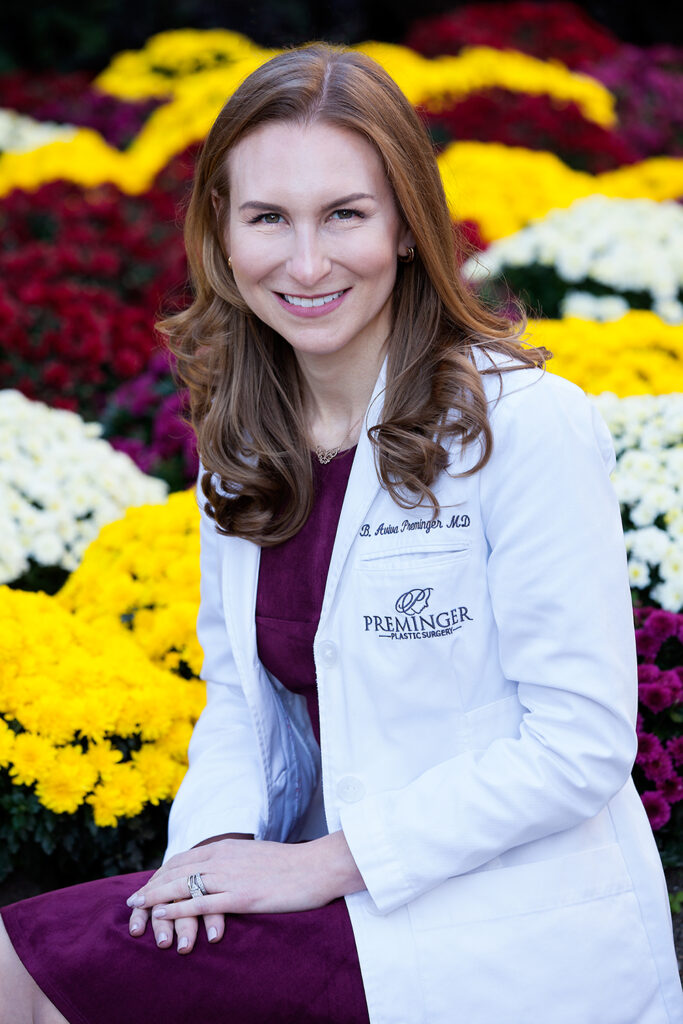
Dr. Aviva Preminger is a board-certified plastic surgeon with degrees from Harvard, Cornell, and Columbia. For more information or to schedule a consultation, please visit PremingerMD.com or call 212-706-1900.