



Where Are You?
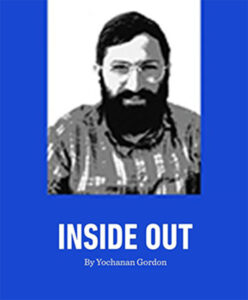
By Yochanan Gordon
With Chanukah now in the rearview mirror, we are drawing close to the conclusion of Sefer Bereishis. This week we read Parashas Vayigash, and next week we complete the sefer. There is a Kabbalistic idea that beginnings and endings are bound together. As such, even as the end of Bereishis comes into view, a question asked at its very beginning begins to resurface.
In Parashas Bereishis, after Adam eats from the fruit of the Tree of Knowledge of Good and Evil, G-d asks him a single word: “Ayekah?” “Where are you?”
I saw in a sefer this past week that the word “ayekah,” whose simple meaning is “Where are you?” has a numerical value of thirty-six, corresponding to the thirty-six candles kindled over the eight days of Chanukah, excluding the shamashim. Whether or not one leans heavily into gematria, the thematic connection is striking.
This Chanukah, somewhat spontaneously, I decided to post original ideas on my WhatsApp status throughout the day. What began as a one-off thought evolved into a deeper reflection on the very concept of a “status.”
What is a status? At its most basic level, it indicates where a person is. It is a marker of location—spatial, experiential, emotional, or otherwise. Today, people use statuses to share inspirational content, relay information, promote businesses, or simply broadcast moments of life. But I began to wonder about the spiritual origin of the idea itself.
The sefarim teach that if one wants to understand the universal essence of a concept, one must examine the first time it appears in the Torah. And it occurred to me that the first time the Torah addresses a person’s “status”—where they are—is precisely when G-d asks Adam: “Ayekah?”
Rashi explains that G-d was not seeking information. As an omniscient Being, G-d did not need Adam to disclose his location. Rather, the question was meant to open a dialogue, to gently invite Adam to confront what he had done and where he now stood.
Chassidus takes this even further. To understand that perspective, one must recall the story of the Alter Rebbe’s imprisonment, from which he was liberated on the 19th of Kislev, just a week before Chanukah. While incarcerated, a prison official asked the Alter Rebbe why G-d needed to ask Adam “ayekah” if He knows everything. The Alter Rebbe replied that this question is not historical; it is eternal. G-d asks every person, in every generation: Where are you?
Then, astonishingly, the Alter Rebbe turned to the official and said, “You are fifty-six years old. What have you done with the years you were given?”
That exchange reframes ayekah not as a question of geography, but of purpose.
The second time we encounter a similar question in the Torah is later in the same parashah, after Kayin kills Hevel. G-d asks Kayin: “Where is Hevel, your brother?” Kayin deflects with his infamous response, “Am I my brother’s keeper?” Once again, G-d is not seeking information. He is confronting a human being who has lost sight of his role and responsibility.
From this perspective, a “status” emerges as a tool used precisely when someone has gone off course. It is a call to reorient, to remember that we are not autonomous beings drifting through opportunity, but agents and ambassadors placed here to fulfill a specific mission that no one else can accomplish.
At its core, the sin of eating from the Tree of Knowledge was the birth of self-consciousness detached from Divine purpose. The Torah immediately tells us that Adam and Chava realized they were naked. G-d responds, “Who told you that you were naked?” This was the first time humanity truly “looked in the mirror,” seeing the self as an independent entity rather than as a conduit for G-d’s will.
Perhaps this is also why the mitzvah of Chanukah is defined as hanacha oseh mitzvah, the placement itself constitutes the mitzvah. The menorah is placed at the threshold between the private home and the public domain. Hanacha is a form of spatial identification, declaring where the light belongs. And that light has the power to reveal that no Jew, at any point in history, has ever truly deviated from the will of G-d.
The Baal Shem Tov teaches that a person is always situated where his or her thoughts are. Not metaphorically, but existentially. One’s true location is not defined by geography, but by consciousness.
Seen through that lens, a status cannot simply be a space to share material, even material that speaks deeply to me. If ayekah is the Torah’s original status update, then a status is meant to reveal where my thoughts are dwelling, where my inner world is presently standing in relation to G-d, meaning, and purpose.
A status, then, is not content.
It is coordinates.
It is presence.
And so, if this Chanukah marked the beginning of a more intentional use of that space—less reposting and more locating—then it is an attempt to answer G-d’s eternal question in real time.
Ayekah is not an accusation.
It is an invitation to remember where we stand, and why we are here.
For anyone interested in following this existential road trip as it unfolds, you’re welcome to follow along via WhatsApp status. You can reach me at 516-902-3373.
Yochanan Gordon can be reached at [email protected]. Read more of Yochanan’s articles at 5TJT.com.